SageMaker Serverless Tool Calling Fine-Tuning
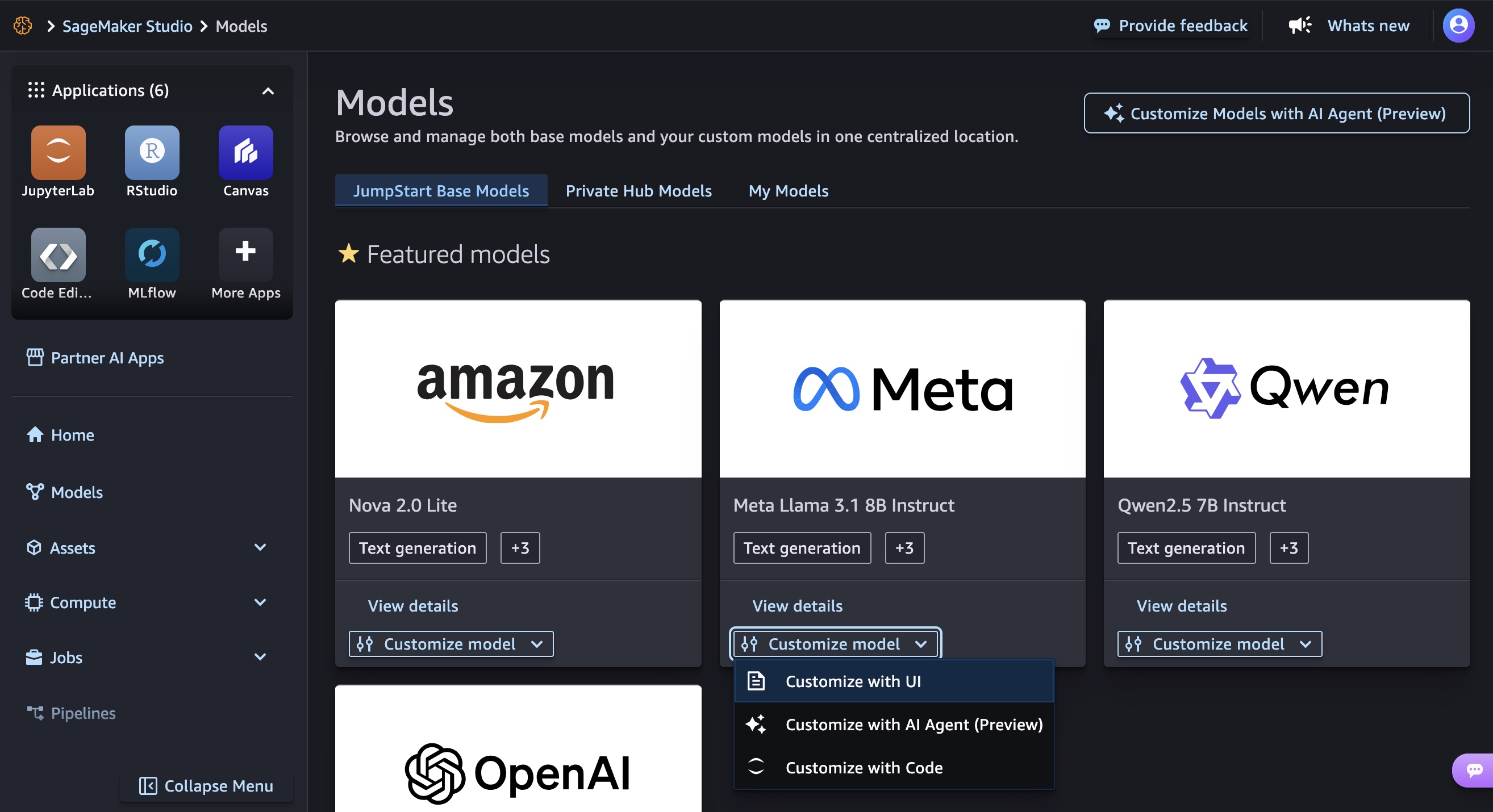
💡Serverless fine-tuning boosts agentic tool calling—deploy faster without infra hassle.
⚡ 30-Second TL;DR
What Changed
Fine-tuned Qwen 2.5 7B Instruct using RLVR for tool calling
Why It Matters
Accelerates development of agentic AI agents by enabling serverless customization, reducing infrastructure overhead for practitioners building tool-using LLMs.
What To Do Next
Fine-tune Qwen models in SageMaker JumpStart using RLVR for agent tool calling.
Key Points
- •Fine-tuned Qwen 2.5 7B Instruct using RLVR for tool calling
- •Dataset prep for three distinct agent behaviors
- •Tiered reward scoring in reward function design
- •Evaluation on held-out data with unseen tools
- •Serverless deployment in SageMaker
🧠 Deep Insight
AI-generated analysis for this event — not the original article.
🔑 Enhanced Key Takeaways
- •The RLVR (Reinforcement Learning from Verifiable Rewards) approach specifically addresses the 'hallucination of tool arguments' by penalizing models that generate syntactically correct but semantically invalid function calls.
- •The implementation leverages SageMaker's serverless inference endpoints to optimize cost-efficiency for agentic workloads that exhibit bursty, non-continuous traffic patterns.
- •The training pipeline utilizes Qwen 2.5 7B's native support for structured output, which significantly reduces the overhead of post-processing and parsing during the reward calculation phase.
📊 Competitor Analysis▸ Show
| Feature | AWS SageMaker RLVR (Qwen 2.5) | Google Vertex AI Agent Builder | Azure AI Foundry (Model Catalog) |
|---|---|---|---|
| Tool Calling Fine-Tuning | Native RLVR support | Managed RLHF/SFT | Managed SFT |
| Deployment | Serverless/Real-time | Serverless | Serverless/Managed |
| Primary Model Focus | Open Weights (Qwen/Llama) | Gemini Pro/Flash | GPT-4o/Phi-3 |
| Pricing Model | Per-second compute/inference | Per-request/token | Per-token/instance |
🛠️ Technical Deep Dive
- Reward Function Architecture: Employs a multi-stage reward model where Stage 1 validates JSON schema compliance, Stage 2 verifies argument existence against the tool definition, and Stage 3 executes the tool in a sandboxed environment to validate output correctness.
- Training Infrastructure: Utilizes SageMaker Training Jobs with distributed data parallelism, specifically configured for low-latency reward feedback loops during the RLVR process.
- Inference Optimization: The serverless deployment utilizes AWS Lambda-backed inference containers with pre-warmed cold-start mitigation for the Qwen 2.5 7B model weights.
- Dataset Structure: Uses a triplet format (System Prompt, Tool Definitions, User Query) mapped to a Chain-of-Thought (CoT) reasoning path to improve tool selection accuracy.
🔮 Future ImplicationsAI analysis grounded in cited sources
⏳ Timeline
Weekly AI Recap
Read this week's curated digest of top AI events →
👉Related Updates
AI-curated news aggregator. All content rights belong to original publishers.
Original source: AWS Machine Learning Blog ↗
This is a summary, not the original. Read the source, or get the weekly briefing.
Weekly AI briefing
One email a week. Unsubscribe anytime.