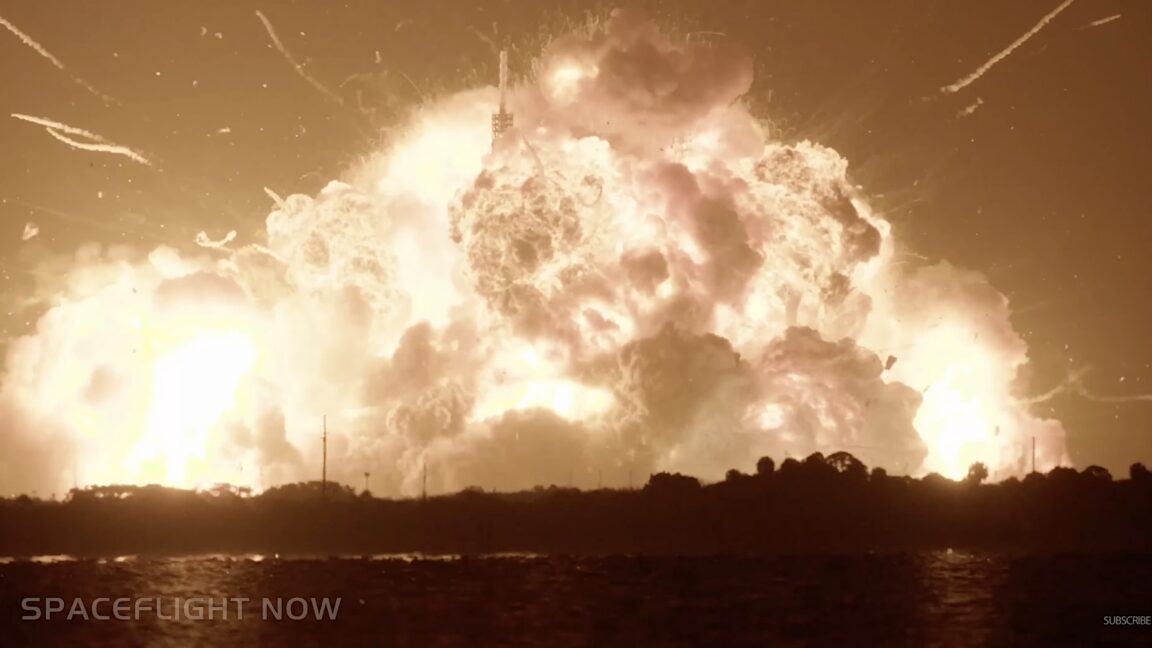
Safety analysis of Blue Origin rocket explosion blast
💡Learn how blast wave data informs safety modeling for large-scale aerospace infrastructure.
⚡ 30-Second TL;DR
What Changed
Blast overpressure caused window shattering a mile away
Why It Matters
This data provides critical insights for safety protocols in aerospace testing. It emphasizes the need for advanced simulation models to predict blast wave propagation.
What To Do Next
Use the blast data to refine physics-informed neural networks (PINNs) for modeling fluid dynamics and pressure wave propagation.
Key Points
- •Blast overpressure caused window shattering a mile away
- •Safety officials are refining blast radius models
- •Highlights risks in large-scale rocket testing
🧠 Deep Insight
Background and context from public sources — not the original article. 17 sources cited.
🔑 Enhanced Key Takeaways
- •The explosion involved Blue Origin's New Glenn rocket during a static fire test at Space Launch Complex 36A at Cape Canaveral Space Force Station on May 28, 2026.
- •This incident was described as the largest explosion in the history of Cape Canaveral.
- •The blast destroyed the New Glenn rocket and severely damaged its sole launch pad, Space Launch Complex 36A.
- •The explosion could significantly impact the timeline for NASA's Artemis program, as Blue Origin is a primary contractor for lunar landing services.
- •Despite the extensive damage to the launch pad, Blue Origin's CEO Dave Limp reported that critical long-lead items such as the water tower, propellant farm, oxygen, and liquid hydrogen tanks remained intact, with the company aiming for New Glenn to fly again before the end of 2026.
🛠️ Technical Deep Dive
- The New Glenn rocket is powered by BE-4 engines.
- The explosion occurred during a static hotfire test, where the seven BE-4 engines in the booster stage were ignited while the vehicle was secured to the launch pad.
- The blast overpressure from the New Glenn explosion was sufficient to shatter windows at a Space Force hangar located approximately one mile from the launch pad.
- For context, an overpressure level of 1 psi can shatter glass, while 8 psi is typically sufficient to destroy buildings.
- Safety officials are actively refining blast radius models based on data from this and similar incidents to enhance future safety protocols.
🔮 Future ImplicationsAI analysis grounded in cited sources
⏳ Timeline
📎 Sources (17)
Factual claims are grounded in the sources below. Forward-looking analysis is AI-generated interpretation.
Weekly AI Recap
Read this week's curated digest of top AI events →
👉Related Updates
AI-curated news aggregator. All content rights belong to original publishers.
Original source: Ars Technica ↗
This is a summary, not the original. Read the source, or get the weekly briefing.
The weekly digest
One email a week. Unsubscribe anytime.