Run AI Agents Safely in GitHub Actions
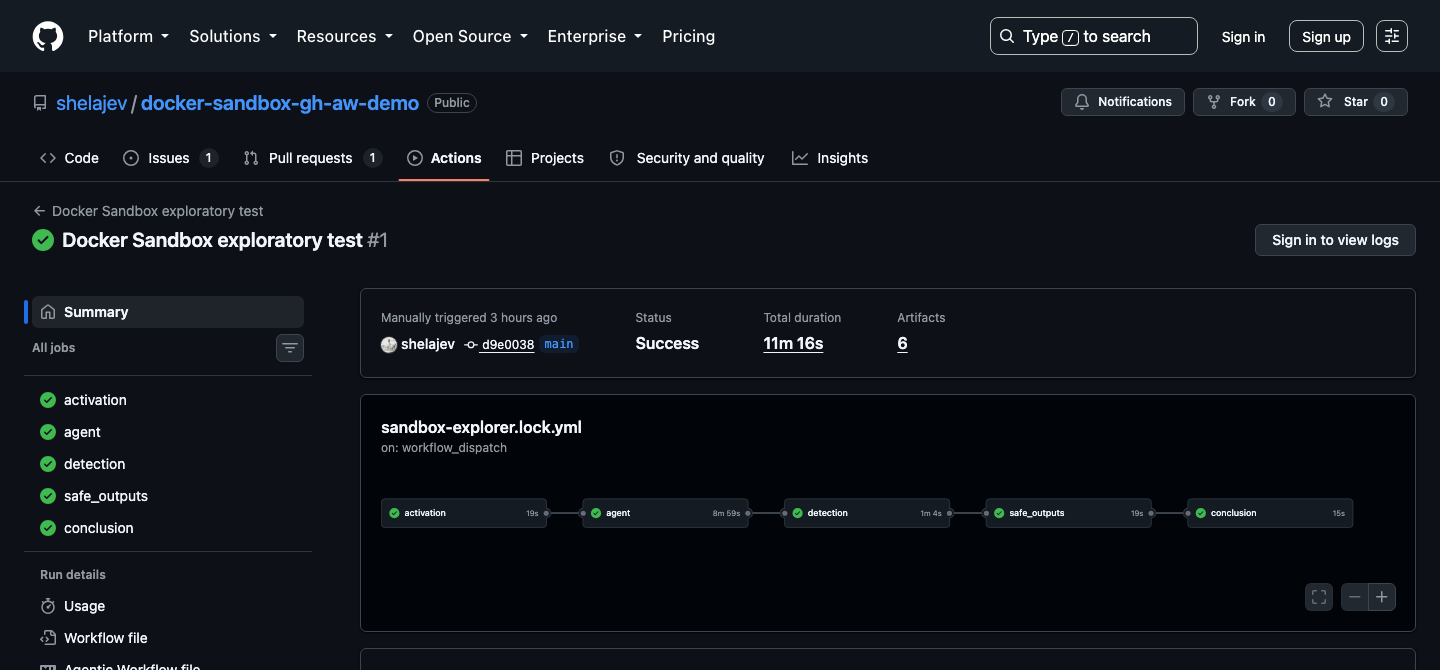
💡See how to let coding agents test, fix, and propose changes without unrestricted CI access.
⚡ 30-Second TL;DR
What Changed
AI agents run in isolated Docker Sandboxes within GitHub Actions
Why It Matters
This workflow could make autonomous code maintenance more practical by combining CI automation with execution isolation. Teams can allow agents to work on repositories while reducing the risk of unrestricted access to the broader build environment.
What To Do Next
Prototype a GitHub Actions workflow that runs your coding agent in Docker Sandboxes and limits its task to a test repository.
Key Points
- •AI agents run in isolated Docker Sandboxes within GitHub Actions
- •Agents can execute Testcontainers-based tests during workflows
- •Successful agents can fix code and open draft pull requests
🧠 Deep Insight
Background and context from public sources — not the original article. 10 sources cited.
🔑 Enhanced Key Takeaways
- •GitHub introduced 'Agentic Workflows' in February 2026, allowing developers to define autonomous tasks in Markdown that compile into security-hardened YAML.
- •Industry standards have shifted from standard containers to hardware-isolated microVMs, such as Docker's 'spx' runtime, to prevent agents from escaping their execution scope.
- •The Model Context Protocol (MCP) is now the industry-standard interface for connecting AI agents to external tools, ensuring secure and standardized service access.
- •Organizations are implementing 'spend drift' governance using OpenTelemetry and credit-capping tools to monitor and limit token usage in CI/CD pipelines.
- •Security best practices now mandate that agents operate with read-only access by default, requiring explicit human-approved stages for write permissions or secret access.
📊 Competitor Analysis▸ Show
| Feature | Docker Sandboxes | GitHub Agentic Workflows | Cloud-Native Agent Platforms (e.g., Flux) |
|---|---|---|---|
| Isolation | Hardware-isolated microVMs | Standardized YAML hardening | Cloud-native micro-segmentation |
| Pricing | Per-sandbox execution time | Integrated into GitHub Actions billing | Enterprise-tier subscription |
| Benchmarks | High security/Low latency | High integration/Native CI/CD | High scalability/Enterprise governance |
🛠️ Technical Deep Dive
- Utilization of hardware-isolated microVMs (spx runtime) to provide kernel-level isolation between the agent and the host environment.
- Integration of Model Context Protocol (MCP) to provide a standardized, secure bridge between the agent and external development tools.
- Implementation of integrity filtering layers to sanitize inputs from issues and PRs, preventing prompt injection attacks.
- OpenTelemetry-based observability hooks to track agent token consumption and prevent runaway compute costs.
- Enforcement of least-privilege access control lists (ACLs) that dynamically scope secret access based on the specific workflow stage.
🔮 Future ImplicationsAI analysis grounded in cited sources
⏳ Timeline
📎 Sources (10)
Factual claims are grounded in the sources below. Forward-looking analysis is AI-generated interpretation.
Weekly AI Recap
Read this week's curated digest of top AI events →
👉Related Updates
AI-curated news aggregator. All content rights belong to original publishers.
Original source: Docker Blog ↗
This is a summary, not the original. Read the source, or get the weekly briefing.
Weekly AI briefing
One email a week. Unsubscribe anytime.