Romania Leads First Private ESA CyberCUBE Mission
💡Learn how space-based cybersecurity is becoming a critical frontier for satellite infrastructure.
⚡ 30-Second TL;DR
What Changed
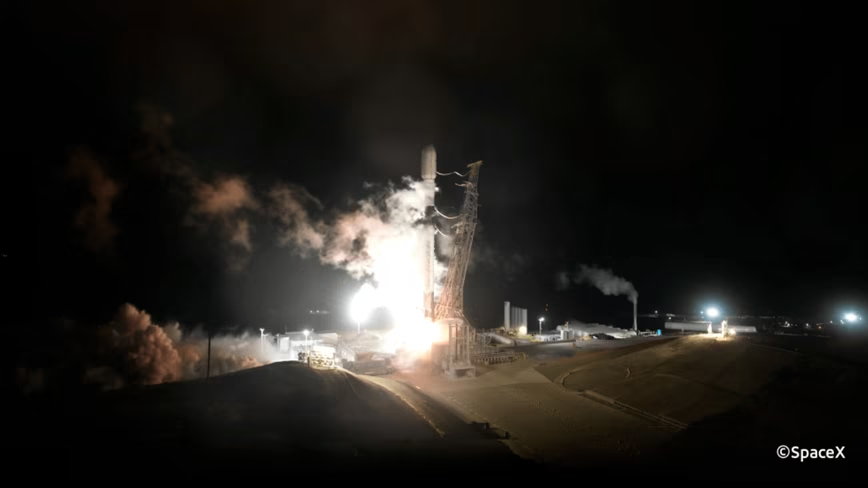
CyberCUBE launched via SpaceX Falcon 9 from Vandenberg
Why It Matters
This mission highlights the growing importance of cybersecurity in space infrastructure. It sets a precedent for private-public partnerships in securing satellite operations.
What To Do Next
Research the security protocols used in small-sat constellations to understand emerging vulnerabilities in orbital infrastructure.
Key Points
- •CyberCUBE launched via SpaceX Falcon 9 from Vandenberg
- •First ESA mission led by Romania focusing on cybersecurity
- •Mission objective is to probe European spacecraft attack vectors
🧠 Deep Insight
AI-generated analysis for this event — not the original article.
🔑 Enhanced Key Takeaways
- •The CyberCUBE mission is developed by a consortium led by the Romanian Space Agency (ROSA) in collaboration with private cybersecurity firm CyberSpaceSec SRL.
- •The satellite utilizes a proprietary 'Cyber-Shield' AI-driven intrusion detection system designed to operate in high-radiation LEO environments.
- •This mission is part of the ESA's 'Secure Space Initiative,' which aims to standardize cybersecurity protocols for all future European satellite constellations.
- •CyberCUBE features a dual-processor architecture that isolates mission-critical flight controls from the experimental cybersecurity testing payload.
- •The project received significant funding from the European Union's Horizon Europe program, marking a shift toward integrating Eastern European tech hubs into core ESA infrastructure.
📊 Competitor Analysis▸ Show
| Feature | CyberCUBE (ESA/Romania) | Starlink Security Layer | Northrop Grumman Cyber-Sat |
|---|---|---|---|
| Primary Focus | Vulnerability Research | Operational Security | Defense/Military Hardening |
| Architecture | Dual-Processor Isolation | Software-Defined | Hardware-Encrypted |
| Open Source | Partial (ESA Standards) | Proprietary | Classified |
🛠️ Technical Deep Dive
- Satellite Bus: 6U CubeSat form factor with deployable solar arrays.
- Payload: Cyber-Shield AI module utilizing a neuromorphic processor for real-time threat detection.
- Communication: S-band for telemetry and X-band for high-speed data downlink of security logs.
- Radiation Hardening: Triple-modular redundancy (TMR) on critical logic gates to prevent bit-flips during vulnerability testing.
- Power System: High-density lithium-ion battery array with autonomous power management to support intensive computational cycles.
🔮 Future ImplicationsAI analysis grounded in cited sources
⏳ Timeline
Weekly AI Recap
Read this week's curated digest of top AI events →
👉Related Updates




AI-curated news aggregator. All content rights belong to original publishers.
Original source: The Next Web (TNW) ↗
This is a summary, not the original. Read the source, or get the weekly briefing.
Weekly AI briefing
One email a week. Unsubscribe anytime.