Robots Become an Architecture, Not a Body
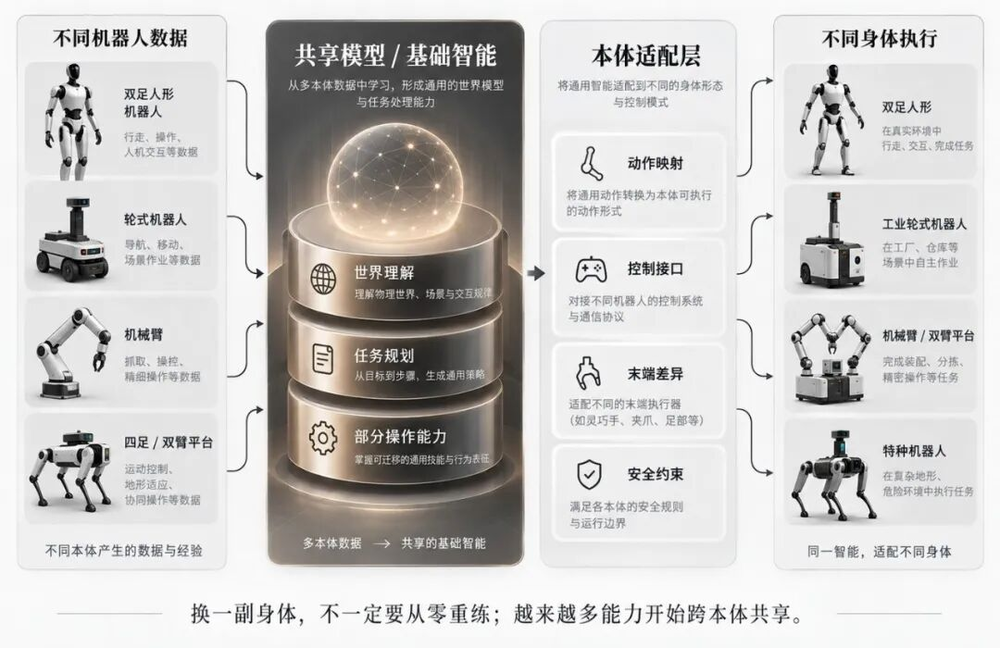
💡See how LingBot, Gemini Robotics, and GR00T are turning robot intelligence into portable infrastructure.
⚡ 30-Second TL;DR
What Changed
LingBot-VLA 2.0 was pretrained on about 60,000 hours of data, including roughly 50,000 hours across 20 robot configurations.
Why It Matters
The article suggests that general-purpose robotics will be defined less by humanoid hardware and more by reusable model and data infrastructure. This could lower the cost of deploying different robot bodies, while keeping embodiment-specific calibration and safety as major engineering challenges.
What To Do Next
Prototype a robot-adaptation pipeline with a normalized end-effector action space, then measure few-shot transfer performance across two different robot platforms.
Key Points
- •LingBot-VLA 2.0 was pretrained on about 60,000 hours of data, including roughly 50,000 hours across 20 robot configurations.
- •LingBot-VLA 2.0 maps different joints, grippers, hands, and mobile bases into a shared 55-dimensional state and action representation.
- •Gemini Robotics 2 uses one checkpoint across Apollo 2 and Franka Duo configurations, while new robots can reportedly adapt with fewer than 200 samples.
- •NVIDIA GR00T N1.7 supports post-training adaptation to new robots, tasks, and environments using relative end-effector action spaces.
Weekly AI Recap
Read this week's curated digest of top AI events →
👉Related Updates



AI-curated news aggregator. All content rights belong to original publishers.
Original source: 虎嗅 ↗
This is a summary, not the original. Read the source, or get the weekly briefing.
Weekly AI briefing
One email a week. Unsubscribe anytime.