Robot Vaccinates Pigs While They Eat
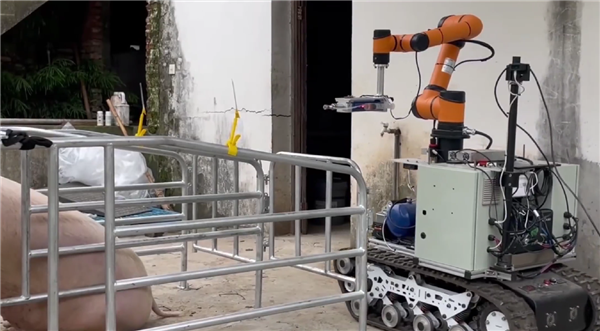
💡A practical embodied-AI case shows how robots can automate high-volume livestock care.
⚡ 30-Second TL;DR
What Changed
The system targets pigs during feeding, when they are less likely to resist injection.
Why It Matters
The robot represents an embodied-automation use case in agriculture, where perception, timing, and precise actuation must operate in a constrained environment. For AI practitioners, it highlights how robotics can address repetitive labor and animal-handling safety beyond conventional factory settings.
What To Do Next
Assess the robot's animal-detection, targeting-accuracy, missed-dose, and needle-breakage metrics before considering a controlled farm pilot.
Key Points
- •The system targets pigs during feeding, when they are less likely to resist injection.
- •It is designed for large-scale farms where pigs may receive more than ten vaccinations before slaughter.
- •Automation could reduce manual restraint, missed doses, needle breakage, and injection-position errors.
- •The approach may also reduce direct contact between farm workers and livestock.
🧠 Deep Insight
AI-generated analysis for this event.
🔑 Enhanced Key Takeaways
- •The system utilizes a deep learning-based visual recognition algorithm to identify the pig's injection site in real-time, even while the animal is moving during feeding.
- •Researchers integrated a multi-degree-of-freedom robotic arm capable of adjusting its position dynamically to compensate for the pig's head and body movements.
- •The technology was specifically tested to address the high prevalence of porcine reproductive and respiratory syndrome (PRRS) and other endemic diseases in intensive farming environments.
- •The robotic platform incorporates a force-feedback mechanism to ensure the needle penetrates to the correct depth, minimizing tissue damage and pain for the animal.
- •Data logging capabilities allow the system to automatically record vaccination timestamps and individual animal IDs, facilitating digital health tracking and compliance with food safety regulations.
📊 Competitor Analysis▸ Show
| Feature | Robot Vaccinates Pigs | Manual Vaccination | Traditional Chute Systems |
|---|---|---|---|
| Throughput | High (Automated) | Low (Labor-intensive) | Medium |
| Stress Levels | Minimal | High | Moderate |
| Error Rate | Low (Precision-guided) | High (Human error) | Moderate |
| Cost | High Initial Investment | Low Initial / High Labor | Moderate |
🛠️ Technical Deep Dive
- Vision System: Employs a high-speed camera coupled with a Convolutional Neural Network (CNN) for real-time localization of the neck region.
- Actuation: Uses a pneumatic or electric servo-driven robotic arm with a range of motion designed to track feeding pigs.
- Safety Protocols: Includes an emergency stop mechanism that triggers if the pig moves outside a predefined safety zone or if the force sensor detects abnormal resistance.
- Injection Mechanism: Features a sterile, automated needle-change system to prevent cross-contamination between individual animals.
🔮 Future ImplicationsAI analysis grounded in cited sources
⏳ Timeline
Weekly AI Recap
Read this week's curated digest of top AI events →
👉Related Updates

AI-curated news aggregator. All content rights belong to original publishers.
Original source: cnBeta (Full RSS) ↗