Robot Tennis Reveals Physical AI’s Real Divide
💡A live tennis demo shows why Physical AI still needs physics—even when control is learned end to end.
⚡ 30-Second TL;DR
What Changed
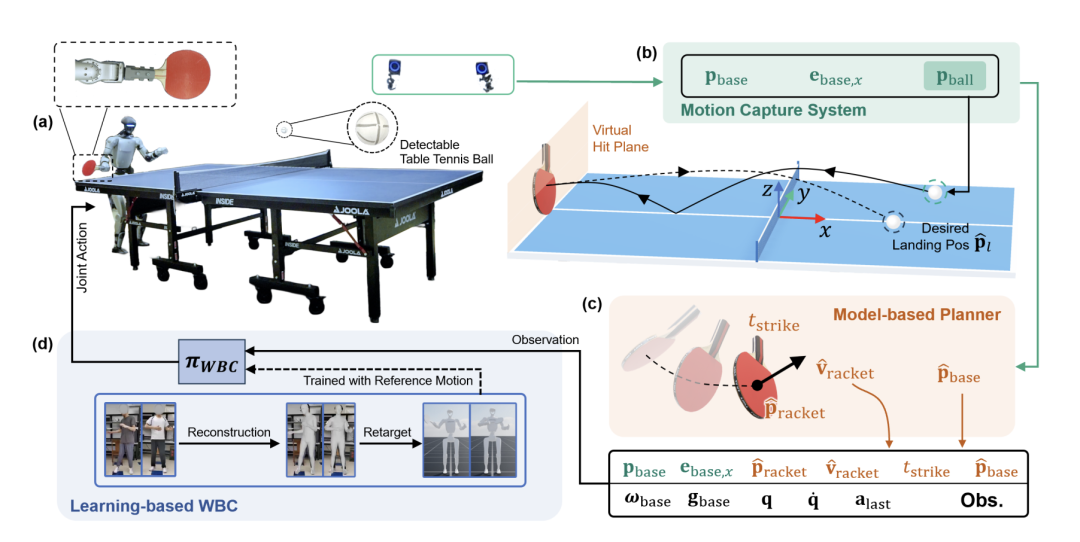
The robot tracked fast incoming balls, predicted landing points, repositioned its body, and coordinated legs, torso, shoulders, and arms during live rallies.
Why It Matters
Physical AI systems may advance fastest through hybrid designs rather than a simple contest between neural networks and classical robotics. Better uncertainty modeling and sim-to-real methods could reduce the data and hardware costs of training capable humanoid systems.
What To Do Next
Prototype a sim-to-real benchmark in MuJoCo with randomized friction, mass, restitution, and drag before collecting more physical robot data.
Key Points
- •The robot tracked fast incoming balls, predicted landing points, repositioned its body, and coordinated legs, torso, shoulders, and arms during live rallies.
- •LATENT extracts motion priors from incomplete human tennis clips and lets reinforcement learning refine and combine primitive skills in simulation.
- •Training randomizes parameters including friction, robot mass, racket mass, ball mass, restitution, and air drag instead of assuming one perfectly identified physical world.
- •The article compares model-based and learned approaches from MIT, Google DeepMind, Berkeley’s HITTER, LATENT, and Sony AI Ace.
- •The central research question is which physical laws should be explicitly modeled, learned by the policy, embedded in simulation, or used only to define plausible parameter ranges.
🧠 Deep Insight
Background and context from public sources — not the original article. 13 sources cited.
🔑 Enhanced Key Takeaways
- •The LATENT system achieves a 96.5% rally success rate by specifically training on noisy, incomplete human sports data rather than requiring high-fidelity motion capture.
- •Tennis is being utilized as a standardized 'proving ground' for embodied AI, specifically to test high-speed projectile tracking and dynamic balance in unpredictable environments.
- •The 2026 World Humanoid Robot Games in Beijing have shifted the industry focus from athletic performance to job-specific benchmarks like power tool assembly and cable connection.
- •The market is bifurcating between high-end research platforms like the Unitree G1 and low-cost consumer humanoids such as the Nori A3, which is priced under $2,000.
- •Sony AI's Ace robot utilizes a 9-camera array to achieve a 20-millisecond reaction time, which is approximately 10 times faster than the average human response.
📊 Competitor Analysis▸ Show
| Competitor | System/Robot | Key Differentiator | Benchmark/Performance |
|---|---|---|---|
| Sony AI | Ace | 9-camera 3D tracking | 20ms reaction time |
| Noitom Robotics | AdaPT | Style replication (Nadal/Federer) | No motion capture required |
| Galaxy General | LATENT | Noisy data learning | 96.5% rally success rate |
| Acemate | S10 | Commercial training | Responsive drill logic |
🛠️ Technical Deep Dive
- LATENT architecture: Employs reinforcement learning to refine primitive skills extracted from imperfect human video clips.
- Sim-to-Real methodology: Utilizes domain randomization across physical parameters including friction, robot/racket/ball mass, restitution, and air drag.
- Perception latency: Sony AI Ace achieves 20ms reaction times via multi-camera 3D vision processing.
- Control loop: Integrates whole-body control (WBC) to coordinate legs, torso, and arms for dynamic balance during high-speed movement.
🔮 Future ImplicationsAI analysis grounded in cited sources
⏳ Timeline
📎 Sources (13)
Factual claims are grounded in the sources below. Forward-looking analysis is AI-generated interpretation.
Weekly AI Recap
Read this week's curated digest of top AI events →
👉Related Updates



AI-curated news aggregator. All content rights belong to original publishers.
Original source: 虎嗅 ↗
This is a summary, not the original. Read the source, or get the weekly briefing.
Weekly AI briefing
One email a week. Unsubscribe anytime.