RoboScience Unveils Visics General-Purpose Embodied AI Model
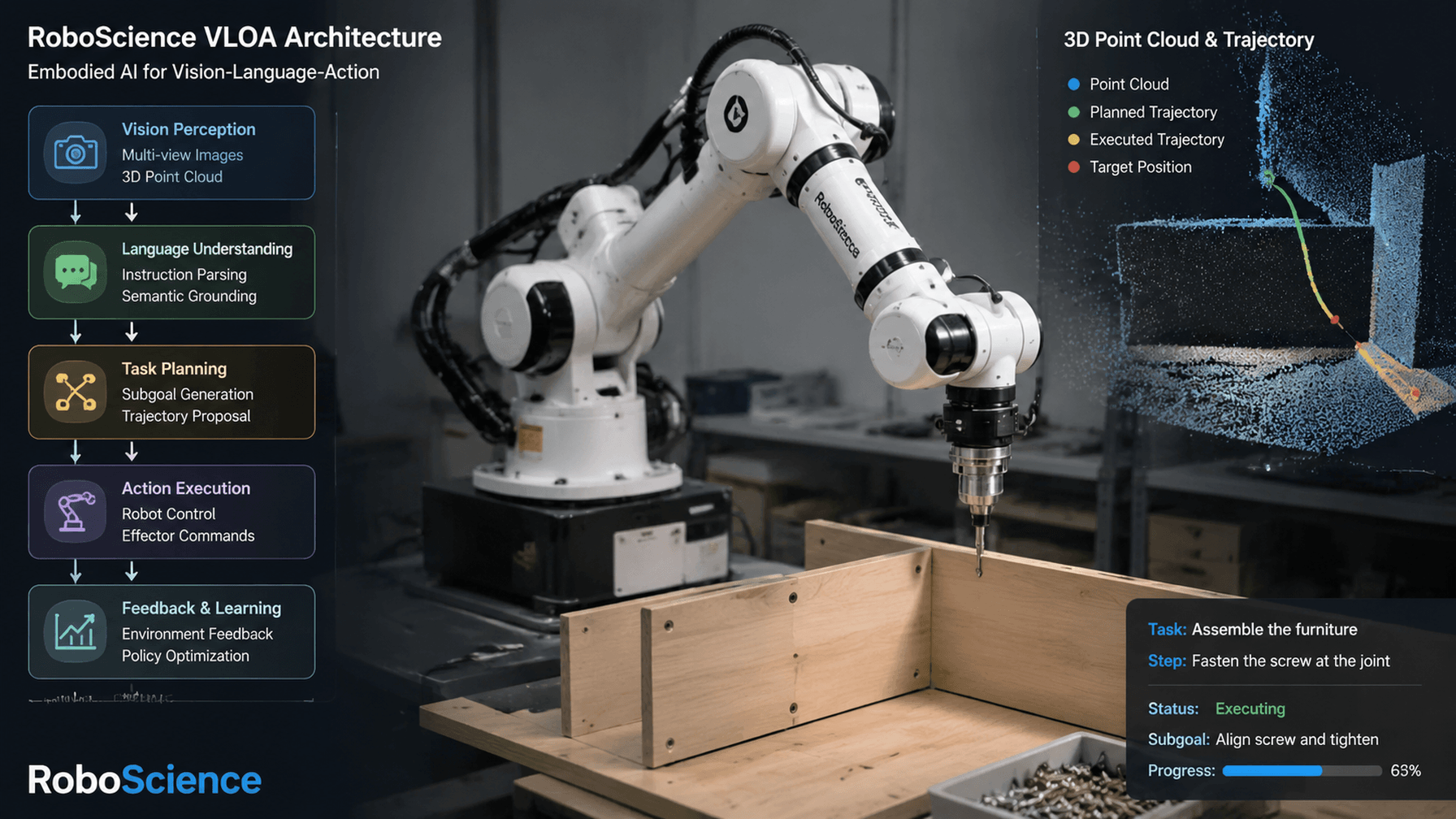
A new general-purpose embodied AI model from China could challenge existing benchmarks in robotic intelligence.
30-Second TL;DR
What Changed
Visics is designed as a general-purpose embodied AI model
Why It Matters
The launch of Visics contributes to the growing ecosystem of embodied AI, potentially lowering the barrier for developers to deploy intelligent agents in physical environments.
What To Do Next
Review the Visics technical documentation to evaluate its compatibility with existing ROS (Robot Operating System) environments.
Key Points
- •Visics is designed as a general-purpose embodied AI model
- •Developed by Beijing-based startup RoboScience
- •Includes a full technical framework for robotic integration
Deep Insight
AI-generated analysis for this event — not the original article.
Enhanced Key Takeaways
- •Visics utilizes a proprietary 'World-Action' transformer architecture that bridges visual perception with motor control commands in real-time.
- •The model was trained on a massive dataset of over 50,000 hours of diverse robotic manipulation tasks across unstructured environments.
- •RoboScience has secured strategic partnerships with three major Chinese industrial automation firms to pilot Visics in factory assembly lines.
- •The framework supports cross-platform deployment, allowing Visics to run on both humanoid robots and traditional robotic arms without retraining.
- •Visics incorporates a safety-first 'Human-in-the-Loop' reinforcement learning layer to prevent erratic movements in collaborative workspaces.
Competitor Analysis
- Visics (RoboScience)
- World-Action Transformer
- Figure AI (Figure 02)
- End-to-End Neural Net
- Tesla (Optimus)
- Vision-Language-Action
- Visics (RoboScience)
- Industrial/General Purpose
- Figure AI (Figure 02)
- Humanoid Autonomy
- Tesla (Optimus)
- Mass-Market Humanoid
- Visics (RoboScience)
- Cross-Platform
- Figure AI (Figure 02)
- Proprietary Hardware
- Tesla (Optimus)
- Proprietary Hardware
- Visics (RoboScience)
- High zero-shot success
- Figure AI (Figure 02)
- High dexterity
- Tesla (Optimus)
- High production scale
| Feature | Visics (RoboScience) | Figure AI (Figure 02) | Tesla (Optimus) |
|---|---|---|---|
| Architecture | World-Action Transformer | End-to-End Neural Net | Vision-Language-Action |
| Primary Focus | Industrial/General Purpose | Humanoid Autonomy | Mass-Market Humanoid |
| Deployment | Cross-Platform | Proprietary Hardware | Proprietary Hardware |
| Benchmarks | High zero-shot success | High dexterity | High production scale |
Technical Deep Dive
- Architecture: Utilizes a multimodal transformer backbone that processes high-frequency visual tokens alongside proprioceptive sensor data.
- Latency: Achieves sub-20ms inference time on edge computing modules, enabling reactive motion planning.
- Integration: Provides a standardized API for ROS2 (Robot Operating System) compatibility, simplifying hardware abstraction.
- Training: Employs a hybrid approach combining imitation learning from human teleoperation and large-scale synthetic simulation data.
Future ImplicationsAI analysis grounded in cited sources
Timeline
- 2024-03RoboScience founded in Beijing with a focus on embodied AI research.
- 2025-01Completion of Series A funding round to support large-scale model training.
- 2025-09Internal testing of Visics prototype begins in controlled industrial environments.
- 2026-06Official public launch of the Visics general-purpose embodied AI model.
Weekly AI Recap
Read this week's curated digest of top AI events →
Related Updates



AI-curated news aggregator. All content rights belong to original publishers.
Original source: Pandaily ↗
This is a summary, not the original. Read the source, or get the weekly briefing.
The weekly digest
One email a week. Unsubscribe anytime.