RLRWLD Partners with Nvidia to Develop DexBench Robotics Standard
💡Standardized benchmarks are essential for measuring progress in embodied AI and humanoid dexterity.
⚡ 30-Second TL;DR
What Changed
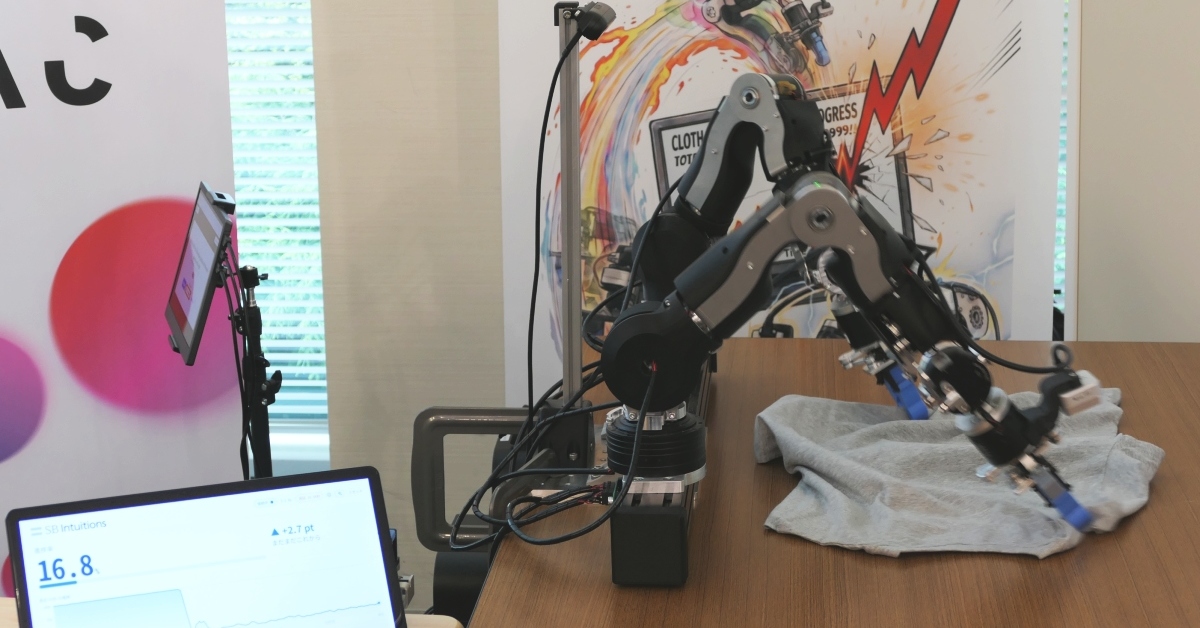
RLRWLD and Nvidia are building a universal benchmark for robotic hand manipulation.
Why It Matters
Standardized benchmarks like DexBench will accelerate the development of dexterous humanoid robots by providing a common metric for researchers and builders.
What To Do Next
Monitor the DexBench release to integrate its evaluation metrics into your own robotic manipulation training pipelines.
Key Points
- •RLRWLD and Nvidia are building a universal benchmark for robotic hand manipulation.
- •The project focuses on quantifying how robots interact with objects to complete tasks.
- •The goal is to define next-generation industry standards for humanoid robotics.
🧠 Deep Insight
Background and context from public sources — not the original article. 18 sources cited.
🔑 Enhanced Key Takeaways
- •DexBench will establish a universal benchmark for evaluating dexterity performance, define a data standard for dexterous manipulation training, and deeply integrate with NVIDIA's open Isaac Lab and Isaac Lab-Arena frameworks.
- •The benchmark defines five core evaluation domains—Grasp Diversity, Spatial Precision, Temporal Precision, Contact Precision, and Context Awareness—across 18 Key Atomic Tasks derived from real-world industrial applications like assembly, sorting, and packaging.
- •DexBench will utilize a dual-validation framework, integrating with NVIDIA's Isaac Lab-Arena environment to ensure performance validation in both simulation and real-world conditions.
- •RLRWLD's RLDX-1 foundation model for humanoid dexterous manipulation has previously demonstrated state-of-the-art performance, surpassing NVIDIA GR00T N1.6 and Physical Intelligence π₀.₅ on eight established simulation benchmarks.
- •The initiative aims to overcome the current industry challenges of lacking a common framework for objectively measuring humanoid dexterity and a shared data standard for training manipulation models at scale, which currently impedes technological advancement and commercial deployment.
📊 Competitor Analysis▸ Show
| Benchmark/Initiative | Focus | Key Features | Integration/Platform |
|---|---|---|---|
| DexBench (RLRWLD & Nvidia) | Universal benchmark for robotic hand manipulation and dexterity. | 5 core evaluation domains, 18 Key Atomic Tasks from industrial settings, dual-validation (sim & real-world), data standard for training. | Deep integration with NVIDIA Isaac Lab and Isaac Lab-Arena. |
| NIST's Proposed Baseline Performance Benchmark | Comprehensive method to evaluate minimum expected physical capabilities for humanoid robots. | Low-footprint set of locomotion and manipulation tasks, uses previously standardized test methods, aims for baseline capabilities in industrial, household, healthcare. | Standardized test methods from ASTM and NIST. |
| ManipulationNet | Measuring real-world robot manipulation performance. | Shared testing platform for standardized real-world tasks, combines distributed testing with centralized verification, aims for realism, accessibility, and authenticity. | Client software for data upload and central server for verification. |
| POMDAR (ETH Zurich) | Taxonomy-grounded dexterity benchmark for anthropomorphic hands. | Formalizes dexterity as task throughput (correctness and speed) across vertical, horizontal, continuous-rotation, and pure-grasping configurations, implemented in real-world and simulation. | Reproducible hardware (3D printing), observable motions via scaffolding. |
| Elliott and Connolly Benchmark (Carnegie Mellon) | Evaluating in-hand dexterity of robot hands. | Based on classification of human manipulations, 13 distinct in-hand manipulation patterns, qualitative and quantitative metrics. | Focuses on hardware design evaluation. |
🛠️ Technical Deep Dive
- DexBench defines dexterity through five core evaluation domains: Grasp Diversity, Spatial Precision, Temporal Precision, Contact Precision, and Context Awareness.
- It comprises 18 Key Atomic Tasks that are directly derived from dexterous manipulation tasks observed in industrial environments, such as precision assembly, sorting, and packaging.
- The benchmark will be integrated into NVIDIA's Isaac Lab-Arena, an open-source framework for efficient and scalable robotic policy evaluation in simulation, enabling a dual-validation approach across both simulated and real-world conditions.
- A shared data standard for dexterous manipulation training will be developed to ensure native compatibility with NVIDIA Isaac Lab pipelines, aiming to serve as a common data interface for global robot manufacturers and research organizations.
- DexBench tasks are defined by specifying initial and goal states, allowing the system under test to determine the method, with success measured by verifiable end-state conditions rather than trajectory similarity.
- The benchmark utilizes commercially available objects with published specifications (dimensions, weights, materials) for its test cases.
- Dexterity is conceptualized as the ability to achieve a required state transition under the object's complexity constraints, rather than an inherent property of the robotic hand itself.
- NVIDIA Isaac Lab-Arena, co-developed with Lightwheel, features a modular architecture for task curation, automated diversification, and large-scale parallel evaluation, using an Affordance system for standardized interactions across diverse objects.
🔮 Future ImplicationsAI analysis grounded in cited sources
⏳ Timeline
📎 Sources (18)
Factual claims are grounded in the sources below. Forward-looking analysis is AI-generated interpretation.
Weekly AI Recap
Read this week's curated digest of top AI events →
👉Related Updates
AI-curated news aggregator. All content rights belong to original publishers.
Original source: Bloomberg Technology ↗
This is a summary, not the original. Read the source, or get the weekly briefing.
The weekly digest
One email a week. Unsubscribe anytime.