Researchers Report Recovering Hidden LLM Reasoning
💡Reasoning traces may be observable rather than private—and that could change benchmark and distillation practices.
⚡ 30-Second TL;DR
What Changed
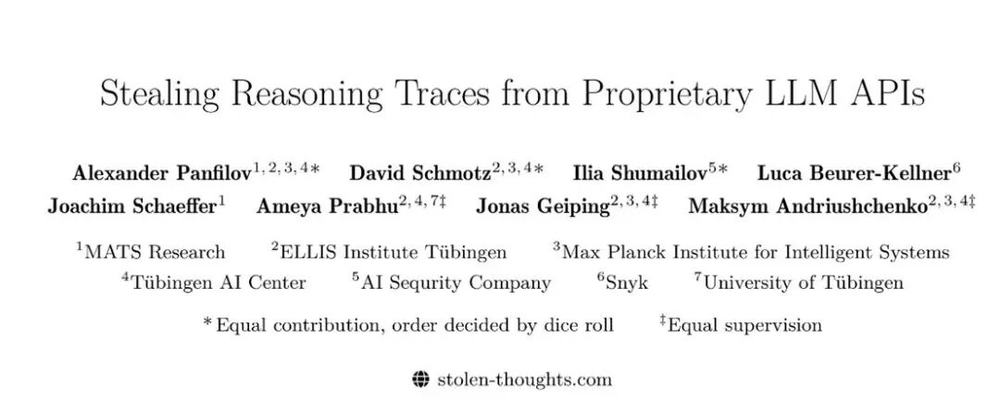
The paper reportedly demonstrates recovery of reasoning traces from Claude and GPT APIs.
Why It Matters
If independently validated, the finding could weaken confidence in reasoning traces as direct evidence of genuine problem-solving and could change how model benchmarks are audited. It may also increase security and privacy concerns for providers that expose detailed reasoning-related outputs.
What To Do Next
Read the cited paper and test whether its extraction method reproduces on your own Claude or GPT API workloads before relying on reasoning traces for evaluation.
Key Points
- •The paper reportedly demonstrates recovery of reasoning traces from Claude and GPT APIs.
- •Recovered traces may reveal memorization or prior familiarity with benchmark questions such as AIME.
- •The discussion suggests that unusual or repetitive reasoning behavior is common even in frontier models.
- •The technique could affect concerns about proprietary-model distillation and benchmark fairness.
🧠 Deep Insight
AI-generated analysis for this event.
🔑 Enhanced Key Takeaways
- •The research identifies that 'reasoning tokens' are often generated in a hidden scratchpad or chain-of-thought buffer that is typically stripped before the final response is delivered to the user.
- •The recovery technique often exploits 'logit bias' or 'prefix injection' attacks, where the model is forced to continue a sequence that includes the hidden reasoning tokens.
- •Evidence suggests that proprietary models may be using these hidden reasoning traces to perform 'self-correction' or 'verification' steps that are not visible in the standard API output.
- •The ability to extract these traces has raised significant concerns regarding intellectual property, as it allows third parties to distill the 'reasoning style' of frontier models into smaller, open-source models.
- •Security researchers have noted that this vulnerability highlights a fundamental tension between model transparency (for safety) and the desire of AI labs to keep their proprietary reasoning processes opaque.
🛠️ Technical Deep Dive
- The extraction process often involves manipulating the model's output probability distribution to force the generation of tokens that would otherwise be suppressed.
- Researchers utilize 'logit manipulation' to increase the probability of tokens associated with reasoning markers (e.g.,
, ). - The vulnerability relies on the fact that the model's internal state often includes the reasoning process as part of the autoregressive generation sequence, even if the API interface filters it out.
- Some implementations use 'forced decoding' where the user provides a prefix that matches the expected start of the hidden reasoning block, causing the model to complete the sequence.
🔮 Future ImplicationsAI analysis grounded in cited sources
⏳ Timeline
Weekly AI Recap
Read this week's curated digest of top AI events →
👉Related Updates

AI-curated news aggregator. All content rights belong to original publishers.
Original source: Reddit r/LocalLLaMA ↗