Relativity Networks Raises $22M for Faster AI Fibre
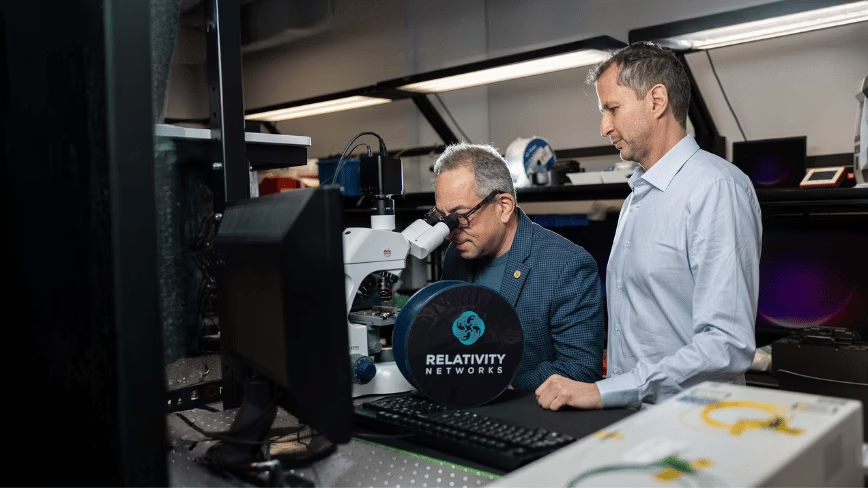
💡A $40M cloud order signals a potentially important new path for scaling AI data-centre networks.
⚡ 30-Second TL;DR
What Changed
Relativity Networks raised $22 million in SAFE financing.
Why It Matters
Faster optical connectivity could help reduce communication bottlenecks as AI clusters scale across larger numbers of accelerators. The cloud-provider order suggests that hyperscalers are actively evaluating alternatives to conventional data-centre networking infrastructure.
What To Do Next
Evaluate Relativity Networks' fibre specifications and pilot availability against your current AI-cluster interconnect roadmap before committing to new networking hardware.
Key Points
- •Relativity Networks raised $22 million in SAFE financing.
- •A large cloud provider placed a $40 million order.
- •The company is targeting faster fibre connectivity for AI data centres.
- •The funding and commercial deal were announced by the Orlando-based company.
🧠 Deep Insight
Web-grounded analysis with 15 cited sources.
🔑 Enhanced Key Takeaways
- •The $22 million SAFE investment secured by Relativity Networks more than doubled its initial fundraising target.
- •Key investors participating in the SAFE round include Rhapsody Venture Partners, Bell Ventures Inc., and Faster Than Glass LLC.
- •The $40 million commercial deal is a follow-on order from an unnamed leading hyperscale cloud provider, placed after successfully testing Relativity Networks' ChronoCore™ technology to link two data centers.
- •Relativity Networks has partnered with Prysmian, a global leader in fiber production, to manufacture its ChronoCore™ hollow-core fiber, achieving a density of 24 fibers in a single 10-millimeter cable.
- •The company's ChronoCore™ technology enables data to travel approximately 47% faster than conventional glass fiber, reducing latency from about 5 microseconds per kilometer to 3.5 microseconds per kilometer.
- •Relativity Networks' technology can extend the practical distance between AI data centers from approximately 60 kilometers to up to 90 kilometers while maintaining critical latency requirements.
🛠️ Technical Deep Dive
- Technology Name: ChronoCore™ advanced optical networking technology.
- Core Innovation: Utilizes hollow-core fiber (HCF) that guides light primarily through an air core, rather than traditional solid glass.
- Speed Enhancement: Data travels approximately 47% faster than with conventional glass fiber, which transmits light at ~5 ns/m. ChronoCore™ reduces this delay to ~3.4 ns/m.
- Latency Reduction: This results in a latency reduction from approximately 5 microseconds per kilometer in traditional fiber to about 3.5 microseconds per kilometer.
- Cable Design: The company, in partnership with Prysmian, has produced a high-density hollow-core fiber cable containing 24 fibers within a single 10-millimeter diameter.
- Deployment Readiness: Testing with Dura-Line confirmed that the high-density cable can be reliably installed in standard microducts, indicating its readiness for real-world deployment.
- Application Focus: Specifically designed to address the "Propagation Tax"—the unavoidable latency penalty when connecting geographically distributed AI compute resources, enabling them to operate as a single synchronized machine.
- Founders' Expertise: Co-founded by Dr. Jason Eichenholz (CEO), a serial entrepreneur in photonics, and Dr. Rodrigo Amezcua Correa (CTO), a pioneer in HCF technology whose lab at the University of Central Florida developed the core HCF breakthroughs.
🔮 Future ImplicationsAI analysis grounded in cited sources
⏳ Timeline
📎 Sources (15)
Factual claims are grounded in the sources below. Forward-looking analysis is AI-generated interpretation.
Weekly AI Recap
Read this week's curated digest of top AI events →
👉Related Updates




AI-curated news aggregator. All content rights belong to original publishers.
Original source: The Next Web (TNW) ↗