Big Tech Courts Communities for AI Data Centres
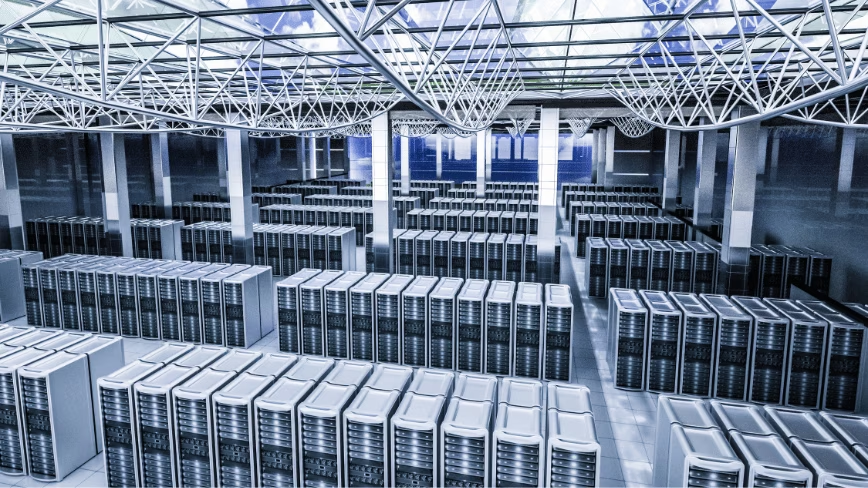
💡Local opposition could determine how quickly and where the next wave of AI compute gets built.
⚡ 30-Second TL;DR
What Changed
Big Tech is spending more on local campaigns to secure data-centre approvals.
Why It Matters
Community resistance could delay AI compute expansion, increase project costs, and shape where future cloud capacity is built. For AI companies, infrastructure planning now requires stronger attention to permitting, power, water, jobs, and local stakeholder relations.
What To Do Next
Add permitting, power, water, and community-approval risks to your AI capacity plan before selecting a region for GPU or inference deployment.
Key Points
- •Big Tech is spending more on local campaigns to secure data-centre approvals.
- •Opposition to new data centres is spreading across the United States.
- •Companies are holding town halls and sponsoring community groups.
- •Tax demands and local economic concerns are central to the negotiations.
🧠 Deep Insight
Web-grounded analysis with 24 cited sources.
🔑 Enhanced Key Takeaways
- •At least 75 AI data center projects, valued at approximately $130 billion, were blocked or delayed in the first three months of 2026 due to growing local opposition across the United States.
- •AI-focused 'hyperscale' data centers can consume as much electricity as 100,000 households or more, and large data centers can use up to 5 million gallons of water daily, equivalent to the usage of a city of 50,000 people, primarily for cooling purposes.
- •Microsoft launched a 'Community-First AI Infrastructure' initiative in January 2026, committing to fair electricity pricing, water stewardship (aiming to be water positive by 2030), local job creation, full property tax contributions, and community AI training and nonprofit grants.
- •Public opposition to data centers is also fueled by concerns over potential increases in residential electricity rates and the often opaque nature of tax breaks and incentives offered to tech companies by local governments.
- •The geographic spread of opposition is significant, with Michigan seeing over 50 communities passing or proposing moratoriums on data center construction, and similar pushback occurring in states like Texas, Mississippi, and Ohio.
🛠️ Technical Deep Dive
- AI data centers require significantly higher rack power densities, often ranging from 40 to 100 kW per rack, a substantial increase compared to the 5-10 kW in legacy CPU racks.
- The intense heat generated by AI workloads necessitates a shift from traditional air cooling (supporting up to 20 kW/rack) to advanced methods like liquid cooling (up to 100 kW/rack), immersion cooling (200+ kW/rack), and direct-to-chip cooling.
- Power Usage Effectiveness (PUE) is the industry-standard metric for energy efficiency, calculated as the ratio of total facility power to IT equipment power. While the global industry average PUE is around 1.55-1.59, hyperscale operators like Google have achieved PUEs as low as 1.09.
- Modern GPUs, central to AI workloads, consume considerably more power (700-1,200 watts per chip) compared to traditional server CPUs (150-250 watts).
- Data centers can require approximately two liters of water for cooling for every kilowatt-hour of energy consumed.
🔮 Future ImplicationsAI analysis grounded in cited sources
⏳ Timeline
📎 Sources (24)
Factual claims are grounded in the sources below. Forward-looking analysis is AI-generated interpretation.
- facebook.com
- thenextweb.com
- lincolninst.edu
- eesi.org
- youtube.com
- reddit.com
- microsoft.com
- youtube.com
- harvard.edu
- techplustrends.com
- ashrae.org
- hanwhadatacenters.com
- penguinsolutions.com
- cadence.com
- infineon.com
- introl.com
- mit.edu
- microsoft.com
- bgr.com
- deloitte.com
- dartpoints.com
- trgdatacenters.com
- ecocenter.org
- newsweek.com
Weekly AI Recap
Read this week's curated digest of top AI events →
👉Related Updates



AI-curated news aggregator. All content rights belong to original publishers.
Original source: The Next Web (TNW) ↗