Reference AWS Secrets Manager secrets in Amazon Bedrock AgentCore
๐กEnhance your AI agent security by centralizing credential management using your existing AWS Secrets Manager workflows.
โก 30-Second TL;DR
What Changed
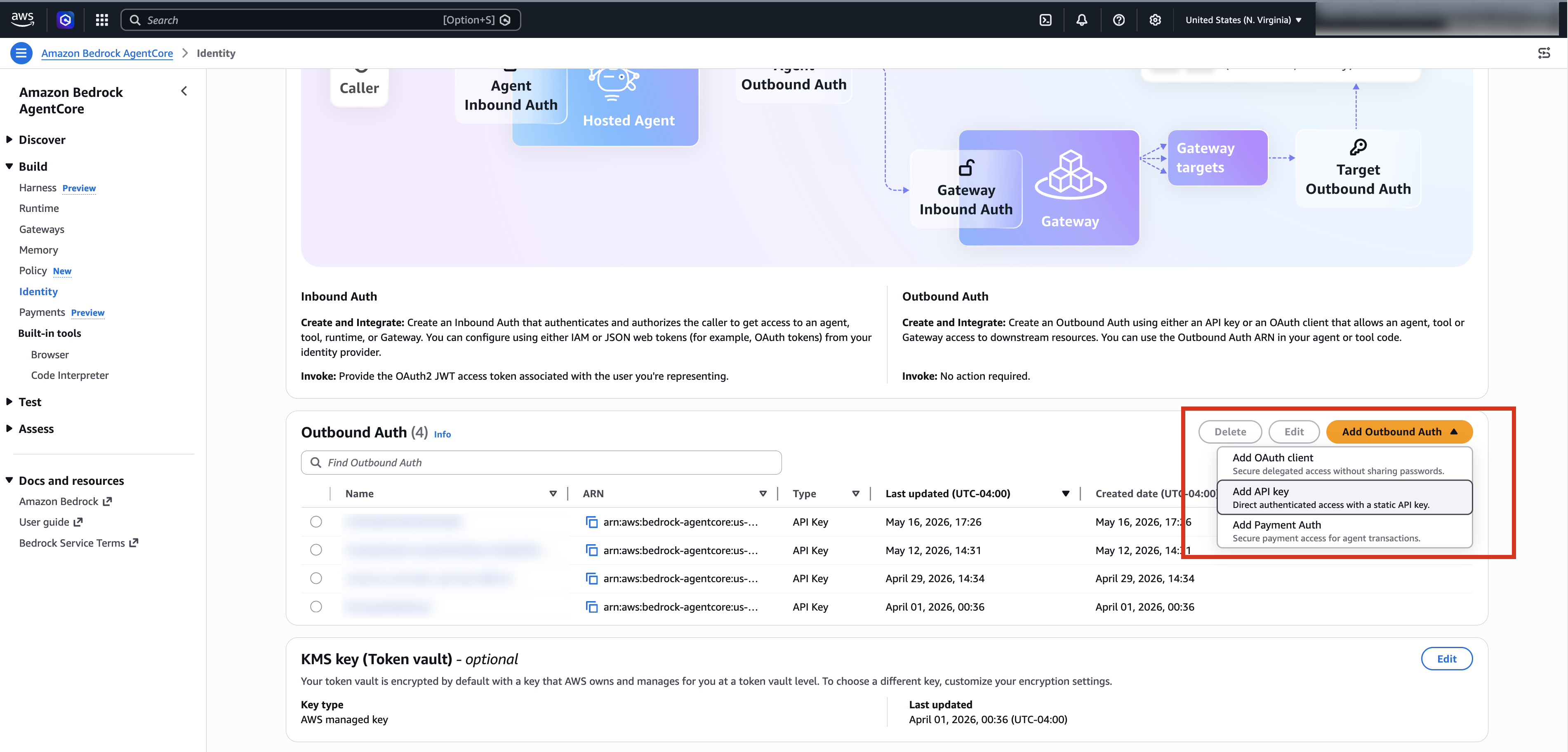
Integrate existing AWS Secrets Manager secrets directly into AgentCore Identity.
Why It Matters
This update simplifies security compliance for enterprise AI agents by allowing them to leverage existing corporate secrets management infrastructure instead of creating new, isolated credential silos.
What To Do Next
Audit your current AgentCore credential providers and migrate hardcoded or local secrets to AWS Secrets Manager to centralize your security governance.
Key Points
- โขIntegrate existing AWS Secrets Manager secrets directly into AgentCore Identity.
- โขMaintain full control over secret lifecycle management like rotation and encryption.
- โขSupport for cross-account secret access within the same AWS Region.
- โขCompatibility with third-party secret managers via AWS Secrets Manager external connectors.
๐ง Deep Insight
Web-grounded analysis with 17 cited sources.
๐ Enhanced Key Takeaways
- โขAgentCore Identity now includes a token vault designed to secure user access tokens and OAuth client credentials, utilizing AWS Key Management Service (KMS) keys for encryption, with support for customer-managed keys.
- โขThis integration enables AI agents to securely access external services regardless of their deployment environment, supporting platforms such as Amazon ECS, Amazon EKS, AWS Lambda, or even on-premises infrastructure.
- โขThe new capability addresses a previous limitation in AgentCore Agent Runtime, which only accepted plaintext environment variables, by allowing secure resolution of Secrets Manager references at container start time, enhancing security and developer ergonomics.
- โขIt facilitates outbound authentication, where agents retrieve necessary API keys from AgentCore Identity's credential provider at runtime, thereby eliminating the security risk of hardcoding secrets directly into agent code or container images.
- โขThe system automates complex OAuth Authorization Code Flows, handling critical steps like user consent, two-hop redirects, and token exchange, which significantly simplifies the process for developers to enable secure access to user data.
๐ Competitor Analysisโธ Show
| Feature / Platform | AWS Bedrock AgentCore | Google Cloud Vertex AI Agent Builder (Gemini Enterprise Agent Platform) | Microsoft Azure AI Studio (Foundry) |
|---|---|---|---|
| Integrated Secret Management Service | AWS Secrets Manager (with token vault for OAuth tokens) | Google Secret Manager (for encrypted secrets) | Azure Key Vault (for secure storage) |
| Agent Identity Management | Dedicated agent identities, enforces least privilege | Native agent identities as first-class IAM principals | Agent identities managed in Microsoft Entra ID |
| Cross-Account/Cross-Service Access | Supports cross-account secret access within the same AWS Region | Integrates with existing GCP IAM roles and VPC networks | Seamless integration with Azure RBAC |
| Third-Party Secret Manager Compatibility | Via AWS Secrets Manager external connectors | Cloud API Registry for tool governance | Supports various external APIs and data sources |
| Pricing Model (General Approach) | Granular, AWS-like pricing based on usage of various modular services | Based on model usage, Agent Engine services, and ADK | Based on model usage, agent services, and underlying Azure resources |
๐ ๏ธ Technical Deep Dive
- AgentCore Identity features a token vault for OAuth 2.0 Access and Refresh tokens, API keys, and OAuth 2.0 client secrets, which are encrypted using AWS Key Management Service (KMS) keys, including support for customer-managed keys.
- Strict access controls are implemented to limit credential retrieval to individual agents, and user-specific credentials (such as OAuth tokens) are accessed solely on behalf of the associated user, thereby enforcing the principle of least privilege.
- During agent invocation, a
@requires_api_keydecorator intercepts calls, retrieves encrypted API keys from AWS Secrets Manager via AgentCore Identity, and injects them as environment variables, preventing hardcoding of secrets. - Required AWS Identity and Access Management (IAM) permissions for agents include
bedrock-agentcore:GetResourceApiKey(to retrieve API keys from AgentCore Identity) andsecretsmanager:GetSecretValue(scoped to AgentCore-managed secrets). - AgentCore Identity manages both inbound authentication (validating callers attempting to invoke agents) and outbound authentication (enabling agents to securely access external services).
- For OAuth Authorization Code Flow, AgentCore automatically handles the exchange of authorization codes for access and refresh tokens, storing them in a token vault and delivering them to the agent without requiring developers to implement complex OAuth logic.
- AgentCore Runtime provides session isolation, allocating a dedicated microVM with isolated compute, memory, and filesystem resources for each user session to prevent data leakage between different agents.
๐ฎ Future ImplicationsAI analysis grounded in cited sources
โณ Timeline
๐ Sources (17)
Factual claims are grounded in the sources below. Forward-looking analysis is AI-generated interpretation.
Weekly AI Recap
Read this week's curated digest of top AI events โ
๐Related Updates
AI-curated news aggregator. All content rights belong to original publishers.
Original source: AWS Machine Learning Blog โ