Red-Light Pauses Rewrite Delivery-Time Economics
💡A real-world case study of using live context to trade delivery speed for safety without sacrificing throughput.
⚡ 30-Second TL;DR
What Changed
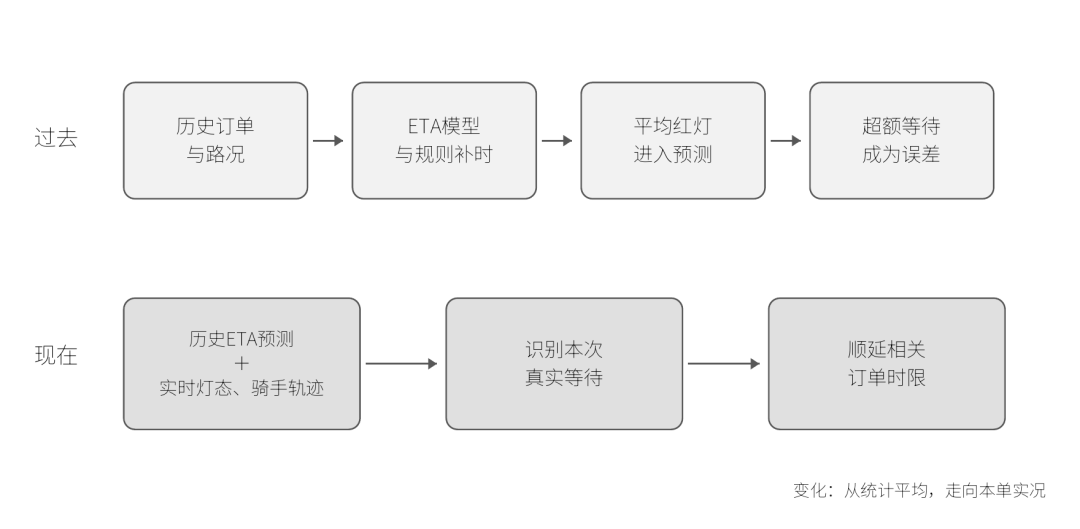
Suzhou pilots reportedly added about two minutes of average delivery time while reducing red-light violations.
Why It Matters
The feature shifts accountability for prediction error from individual riders toward the platform’s scheduling system. For AI and logistics practitioners, it is a useful example of how real-time context can improve safety without automatically reducing system throughput.
What To Do Next
Instrument your dispatch simulator to compare red-light-aware routing against baseline routing on TPH, on-time rate, rider idle time, and safety violations before changing task-density targets.
Key Points
- •Suzhou pilots reportedly added about two minutes of average delivery time while reducing red-light violations.
- •Wuxi expanded the feature to all 4,253 signalized intersections, and Beijing plans trials across selected districts with three platforms.
- •The system combines traffic-signal data, rider location, trajectory, and order status to identify real-time waiting at a red light.
- •The recovered time could improve batching, routing, and order combinations, but platforms have not disclosed batch rate, carried-order count, TPH, or unit delivery cost.
- •Consumer ETAs and rider deadlines are separate clocks, so giving riders two minutes does not necessarily delay customers by two minutes.
🧠 Deep Insight
AI-generated analysis for this event.
🔑 Enhanced Key Takeaways
- •The initiative is part of a broader 'Rider Care' regulatory push in China, where local governments are increasingly mandating that platforms implement 'human-centric' algorithms to reduce traffic accidents.
- •Data integration involves collaboration with municipal 'Smart City' traffic management bureaus to access real-time signal timing (SPaT - Signal Phase and Timing) data, rather than relying solely on GPS inference.
- •Initial pilot data indicates that while rider stress levels decreased, the 'buffer time' is being dynamically adjusted based on weather conditions and peak-hour traffic density to prevent system gaming.
- •Labor unions and rider advocacy groups in China have criticized the feature as a 'band-aid' solution, arguing that it does not address the underlying issue of low per-order compensation that forces riders to speed.
- •The algorithm utilizes a 'Geofencing-Signal-Match' model that triggers the pause only when the rider's trajectory aligns with a verified intersection coordinate and the signal state is confirmed as red.
📊 Competitor Analysis▸ Show
| Feature | Meituan (Red-Light Pause) | Ele.me (Alibaba) | Dada/JD Daojia |
|---|---|---|---|
| Red-Light Pause | Active Pilot | Testing/Limited | Not Disclosed |
| Algorithm Focus | Safety-First Optimization | Efficiency/Volume | Retail/Grocery Speed |
| Regulatory Compliance | High (Proactive) | Moderate | Moderate |
| Data Integration | Municipal Traffic Data | Proprietary/Map Data | Internal Logistics |
🛠️ Technical Deep Dive
- The system employs a multi-modal fusion architecture combining GNSS (Global Navigation Satellite System) data with high-precision map layers to distinguish between waiting at a red light and stopping for a delivery.
- Signal Phase and Timing (SPaT) data is ingested via API from municipal traffic control centers, allowing the platform to verify the signal status in real-time.
- The 'Pause' logic is governed by a dynamic threshold model that calculates the probability of a stop being a traffic-related event versus a delivery-related event based on historical dwell-time patterns.
- The backend infrastructure utilizes a distributed event-driven architecture to update the rider's 'Remaining Time' field in the delivery app without triggering a full re-route calculation, minimizing latency.
🔮 Future ImplicationsAI analysis grounded in cited sources
⏳ Timeline
Weekly AI Recap
Read this week's curated digest of top AI events →
👉Related Updates
AI-curated news aggregator. All content rights belong to original publishers.
Original source: 虎嗅 ↗