Mech-Mind Debuts as Embodied AI’s Eye-Brain-Hand Pioneer
💡Mech-Mind’s IPO reveals the metrics—and unresolved gaps—behind an embodied-AI infrastructure play.
⚡ 30-Second TL;DR
What Changed
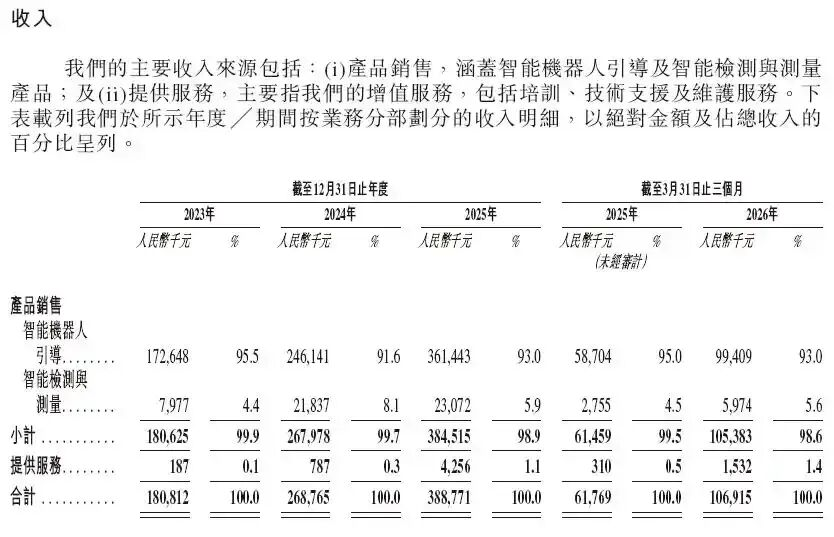
Revenue rose from RMB 180.8 million in 2023 to RMB 388.8 million in 2025, while gross margin increased from 39.1% to 51.1% and then 64.6%.
Why It Matters
The IPO may give Mech-Mind early capital-market visibility in embodied AI, but listing status is not a technical moat. AI developers and robotics founders should evaluate whether its industrial data can transfer across robots, tasks, and consumer environments.
What To Do Next
Benchmark Mech-GPT and Mech-Eye on your robot’s multi-scene grasping tasks, measuring cross-object generalization, recovery from occlusion, and deployment latency before committing to the stack.
Key Points
- •Revenue rose from RMB 180.8 million in 2023 to RMB 388.8 million in 2025, while gross margin increased from 39.1% to 51.1% and then 64.6%.
- •Existing customers contributed 78% of 2025 revenue, and average purchases per customer increased from 7.2 to 13.2 units.
- •Overseas revenue grew at an 82.7% CAGR from 2023 to 2025 and reached 50.3% of total revenue across nearly 50 countries and regions.
- •The Mech-GPT model, Mech-Eye 3D cameras, and Mech-Hand dexterous hand form the company’s proposed embodied-AI component stack.
- •Its industrial-vision strength is established, but model generalization, physical-world data loops, and dexterous-hand capabilities remain unproven.
🧠 Deep Insight
AI-generated analysis for this event.
🔑 Enhanced Key Takeaways
- •Mech-Mind Robotics was founded by Dr. Tianqi Shao, a Tsinghua University alumnus, who previously worked at Google and focused on 3D vision and AI algorithms.
- •The company secured significant backing from major investors including Meituan, Source Code Capital, and Sequoia China prior to its HKEX filing.
- •Mech-Mind's 3D vision systems are widely deployed in automotive manufacturing for complex tasks like bin picking, depalletizing, and high-precision assembly.
- •The company's transition to 'Embodied AI' involves integrating its proprietary Mech-GPT with hardware to enable robots to understand natural language commands and perform autonomous planning.
- •Mech-Mind has established a strategic partnership ecosystem, collaborating with major industrial robot manufacturers like ABB, FANUC, and KUKA to integrate its vision software into their existing platforms.
📊 Competitor Analysis▸ Show
| Competitor | Primary Focus | Key Differentiator | Pricing/Benchmarking |
|---|---|---|---|
| Photoneo | 3D Vision/Scanning | High-resolution industrial sensors | Premium industrial pricing |
| Cognex | Industrial Machine Vision | Global market share/reliability | High-end enterprise pricing |
| Mujin | Robot Control/Motion Planning | Intelligent motion planning software | Project-based pricing |
| Universal Robots | Collaborative Robots | Ease of use/ecosystem | Mid-range hardware pricing |
🛠️ Technical Deep Dive
- Mech-Eye 3D Cameras: Utilize structured light and time-of-flight (ToF) technology to achieve sub-millimeter accuracy in complex industrial environments.
- Mech-GPT Architecture: A multimodal large model designed for robotic task planning, capable of translating natural language instructions into robot motion sequences.
- Mech-Hand Integration: Focuses on tactile sensing and force-feedback control loops to enable dexterous manipulation of objects with varying shapes and textures.
- Software Stack: Includes Mech-Vision (graphical development environment) and Mech-DLK (deep learning training platform) to facilitate rapid deployment of AI-driven vision tasks.
🔮 Future ImplicationsAI analysis grounded in cited sources
⏳ Timeline
Weekly AI Recap
Read this week's curated digest of top AI events →
👉Related Updates
AI-curated news aggregator. All content rights belong to original publishers.
Original source: 虎嗅 ↗