Readers Prefer AI Text in Blind Tests
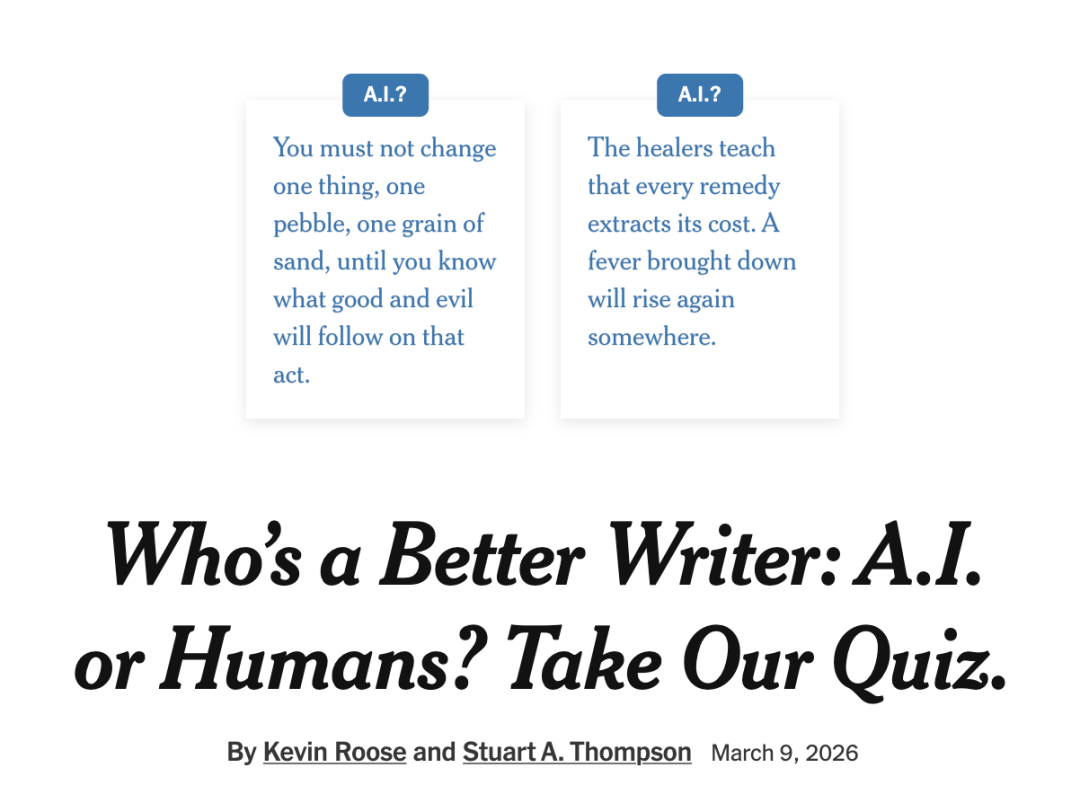
💡AI fools 56% readers blindly—learn detection gaps now
⚡ 30-Second TL;DR
What Changed
56% of NYT test voters picked AI text blindly
Why It Matters
Undermines claims of inherent human writing superiority; forces reevaluation of AI content authenticity in publishing.
What To Do Next
Run ChatGPT on NYT quiz samples to benchmark your own text detection model.
Key Points
- •56% of NYT test voters picked AI text blindly
- •ChatGPT aced all 5 human-vs-AI identification questions
- •AI excels at detecting templated patterns in machine writing
- •GitHub Copilot embraced for code, unlike prose
🧠 Deep Insight
Background and context from public sources — not the original article. 2 sources cited.
🔑 Enhanced Key Takeaways
- •The NYT quiz involved 86,000 readers evaluating five pairs of passages across literary fiction, fantasy, science writing, historical fiction, and poetry genres[1].
- •AI passages were generated by prompting models to emulate strong existing human writing in their own voice, ensuring a rigorous side-by-side comparison without metadata[1].
- •Prior studies have similarly shown readers often fail to distinguish AI from human writing in blind tests and sometimes prefer AI output, though NYT's scale with 86,000 participants sets a new benchmark[1].
🔮 Future ImplicationsAI analysis grounded in cited sources
📎 Sources (2)
Factual claims are grounded in the sources below. Forward-looking analysis is AI-generated interpretation.
Weekly AI Recap
Read this week's curated digest of top AI events →
👉Related Updates
AI-curated news aggregator. All content rights belong to original publishers.
Original source: 虎嗅 ↗
This is a summary, not the original. Read the source, or get the weekly briefing.
Weekly AI briefing
One email a week. Unsubscribe anytime.