Rare Elements: Robot Era's True Gold

💡Robot era's scarcest resource: elements pricier than gold
⚡ 30-Second TL;DR
What Changed
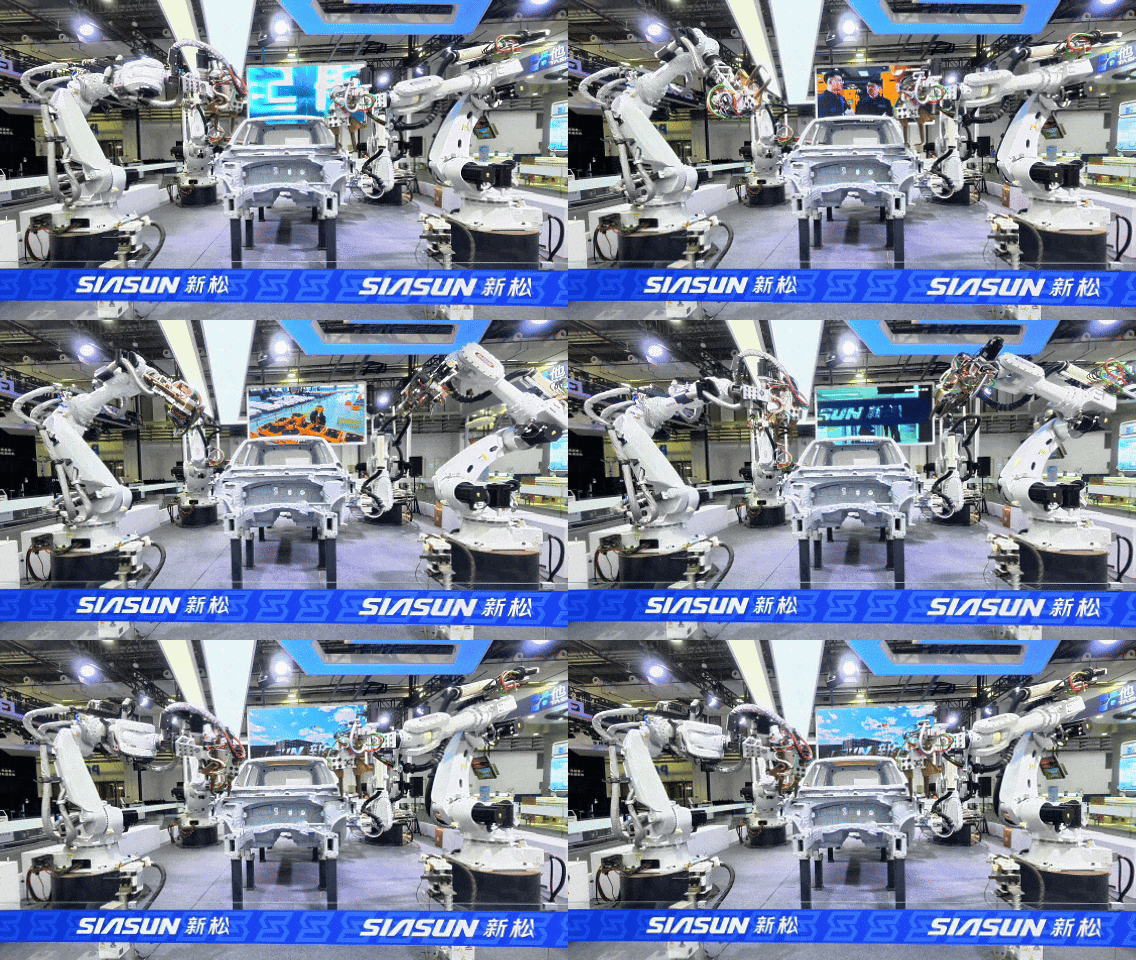
Spring Gala robots signal real robot era onset.
Why It Matters
Highlights potential supply bottlenecks for robot hardware, raising costs for AI embodied systems.
What To Do Next
Audit periodic table elements in your robotics bill of materials.
Key Points
- •Spring Gala robots signal real robot era onset.
- •Focus shifts from AI compute/chips to periodic elements.
- •These materials valued higher than gold/petroleum in robotics.
🧠 Deep Insight
Background and context from public sources — not the original article. 9 sources cited.
🔑 Enhanced Key Takeaways
- •Humanoid robots require 30 or more motors per unit, each using rare earth magnets like NdFeB for high power density, straining global supply chains[5][2].
- •AI-driven discoveries have identified 25 new high-temperature magnetic materials and a database of 67,573 compounds, enabling rare-earth-free alternatives for motors[1].
- •Companies like Niron Magnetics are developing iron-nitrogen based permanent magnets, while Japan-based Proterial and Aichi Steel commercialize rare-earth-free options[6][5].
- •Aclara is investing $277 million in a U.S. facility for heavy rare earth separation using sustainable tech from Brazil and Chile deposits, starting construction in 2026[7].
- •New high-entropy borides using earth-abundant 3d transition metals and boron achieve strong magnetic anisotropy without rare earths or precious metals[3].
🛠️ Technical Deep Dive
- •AI system scans scientific papers to extract experimental data on 67,573 magnetic compounds, training models to predict magnetism and Curie temperature for high-temperature stability[1].
- •High-entropy borides in C16 crystal structure use 3d transition metals (first row d-block) and boron, achieving high magnetic anisotropy via boron-assisted synthesis[3].
- •NdFeB magnets dominate robotics motors for superior power density; thrifting innovations reduce heavy rare earth content while maintaining performance[4][5].
- •Iron-nitrogen compounds replace neodymium/praseodymium in permanent magnets, targeting applications in electric motors and sensors[6].
🔮 Future ImplicationsAI analysis grounded in cited sources
⏳ Timeline
📎 Sources (9)
Factual claims are grounded in the sources below. Forward-looking analysis is AI-generated interpretation.
- sciencedaily.com — 260218031611
- adamasintel.com — Robotics Remain the New Frontier of Medium to Long Term Demand
- phys.org — 2026 01 Class Strong Magnets Earth Abundant
- roboticsresear.ch — New Idtechex Market Report Rare Earth Magnets 2026 2036
- spglobal.com — Robot Rise Could Be Slowed by Metals Shortage 98483872
- forumvc.com — Mining the Future the Rare Earth Crisis Shaping U S Industrial Power
- opportunitylouisiana.gov — Aclara Invests 277 Million to Build Nations First Heavy Rare Earth Separation Facility in Southwest Louisiana
- euronews.com — Oil vs Rare Earths Which Will Shape the Global Economys Future
- state.gov — 2026 Critical Minerals Ministerial
Weekly AI Recap
Read this week's curated digest of top AI events →
👉Related Updates

AI-curated news aggregator. All content rights belong to original publishers.
Original source: 虎嗅 ↗
This is a summary, not the original. Read the source, or get the weekly briefing.
Weekly AI briefing
One email a week. Unsubscribe anytime.