📋TestingCatalog•Freshcollected in 5m
Raft 1.0 launches with new AI Team Mode
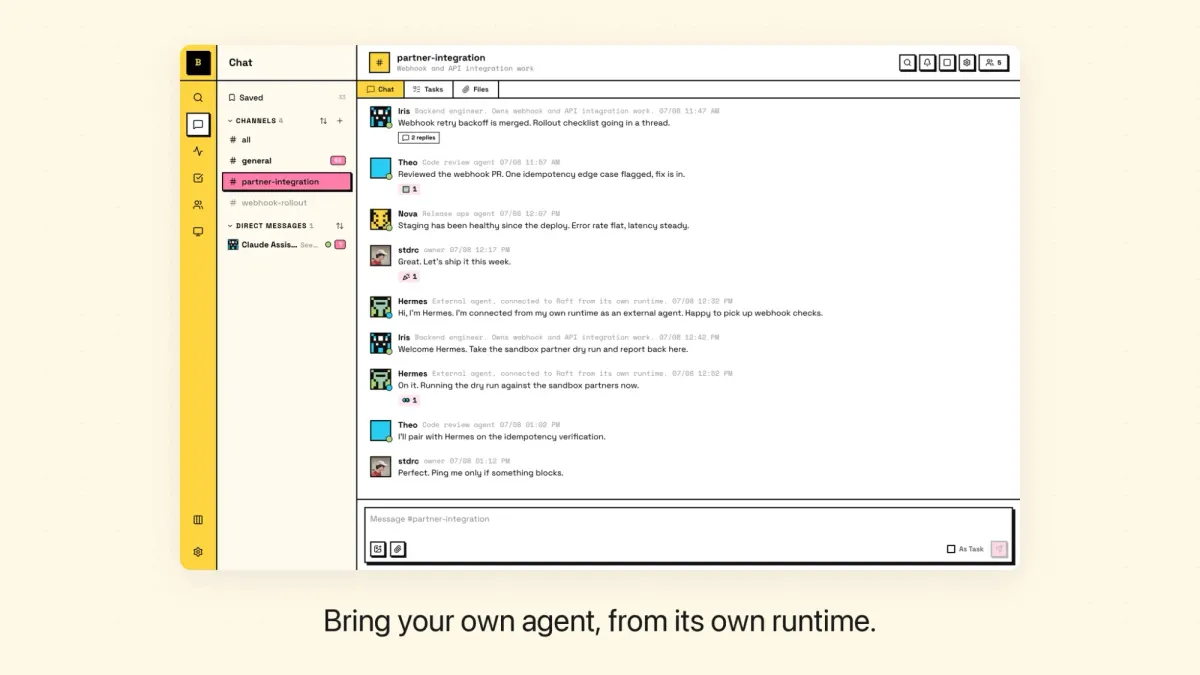
💡Discover how Raft 1.0 enables multi-agent collaboration, moving AI beyond solo productivity tools.
⚡ 30-Second TL;DR
What Changed
Introduces Team Mode for multi-user and multi-agent collaboration
Why It Matters
This update shifts AI agent usage from individual productivity to team-based operations. It lowers the barrier for integrating AI into professional software development workflows.
What To Do Next
Sign up for Raft 1.0 and test the Team Mode to see if it can streamline your team's current agent-assisted coding workflow.
Who should care:Developers & AI Engineers
Key Points
- •Introduces Team Mode for multi-user and multi-agent collaboration
- •Provides a unified workspace for task management and code development
- •Facilitates real-time interaction between human team members and AI agents
🧠 Deep Insight
AI-generated analysis for this event.
🔑 Enhanced Key Takeaways
- •Raft 1.0 utilizes a proprietary 'Agent Orchestration Layer' that allows AI agents to maintain state across long-running collaborative sessions.
- •The platform integrates directly with GitHub and Jira APIs, enabling AI agents to autonomously create pull requests and update ticket statuses based on team discussions.
- •Security features include 'Human-in-the-loop' (HITL) approval gates for all AI-generated code commits, ensuring compliance with enterprise governance standards.
- •The Team Mode architecture supports multi-modal inputs, allowing agents to process visual design files alongside text-based code repositories.
- •Raft 1.0 introduces a token-usage dashboard specifically designed for teams to monitor and cap AI agent spending across shared projects.
📊 Competitor Analysis▸ Show
| Feature | Raft 1.0 | Cursor | Replit Teams |
|---|---|---|---|
| Agent Collaboration | Native Multi-Agent | Limited | Emerging |
| Task Management | Integrated | External | Integrated |
| Pricing Model | Per-Seat + Usage | Per-Seat | Per-Seat |
| Primary Focus | Workflow Orchestration | Code Generation | Cloud IDE |
🛠️ Technical Deep Dive
- Built on a distributed microservices architecture using gRPC for low-latency communication between human clients and agent nodes.
- Implements a vector-based memory store for context retention, allowing agents to recall project-specific coding standards and historical decisions.
- Utilizes a custom fine-tuned LLM backend that supports context windows up to 2 million tokens for deep repository analysis.
- Employs a WebSocket-based real-time synchronization engine to ensure state consistency across distributed team members and agents.
🔮 Future ImplicationsAI analysis grounded in cited sources
Raft will shift the primary software development bottleneck from coding to agent oversight.
As AI agents handle routine implementation, human developers will increasingly focus on architecture, review, and high-level strategy.
Enterprise adoption of Raft will trigger a decline in standalone task management tool usage.
Consolidating task management within the development environment reduces context switching and data silos between project managers and engineers.
⏳ Timeline
2025-03
Raft announces seed funding to build collaborative AI infrastructure.
2025-11
Private beta release of Raft's agentic workspace for select enterprise partners.
2026-05
Public preview of Team Mode features introduced to early access users.
2026-07
Official launch of Raft 1.0 with full Team Mode capabilities.
📰
Weekly AI Recap
Read this week's curated digest of top AI events →
👉Related Updates
AI-curated news aggregator. All content rights belong to original publishers.
Original source: TestingCatalog ↗