Qwen’s Architect Launches Shanghai AI Lab
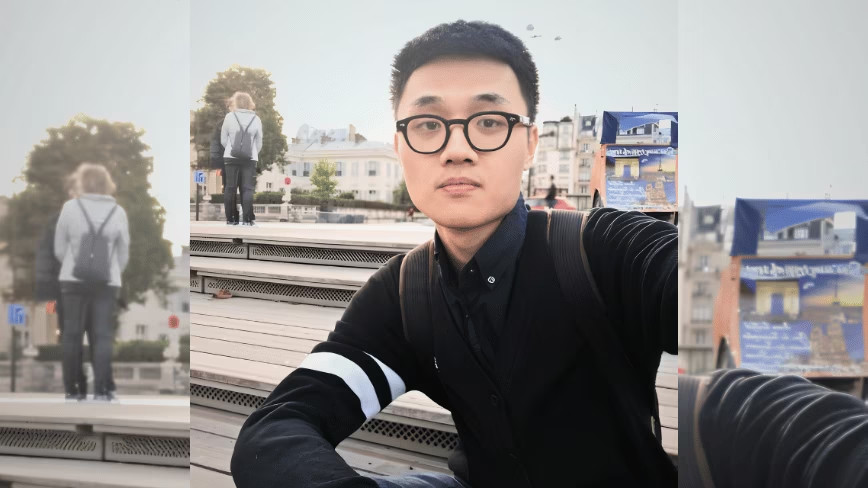
💡The Qwen leader’s new lab could become a major force in China’s agent race.
⚡ 30-Second TL;DR
What Changed
Junyang Lin founded Pragmatik Labs five months after leaving Alibaba.
Why It Matters
Lin’s move could intensify competition for advanced agent research and talent in China. Government backing also signals that Shanghai views embodied and general-purpose agents as strategically important areas.
What To Do Next
Track Pragmatik Labs releases and benchmark any future agent model against Alibaba Qwen on tool use, long-horizon tasks, and embodied-agent workloads.
Key Points
- •Junyang Lin founded Pragmatik Labs five months after leaving Alibaba.
- •The Shanghai-based lab is focused on agents operating across digital and physical worlds.
- •Gaorong Ventures, HSG, and the Shanghai government are investors.
🧠 Deep Insight
AI-generated analysis for this event.
🔑 Enhanced Key Takeaways
- •Pragmatik Labs is specifically targeting the development of 'Embodied AI' agents, aiming to bridge the gap between Large Language Models (LLMs) and robotic control systems.
- •Junyang Lin's departure from Alibaba followed his significant role in the open-source success of the Qwen series, which became a cornerstone of China's domestic AI ecosystem.
- •The funding round led by Gaorong Ventures and HSG is reportedly valued at a multi-million dollar seed stage, reflecting strong investor confidence in Lin's technical leadership.
- •The Shanghai government's involvement is part of a broader municipal strategy to cultivate 'AI-native' startups that can integrate with the city's advanced manufacturing and robotics industrial base.
- •Pragmatik Labs is adopting a 'world model' approach to agent training, prioritizing spatial reasoning and real-time sensor fusion over traditional text-only generative architectures.
📊 Competitor Analysis▸ Show
| Feature | Pragmatik Labs | Figure AI | Tesla (Optimus) |
|---|---|---|---|
| Primary Focus | Embodied Agents | Humanoid Robotics | Humanoid Robotics |
| Model Architecture | World Models | End-to-End Neural | End-to-End Neural |
| Target Market | Digital/Physical Hybrid | Industrial/Commercial | Consumer/Industrial |
| Funding Source | VC/Gov (China) | OpenAI/Microsoft/Nvidia | Public/Internal |
🛠️ Technical Deep Dive
- Architecture: Utilizes a multimodal foundation model capable of processing high-frequency sensor data alongside natural language instructions.
- Agent Framework: Implements a hierarchical planning system where high-level goals are decomposed into low-level motor control primitives.
- Training Methodology: Employs a combination of large-scale synthetic simulation (Sim-to-Real) and real-world fine-tuning to improve generalization in unstructured environments.
- Integration: Designed to be hardware-agnostic, allowing the agent software to interface with various robotic platforms via standardized APIs.
🔮 Future ImplicationsAI analysis grounded in cited sources
⏳ Timeline
Weekly AI Recap
Read this week's curated digest of top AI events →
👉Related Updates



AI-curated news aggregator. All content rights belong to original publishers.
Original source: The Next Web (TNW) ↗