AI Tennis Robots Move From Ball Machines to Sparring Partners
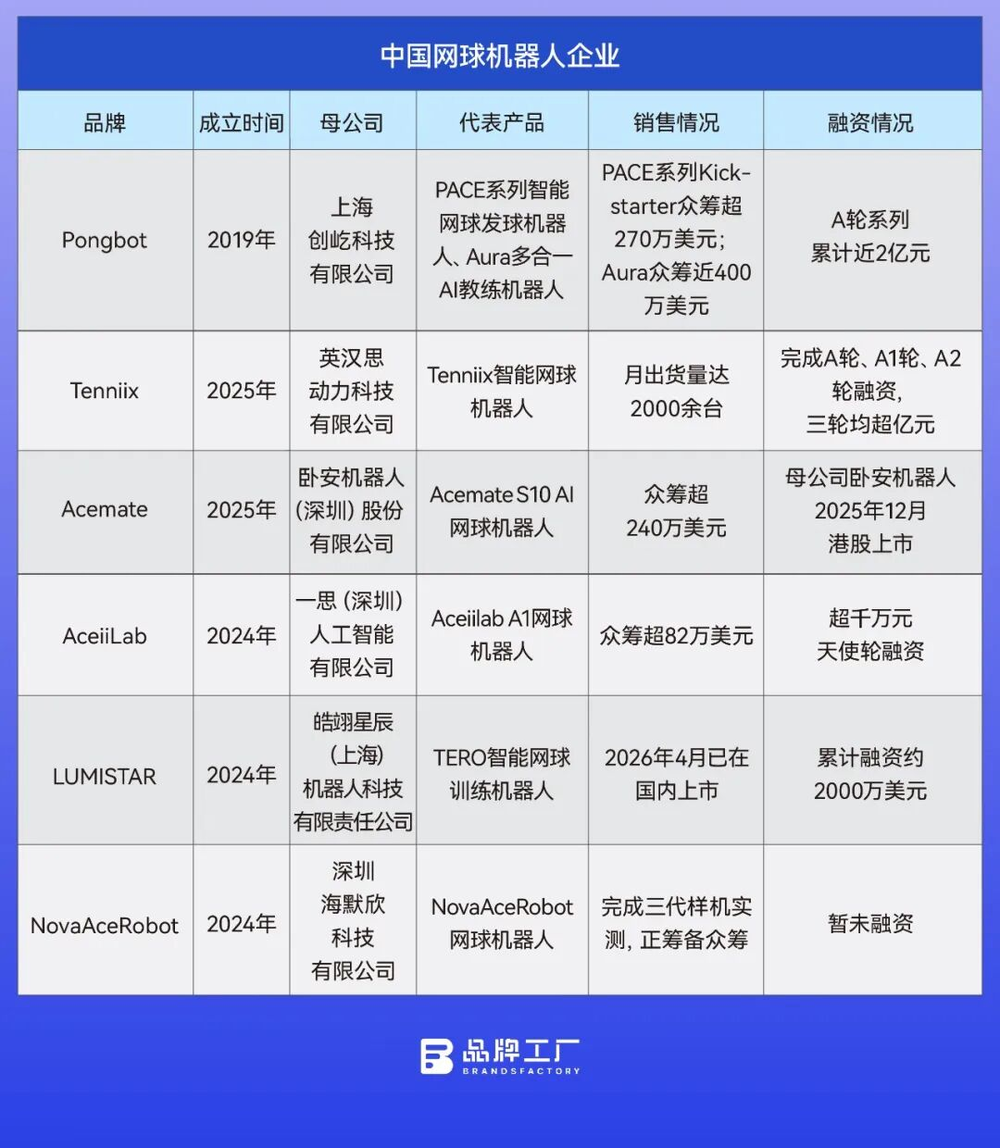
💡Chinese startups are turning tennis ball machines into embodied-AI training partners with vision, UWB, and adaptive cont
⚡ 30-Second TL;DR
What Changed
Yisi Intelligent raised more than 10 million yuan in angel funding, while Pongbot and Yinghansi each completed multi-round financing totaling nearly or above 100 million yuan.
Why It Matters
This is a notable embodied-AI opportunity: sports robotics provides a constrained environment for real-time perception, decision-making, and motion control. For founders, the main challenge is not funding but improving reliability, interaction quality, and repeatable training outcomes.
What To Do Next
Prototype a ROS 2 perception-to-control pipeline using OpenCV and UWB player tracking, then benchmark shot-placement accuracy and return success rate before adding generative coaching features.
Key Points
- •Yisi Intelligent raised more than 10 million yuan in angel funding, while Pongbot and Yinghansi each completed multi-round financing totaling nearly or above 100 million yuan.
- •Pongbot’s PACE tracks player position and dynamically adjusts speed, spin, landing point, and match-style training scenarios.
- •Tenniix combines 4K dual cameras with UWB sensing to identify player position, swing motion, and ball trajectory.
- •Acemate S10 uses machine vision and autonomous movement to catch and return balls, but reported catch accuracy remains around 30%.
- •The market is still early: leading companies ship roughly 1,000–2,000 units per month, despite strong crowdfunding demand.
🧠 Deep Insight
AI-generated analysis for this event.
🔑 Enhanced Key Takeaways
- •The surge in Chinese tennis robotics is partially driven by the 'Healthy China 2030' initiative, which promotes increased participation in sports and has spurred government-backed investment in smart fitness equipment.
- •Beyond consumer training, these robots are increasingly being integrated into professional tennis academies to provide standardized, high-repetition drills that reduce the physical strain on human coaches.
- •Data privacy concerns have emerged regarding these systems, as the high-resolution cameras and UWB sensors collect granular biometric data and movement patterns of users, prompting early discussions on data sovereignty in smart sports.
- •Supply chain localization has been a critical factor for these startups, with many leveraging China's mature drone and EV motor industries to source high-torque, low-latency actuators at a fraction of the cost of international competitors.
- •The 'catch and return' capability of robots like Acemate is being tested for potential expansion into other racket sports, such as pickleball and badminton, to diversify the addressable market for these robotics platforms.
📊 Competitor Analysis▸ Show
| Feature | Pongbot (PACE) | Acemate (S10) | Tenniix | Traditional Ball Machines |
|---|---|---|---|---|
| Movement | Static/Fixed | Autonomous (Wheels) | Static/Fixed | Static |
| Tracking | AI Vision | AI Vision + Lidar | 4K Vision + UWB | None |
| Return Capability | No | Yes (Limited) | No | No |
| Target Market | Pro/Advanced | Consumer/Home | Coaching/Academy | Casual/Club |
🛠️ Technical Deep Dive
- Motion Control: Utilizes Field Oriented Control (FOC) algorithms to manage high-speed brushless DC motors, allowing for precise spin and velocity adjustments in milliseconds.
- Computer Vision: Employs edge-computing modules (typically NVIDIA Jetson or similar SoCs) to perform real-time pose estimation and ball trajectory prediction without relying on cloud latency.
- Sensor Fusion: Combines UWB (Ultra-Wideband) for centimeter-level player positioning with optical flow sensors to maintain tracking accuracy even in varying outdoor lighting conditions.
- Autonomous Navigation: Uses SLAM (Simultaneous Localization and Mapping) algorithms adapted for tennis court boundaries to ensure the robot remains within safe operating zones while tracking the player.
🔮 Future ImplicationsAI analysis grounded in cited sources
⏳ Timeline
Weekly AI Recap
Read this week's curated digest of top AI events →
👉Related Updates


AI-curated news aggregator. All content rights belong to original publishers.
Original source: 虎嗅 ↗