Qwen Office Gives Agents Task Authority
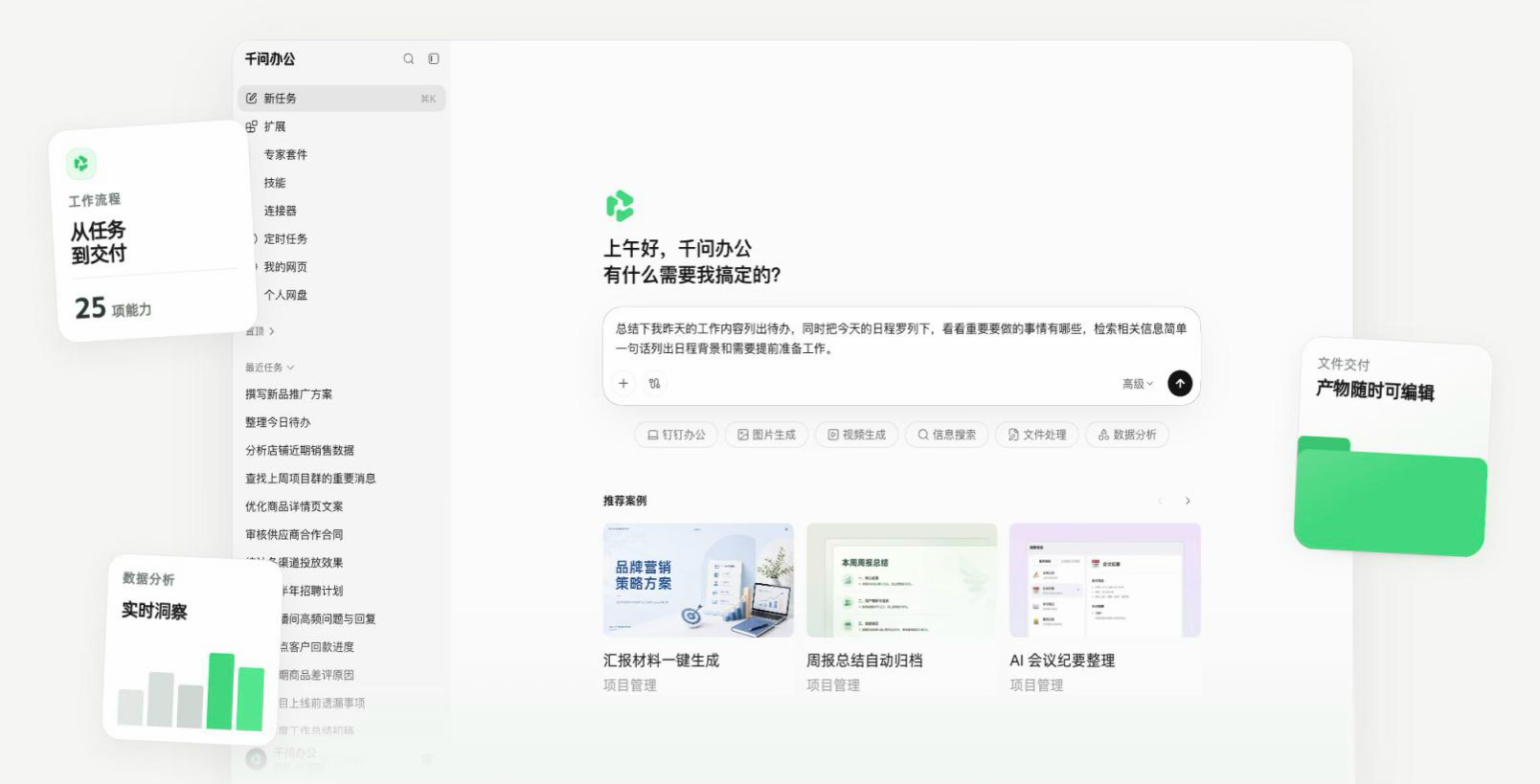
Qwen Office gives Agents a new enterprise power: deciding who handles which task.
30-Second TL;DR
What Changed
Qwen Office is positioned as a new office Agent product.
Why It Matters
Granting Agents task allocation authority could improve workflow automation and reduce coordination overhead. It also raises the importance of permissioning, human oversight, and accountability in enterprise deployments.
What To Do Next
Evaluate Qwen Office's task-allocation controls in a sandbox, focusing on approval gates, role permissions, and audit logs before connecting it to production workflows.
Key Points
- •Qwen Office is positioned as a new office Agent product.
- •The Agent can participate in enterprise task allocation.
- •AI assistants may increasingly influence organizational workflow coordination.
Deep Insight
AI-generated analysis for this event — not the original article.
Enhanced Key Takeaways
- •Qwen Office integrates deeply with Alibaba's DingTalk ecosystem, leveraging existing enterprise data silos to enable autonomous task routing.
- •The system utilizes a multi-agent orchestration framework that allows the AI to act as a manager, assigning sub-tasks to human employees or other specialized AI agents based on role-based access control (RBAC).
- •It incorporates a 'Human-in-the-Loop' verification layer that requires managerial approval for high-stakes task delegation, mitigating risks associated with autonomous decision-making.
- •The underlying model architecture utilizes Qwen-Max's latest iteration, optimized specifically for long-context reasoning to maintain state across complex, multi-day organizational projects.
- •Alibaba has introduced a proprietary 'Agent-to-Agent' communication protocol within Qwen Office, enabling seamless data exchange between different departmental AI agents without manual API configuration.
Competitor Analysis
- Qwen Office
- Task Allocation/Orchestration
- Microsoft 365 Copilot
- Productivity/Content Creation
- Salesforce Agentforce
- CRM/Sales Automation
- Qwen Office
- DingTalk / Alibaba Cloud
- Microsoft 365 Copilot
- Microsoft 365 / Azure
- Salesforce Agentforce
- Salesforce Data Cloud
- Qwen Office
- Enterprise Subscription
- Microsoft 365 Copilot
- Per User/Month
- Salesforce Agentforce
- Consumption-based
- Qwen Office
- High (Managerial)
- Microsoft 365 Copilot
- Medium (Assistant)
- Salesforce Agentforce
- High (Functional)
| Feature | Qwen Office | Microsoft 365 Copilot | Salesforce Agentforce |
|---|---|---|---|
| Primary Focus | Task Allocation/Orchestration | Productivity/Content Creation | CRM/Sales Automation |
| Ecosystem | DingTalk / Alibaba Cloud | Microsoft 365 / Azure | Salesforce Data Cloud |
| Pricing Model | Enterprise Subscription | Per User/Month | Consumption-based |
| Agent Autonomy | High (Managerial) | Medium (Assistant) | High (Functional) |
Technical Deep Dive
- Architecture: Built on a hierarchical multi-agent framework where a 'Controller Agent' manages task decomposition and delegation.
- Context Window: Supports up to 1M tokens to ingest entire project histories and organizational charts for context-aware decision making.
- Integration: Uses a proprietary middleware layer to interface with DingTalk APIs, allowing real-time read/write access to enterprise communication logs.
- Security: Implements a sandboxed execution environment for agentic actions, ensuring that task allocation adheres to pre-defined enterprise compliance policies.
Future ImplicationsAI analysis grounded in cited sources
Timeline
- 2023-08Alibaba releases Qwen-7B, marking the start of the Qwen open-source model series.
- 2024-04Qwen1.5 series launched with significant improvements in reasoning and multilingual capabilities.
- 2024-09Alibaba integrates Qwen-Max into DingTalk to enhance AI assistant capabilities.
- 2025-05Introduction of Qwen-Agent framework, providing developers tools to build autonomous agents.
- 2026-08Launch of Qwen Office, transitioning from assistant-based AI to agentic task authority.
Weekly AI Recap
Read this week's curated digest of top AI events →
AI-curated news aggregator. All content rights belong to original publishers.
Original source: 钛媒体 ↗
This is a summary, not the original. Read the source, or get the weekly briefing.
The weekly digest
One email a week. Unsubscribe anytime.