Qwen Comes to Siri in China
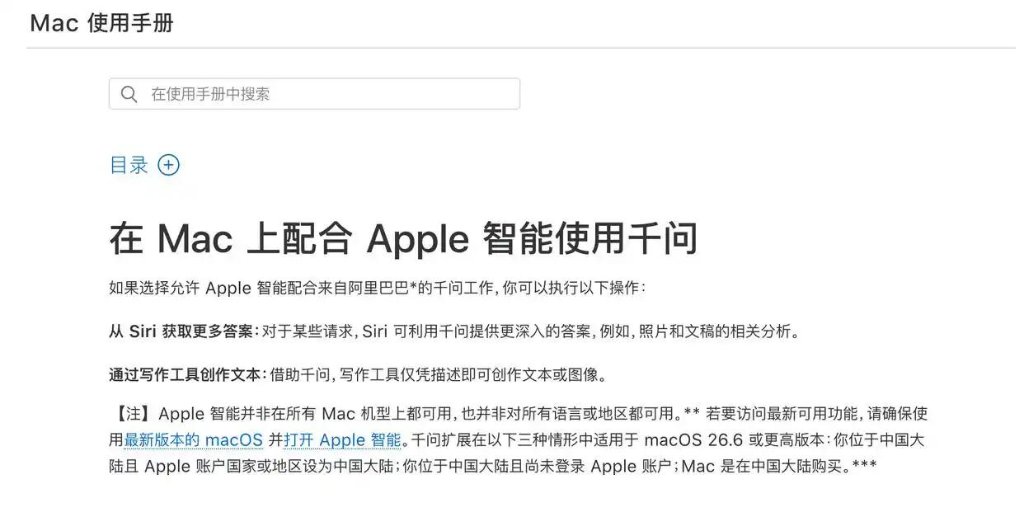
Apple’s official documentation points to Qwen powering Apple Intelligence and Siri for China.
30-Second TL;DR
What Changed
Apple’s China website documents Qwen integration with Apple Intelligence on Mac.
Why It Matters
The integration could give Apple a locally compliant AI partner in China, where access to overseas AI services is constrained. For AI builders, it signals that platform distribution and regional regulation will increasingly shape model partnerships.
What To Do Next
Monitor Apple’s China Mac user guide and test whether Qwen-related Apple Intelligence features appear in the next regional macOS beta.
Key Points
- •Apple’s China website documents Qwen integration with Apple Intelligence on Mac.
- •The partnership may extend Apple’s AI capabilities to users in China.
- •The documentation strengthens evidence that Qwen will work with Siri in China.
Deep Insight
AI-generated analysis for this event — not the original article.
Enhanced Key Takeaways
- •The integration is part of Apple's broader strategy to comply with China's strict generative AI regulations, which require local models to be registered with the Cyberspace Administration of China (CAC).
- •Qwen (Tongyi Qianwen) is developed by Alibaba Cloud and is one of the first large language models to receive official approval for public use in China, making it a compliant choice for Apple's local operations.
- •Apple Intelligence features in China will likely operate within a 'walled garden' architecture, where requests are routed to Alibaba's servers rather than Apple's Private Cloud Compute used in other regions.
- •This move follows a trend of foreign tech companies, including Samsung and Honor, partnering with Chinese AI firms to bypass regulatory hurdles regarding data sovereignty and AI safety.
- •The documentation specifically highlights that Qwen will assist with writing, summarizing, and image generation tasks, mirroring the functionality of Apple's partnership with OpenAI in Western markets.
Competitor Analysis
- Apple/Qwen (China)
- Qwen (Alibaba)
- Samsung/Baidu (China)
- Ernie Bot (Baidu)
- Honor/MagicLM (China)
- MagicLM (In-house/Cloud)
- Apple/Qwen (China)
- Siri/System-wide
- Samsung/Baidu (China)
- Galaxy AI/System-wide
- Honor/MagicLM (China)
- MagicOS/System-wide
- Apple/Qwen (China)
- CAC Approved
- Samsung/Baidu (China)
- CAC Approved
- Honor/MagicLM (China)
- CAC Approved
- Apple/Qwen (China)
- Local/Alibaba Cloud
- Samsung/Baidu (China)
- Local/Baidu Cloud
- Honor/MagicLM (China)
- Hybrid/Cloud
| Feature | Apple/Qwen (China) | Samsung/Baidu (China) | Honor/MagicLM (China) |
|---|---|---|---|
| Primary Model | Qwen (Alibaba) | Ernie Bot (Baidu) | MagicLM (In-house/Cloud) |
| Integration | Siri/System-wide | Galaxy AI/System-wide | MagicOS/System-wide |
| Regulatory Status | CAC Approved | CAC Approved | CAC Approved |
| Data Processing | Local/Alibaba Cloud | Local/Baidu Cloud | Hybrid/Cloud |
Technical Deep Dive
- Qwen utilizes a Transformer-based architecture with Mixture-of-Experts (MoE) capabilities in its larger variants to optimize inference latency.
- The integration relies on Apple's App Intents framework, allowing Siri to pass structured data to the Qwen API while maintaining user privacy boundaries.
- Data transmission between Apple devices and Alibaba servers is encrypted using TLS 1.3, with specific protocols to ensure that user prompts are not used for model training by the provider.
- The system supports multimodal inputs, enabling the model to process images and text concurrently within the Apple Intelligence interface.
Future ImplicationsAI analysis grounded in cited sources
Timeline
- 2023-04Alibaba officially launches the Qwen (Tongyi Qianwen) large language model.
- 2024-06Apple announces Apple Intelligence at WWDC, initially excluding China due to regulatory uncertainty.
- 2025-03Reports emerge of Apple entering high-level discussions with Chinese AI firms to localize Apple Intelligence.
- 2026-05Apple confirms plans to bring Apple Intelligence to Chinese users via local partnerships.
- 2026-08Apple China Mac user guide is updated to officially document Qwen integration.
Weekly AI Recap
Read this week's curated digest of top AI events →
Related Updates

AI-curated news aggregator. All content rights belong to original publishers.
Original source: cnBeta (Full RSS) ↗
This is a summary, not the original. Read the source, or get the weekly briefing.
The weekly digest
One email a week. Unsubscribe anytime.