Quantum Photons Transmitted Over Chicago Commercial Fiber
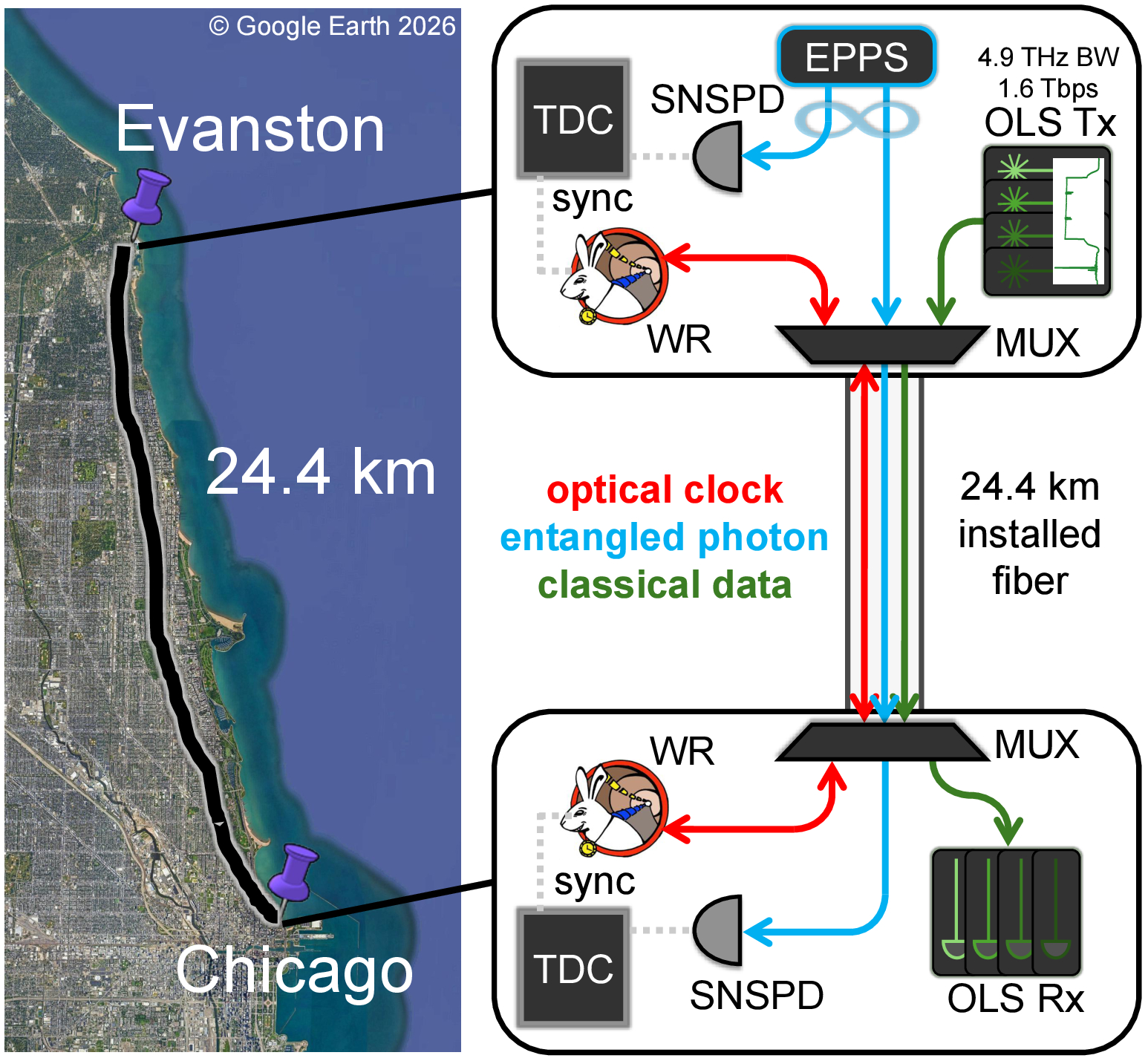
A major step toward a practical quantum internet using existing fiber, bypassing the need for new infrastructure.
30-Second TL;DR
What Changed
Achieved 24.4km quantum entanglement transmission in active commercial fiber
Why It Matters
This breakthrough significantly lowers the barrier for quantum internet deployment by utilizing existing telecom assets. It paves the way for secure, distributed quantum computing clusters.
What To Do Next
Monitor developments in quantum key distribution (QKD) hardware to prepare for future secure communication infrastructure integration.
Key Points
- •Achieved 24.4km quantum entanglement transmission in active commercial fiber
- •Demonstrated coexistence of quantum signals with high-capacity classical data
- •Validates feasibility of deploying quantum internet on existing telecom infrastructure
Deep Insight
AI-generated analysis for this event — not the original article.
Enhanced Key Takeaways
- •The experiment utilized a specialized 'quantum frequency conversion' process to shift photon wavelengths to the telecommunications C-band, minimizing signal loss in standard fiber.
- •Researchers employed time-bin encoding to ensure the quantum states remained robust against the noise and thermal fluctuations inherent in active commercial networks.
- •The transmission was facilitated by the Chicago Quantum Exchange, a hub that connects Northwestern University with other regional research institutions and industry partners.
- •This demonstration specifically addressed the 'noise floor' challenge, proving that quantum signals can be filtered out from classical data streams even when sharing the same physical fiber strand.
- •The project is part of a broader effort to develop a 'quantum metropolitan area network' (QMAN) that could eventually link quantum computers across the Chicago area.
Technical Deep Dive
- Wavelength: Utilized the 1550 nm telecommunications window to match standard fiber optic attenuation profiles.
- Encoding Method: Time-bin entanglement, which is highly resistant to polarization mode dispersion in fiber.
- Noise Mitigation: Implemented high-extinction ratio filtering to isolate quantum signals from classical data channels.
- Infrastructure: Leveraged existing dark fiber and lit fiber segments managed by regional telecom providers in the Chicago loop.
- Detection: Used superconducting nanowire single-photon detectors (SNSPDs) to achieve high efficiency and low dark-count rates at the receiving end.
Future ImplicationsAI analysis grounded in cited sources
Timeline
- 2017-01Establishment of the Chicago Quantum Exchange to foster regional quantum research.
- 2023-09Northwestern University researchers demonstrate initial lab-based quantum entanglement over simulated fiber loops.
- 2026-05Integration of quantum transmission hardware into the active Chicago commercial fiber testbed.
Weekly AI Recap
Read this week's curated digest of top AI events →
Related Updates
AI-curated news aggregator. All content rights belong to original publishers.
Original source: cnBeta (Full RSS) ↗
This is a summary, not the original. Read the source, or get the weekly briefing.
The weekly digest
One email a week. Unsubscribe anytime.