PyTorch Docathon 2026 Results in 150+ Merged Pull Requests
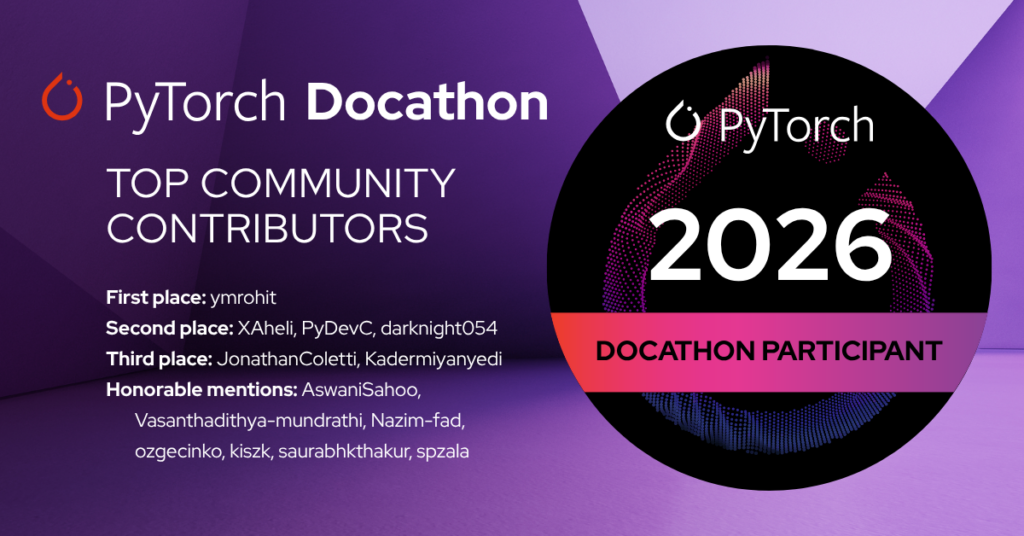
Explore the latest documentation improvements in PyTorch to streamline your deep learning development workflow.
30-Second TL;DR
What Changed
Over 150 pull requests were merged during the event
Why It Matters
Better documentation reduces the learning curve for new developers and streamlines troubleshooting for experienced engineers. This contributes to the long-term stability and adoption of the PyTorch ecosystem.
What To Do Next
Check the updated PyTorch documentation for the specific modules you use, as many examples and API descriptions have been refined.
Key Points
- •Over 150 pull requests were merged during the event
- •Community-driven effort to enhance PyTorch documentation
- •Improved developer experience and resource accessibility
Deep Insight
Background and context from public sources — not the original article. 25 sources cited.
Enhanced Key Takeaways
- •The PyTorch Docathon 2026 was a community-powered, hackathon-style sprint that took place from May 5 to May 19, 2026, with winner announcements on May 20, 2026.
- •A significant motivation for the Docathon is the increasing reliance of Large Language Models (LLMs) and AI agents on public technical documentation for learning APIs, generating code, and troubleshooting, making high-quality PyTorch documentation crucial for accurate AI-generated guidance.
- •The event was designed to be inclusive, offering tasks categorized by difficulty (easy, medium, advanced) to encourage participation from both newcomers and experienced machine learning/PyTorch users.
- •The Docathon focused on enhancing documentation across key PyTorch repositories, including
pytorch/pytorch,pytorch/tutorials, andpytorch/executorch. - •Building on previous successes, such as the November 2023 Docathon which improved docstrings and added new tutorials (some contributed by ecosystem partners), the 2026 event continued PyTorch's ongoing commitment to documentation quality.
Competitor Analysis
- PyTorch
- Community-driven Docathons, focus on clarity, accessibility, tutorials, API references, moving from reStructuredText to MyST-flavored Markdown.
- TensorFlow
- Comprehensive, organized into sections (description, syntax, arguments, returns, examples), guides for beginners, and user guides for specific features like distributed training.
- JAX
- Emphasizes functional programming style, NumPy-like API, detailed explanations of transformations (JIT, grad, vmap, pmap), and concepts like
jaxprandpytrees.
- PyTorch
- Dynamic computational graph, flexibility, developer-friendly, research-focused, robust ecosystem with libraries like Captum and PyTorch Geometric.
- TensorFlow
- Historically static computational graph (now more flexible), end-to-end platform, production deployment, MLOps tools (TFX), and distributed training strategies (
tf.distribute.Strategy). - JAX
- High-performance numerical computing, XLA compilation, automatic differentiation, functional purity, accelerator-oriented design for CPUs, GPUs, and TPUs.
- PyTorch
- Regular Docathons, active Discord and GitHub communities, localized tutorials (e.g., Chinese, Korean, Japanese), and contribution guides.
- TensorFlow
- Official website, extensive guides, community forums, and resources for understanding and implementing documentation.
- JAX
- Official documentation, community-driven libraries built on top (e.g., Flax, Optax), and resources for learning functional programming with JAX.
| Feature/Aspect | PyTorch | TensorFlow | JAX |
|---|---|---|---|
| Documentation Approach | Community-driven Docathons, focus on clarity, accessibility, tutorials, API references, moving from reStructuredText to MyST-flavored Markdown. | Comprehensive, organized into sections (description, syntax, arguments, returns, examples), guides for beginners, and user guides for specific features like distributed training. | Emphasizes functional programming style, NumPy-like API, detailed explanations of transformations (JIT, grad, vmap, pmap), and concepts like jaxpr and pytrees. |
| Core Philosophy/Key Differentiator | Dynamic computational graph, flexibility, developer-friendly, research-focused, robust ecosystem with libraries like Captum and PyTorch Geometric. | Historically static computational graph (now more flexible), end-to-end platform, production deployment, MLOps tools (TFX), and distributed training strategies (tf.distribute.Strategy). | High-performance numerical computing, XLA compilation, automatic differentiation, functional purity, accelerator-oriented design for CPUs, GPUs, and TPUs. |
| Community Engagement (Docs) | Regular Docathons, active Discord and GitHub communities, localized tutorials (e.g., Chinese, Korean, Japanese), and contribution guides. | Official website, extensive guides, community forums, and resources for understanding and implementing documentation. | Official documentation, community-driven libraries built on top (e.g., Flax, Optax), and resources for learning functional programming with JAX. |
Technical Deep Dive
- PyTorch documentation provides comprehensive guidance covering installation instructions, tutorials for various skill levels, detailed API references, best practices for model training, and troubleshooting tips.
- The PyTorch build system integrates core Torch libraries (TH, THC, THNN, THCUNN), vendor libraries (CuDNN, NCCL), Python Extension libraries, and additional third-party libraries such as NumPy, MKL, and LAPACK.
- Python's Setuptools, with the
setup.pyfile, serves as the main entry point for building the PyTorch library. - There is an ongoing effort to transition PyTorch documentation from reStructuredText to MyST-flavored Markdown to simplify the writing process for contributors.
- Docstrings are a critical area of focus for documentation improvement, with community contributors meticulously reviewing and enhancing them.
- PyTorch models are fundamentally constructed using the
torch.nnmodule, which offers a suite of tools for defining and managing neural network layers and their architectures.
Future ImplicationsAI analysis grounded in cited sources
Timeline
- 2016-09PyTorch initial release.
- 2017-01PyTorch publicly released, quickly gaining traction among researchers.
- 2018-03Caffe2 merged into PyTorch, combining research-friendly design with production deployment capabilities.
- 2018-12PyTorch 1.0 released, enabling seamless deployment of models at scale.
- 2022-09PyTorch Foundation established under the Linux Foundation, strengthening governance and open development.
- 2023-03-15PyTorch 2.0 released, introducing TorchDynamo for faster code execution and performance improvements.
- 2023-11A PyTorch Docathon successfully conducted, focusing on improving docstrings and adding new tutorials.
- 2025-06-03PyTorch Docathon 2025 Kickoff event.
- 2026-05-05PyTorch Docathon 2026 begins, a community-powered sprint to enhance documentation.
- 2026-05-19PyTorch Docathon 2026 concludes.
- 2026-05-20PyTorch Docathon 2026 Winner Announcements.
Sources (25)
Factual claims are grounded in the sources below. Forward-looking analysis is AI-generated interpretation.
Weekly AI Recap
Read this week's curated digest of top AI events →
Related Updates

AI-curated news aggregator. All content rights belong to original publishers.
Original source: PyTorch Blog ↗
This is a summary, not the original. Read the source, or get the weekly briefing.
The weekly digest
One email a week. Unsubscribe anytime.