PyTorch 2026 Keynote Lineup Revealed
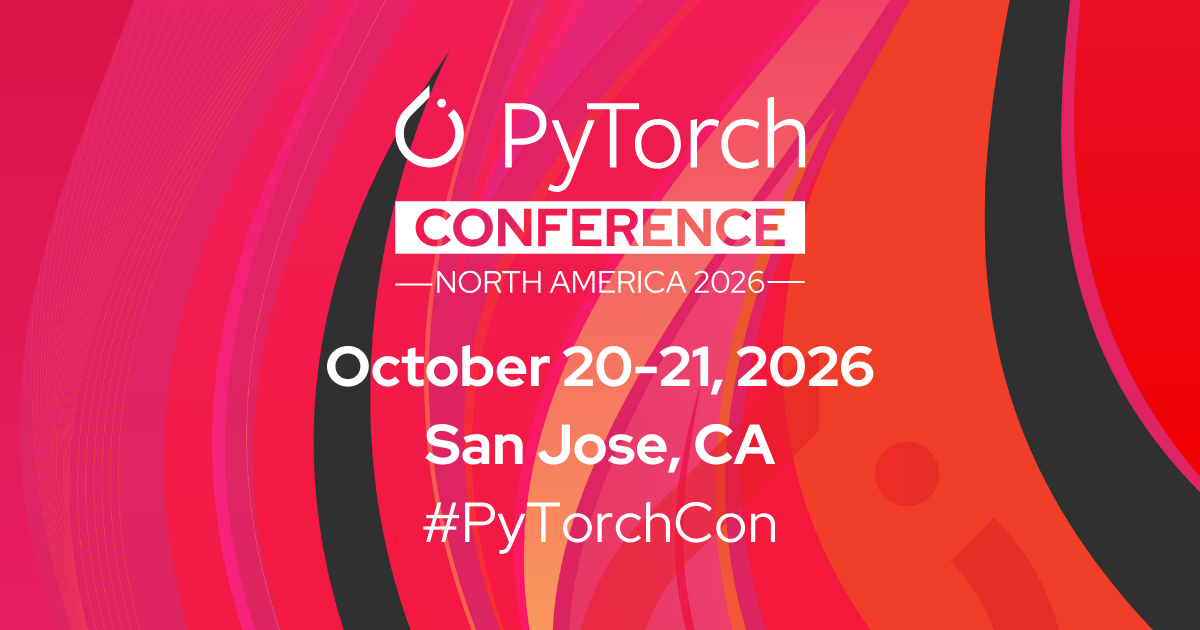
💡Preview PyTorch’s next priorities, including native Trainium support, before the 2026 conference.
⚡ 30-Second TL;DR
What Changed
PyTorch Conference North America 2026 will take place October 20–21 in San Jose, California.
Why It Matters
The announced sessions give PyTorch developers an early view of the conference’s technical priorities, including framework evolution and hardware acceleration. The Trainium focus may be particularly relevant to teams evaluating alternatives for large-scale model training and inference.
What To Do Next
Review the PyTorch Conference North America 2026 agenda and flag the PyTorch and Trainium sessions for your team’s training and inference roadmap.
Key Points
- •PyTorch Conference North America 2026 will take place October 20–21 in San Jose, California.
- •The keynote program includes sessions focused on the latest PyTorch updates.
- •A session will cover native PyTorch on Trainium.
🧠 Deep Insight
Background and context from public sources — not the original article. 29 sources cited.
🔑 Enhanced Key Takeaways
- •The PyTorch Conference North America 2026 is projected to attract over 3,000 in-person attendees.
- •The conference will feature 11 keynote speakers from prominent organizations such as Meta, Google Cloud, NVIDIA, Red Hat, Cohere, and the PyTorch Foundation.
- •Early registration for the event is available at $799, offering a $200 saving, with the deadline on September 4.
- •Beyond general updates and Trainium support, the conference agenda includes sessions on CUDAGraph observability, TorchDynamo-based debugging, multi-node foundation model training, compiler innovations, responsible AI, and various applications within the PyTorch ecosystem.
- •Native PyTorch support for AWS Trainium is facilitated by TorchNeuron, an open-source PyTorch backend that enables eager mode execution,
torch.compileintegration, and standard PyTorch native distributed APIs.
📊 Competitor Analysis▸ Show
| Feature/Aspect | PyTorch | TensorFlow | JAX |
|---|---|---|---|
| Primary Use Case | Research, fast iteration, production (growing) | MLOps, enterprise stability, edge/mobile deployment | Large-scale distributed training, high-performance research |
| Execution Model | Dynamic computation graphs (eager execution) with torch.compile for optimization | Static computation graphs (with Keras jit_compile=True for XLA) | Function transformations, automatic differentiation, native XLA compilation |
| Hardware Acceleration | Strong GPU support (NVIDIA, AMD ROCm, Apple Silicon), native Trainium support via TorchNeuron | Strong GPU support, TPUs (via XLA), TFLite for mobile/edge | Native TPU support (Google's custom ASICs), strong GPU support via XLA |
| Performance (General) | Often fastest for small-to-mid scale tasks, good VRAM efficiency | Competitive, consistent performance, good for structured pipelines | Can be slower due to compilation overhead on small tasks, but superior for massive-scale distributed training (128+ GPU clusters) |
| Ecosystem/Tooling | Rich ecosystem (TorchVision, TorchAudio, TorchText), PyTorch Lightning, Hugging Face Transformers | Comprehensive MLOps platform (TFX), TFLite/LiteRT for deployment, TF.js for web | Functional programming style, integrates with Flax for NN abstraction |
| Trainium Specific | Native PyTorch support via TorchNeuron, supports eager mode and torch.compile | N/A (Trainium is AWS-specific, TensorFlow primarily associated with Google Cloud TPUs) | N/A (Trainium is AWS-specific, JAX primarily associated with Google Cloud TPUs) |
| Price-Performance (Trainium) | AWS Trainium 2 claims 30-40% better price-performance vs. contemporary GPU-based instances (e.g., Nvidia A100/H100) | N/A | N/A |
🛠️ Technical Deep Dive
- AWS Trainium is a purpose-built Machine Learning accelerator, with Trainium 1 fabricated on a 7 nm process and Trainium 2 on a 5 nm process.
- Each Trainium 1 device incorporates two NeuronCore-v2 cores, capable of 420 INT8 TOPS, 190 FP16/BF16/cFP8/TF32 TFLOPS, and 47.5 FP32 TFLOPS.
- Trainium 1 devices are equipped with 32GB of device memory, offering 820 GB/sec of bandwidth, while Trainium 2 boasts 96GB HBM capacity and 2.9 TB/s bandwidth.
- NeuronLink-v2 serves as the proprietary device-to-device interconnect, facilitating efficient scale-out training and memory pooling across multiple Trainium devices.
- Trainium supports dynamic shapes and control flow through Instruction Set Architecture (ISA) extensions of NeuronCore-v2.
- TorchNeuron is the open-source PyTorch backend designed for native integration with AWS Trainium, providing support for eager mode,
torch.compile, and standard PyTorch native distributed APIs. - TorchNeuron also integrates with the Neuron Kernel Interface (NKI), allowing for the development, optimization, and execution of custom operators on Trainium hardware.
- PyTorch 2.0's
torch.compilefeature leverages several underlying technologies, including TorchDynamo (a Python-level Just-in-Time compiler), AOTAutograd, PrimTorch, and TorchInductor, to automatically optimize PyTorch code for enhanced performance.
🔮 Future ImplicationsAI analysis grounded in cited sources
torch.compile and hardware-specific optimizations will solidify PyTorch's performance leadership in the AI training landscape.⏳ Timeline
📎 Sources (29)
Factual claims are grounded in the sources below. Forward-looking analysis is AI-generated interpretation.
- linuxfoundation.org
- daily.dev
- vdura.com
- linuxfoundation.org
- futurumgroup.com
- readthedocs-hosted.com
- readthedocs-hosted.com
- apxml.com
- blackthorn-vision.com
- emergingai.pro
- arxiv.org
- newhorizons.com
- medium.com
- datacamp.com
- medium.com
- pytorch.org
- github.com
- tensorgym.com
- medium.com
- uncoveralpha.com
- readthedocs-hosted.com
- readthedocs-hosted.com
- mirrorfrog.com
- pytorch.org
- github.com
- wikipedia.org
- youtube.com
- pytorch.org
- pytorch.org
Weekly AI Recap
Read this week's curated digest of top AI events →
👉Related Updates
AI-curated news aggregator. All content rights belong to original publishers.
Original source: PyTorch Blog ↗
This is a summary, not the original. Read the source, or get the weekly briefing.
Weekly AI briefing
One email a week. Unsubscribe anytime.