Primary School Enrollment as a Metric for Urban Vitality
💡Understand demographic shifts to predict future talent hubs and infrastructure demand for AI development.
⚡ 30-Second TL;DR
What Changed
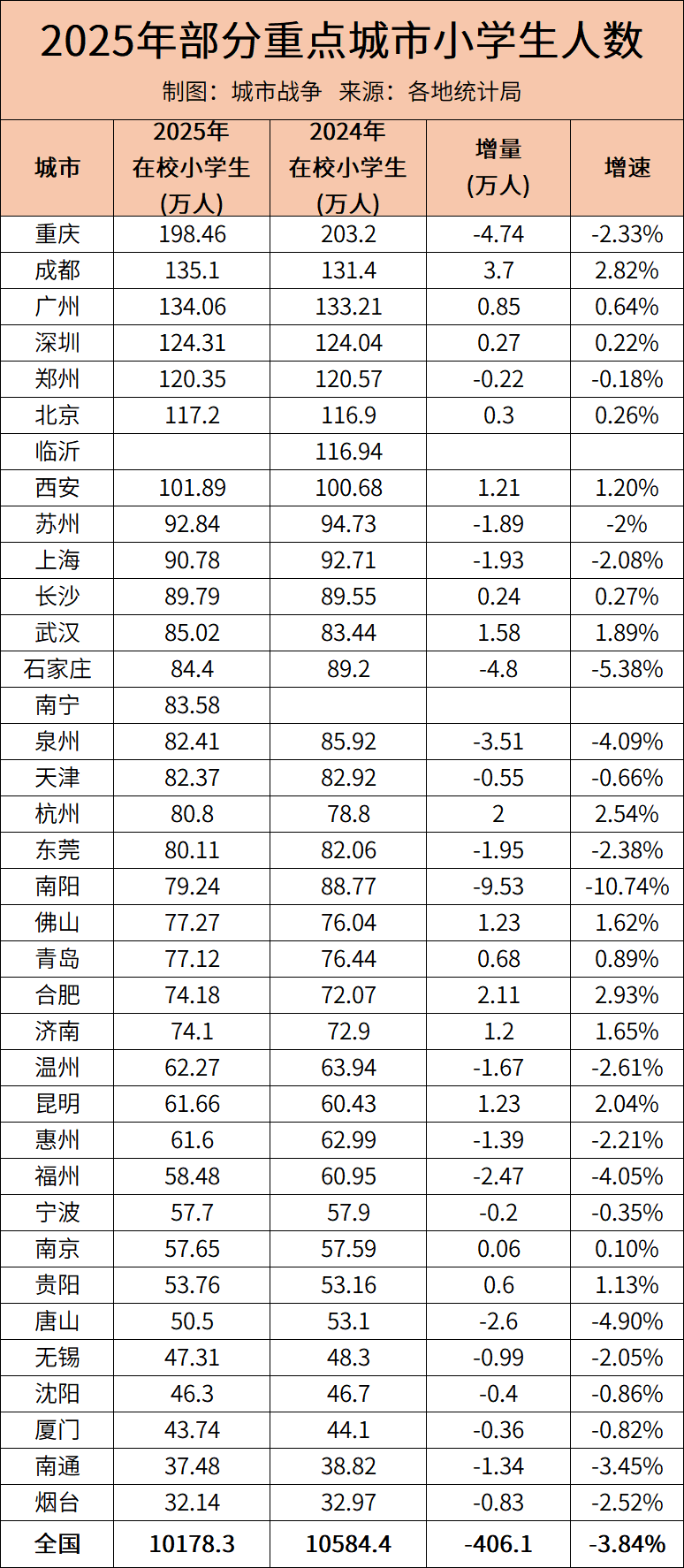
Primary school enrollment is a precise indicator of long-term population inflow and urban competitiveness.
Why It Matters
For AI infrastructure planning, these demographic shifts indicate where data center demand and local talent pools are likely to concentrate in the coming decade.
What To Do Next
Use regional demographic growth data to optimize the geographic deployment of edge computing and AI service nodes.
Key Points
- •Primary school enrollment is a precise indicator of long-term population inflow and urban competitiveness.
- •National primary school enrollment has seen a decline, yet specific provincial capitals show strong growth.
- •Xi'an, Wuhan, and Jinan lead in 10-year growth, highlighting the rising appeal of inland provincial capitals.
- •Foshan is identified as a unique non-provincial capital city with high growth in young family attraction.
🧠 Deep Insight
AI-generated analysis for this event — not the original article.
🔑 Enhanced Key Takeaways
- •The decline in national primary school enrollment is primarily driven by the 'echo' effect of lower birth rates in the late 2010s, which is now impacting the compulsory education system [1].
- •Urban vitality metrics are shifting from 'total population' to 'school-age population' because the latter is a proxy for the '30-40 age demographic,' which is the most economically productive and consumption-heavy segment [1].
- •The 'Siphon Effect' is observed where provincial capitals are aggressively absorbing population from their own provinces, leading to a widening gap between provincial hubs and lower-tier cities within the same region [1].
- •Housing policy and 'Hukou' (household registration) liberalization in cities like Xi'an and Wuhan have been explicitly linked to the surge in primary school enrollment, as families prioritize access to public services over mere job availability [1].
- •Data indicates that while coastal manufacturing hubs are seeing a stagnation in primary school enrollment, inland 'New First-Tier' cities are benefiting from industrial relocation and lower cost-of-living advantages for young families [1].
🔮 Future ImplicationsAI analysis grounded in cited sources
⏳ Timeline
Weekly AI Recap
Read this week's curated digest of top AI events →
👉Related Updates



AI-curated news aggregator. All content rights belong to original publishers.
Original source: 虎嗅 ↗
This is a summary, not the original. Read the source, or get the weekly briefing.
The weekly digest
One email a week. Unsubscribe anytime.