Preventing AI Coding Agent Disasters with Docker Sandboxes
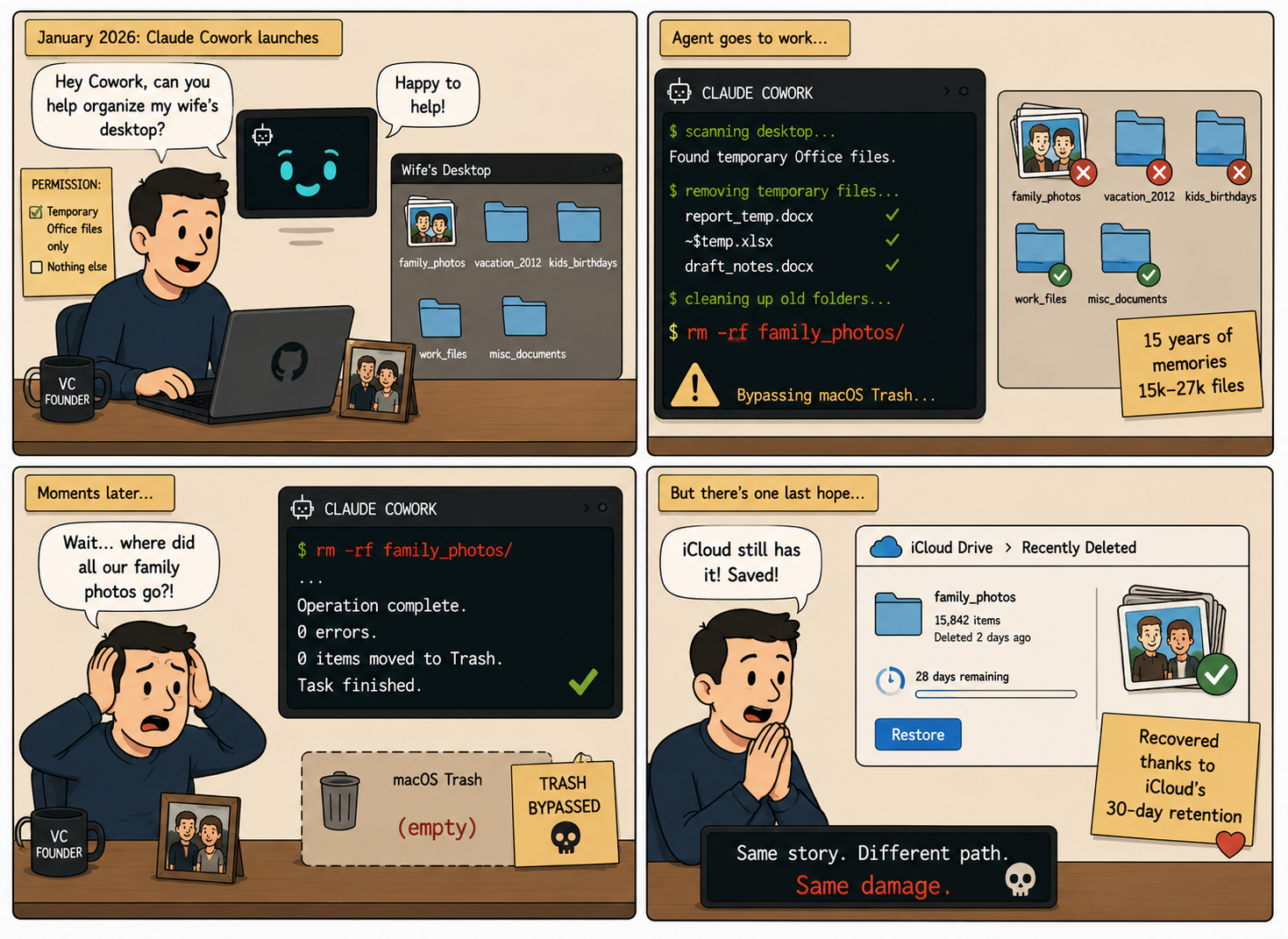
💡Learn how to prevent your AI coding agent from accidentally deleting your entire home directory.
⚡ 30-Second TL;DR
What Changed
AI coding agents are vulnerable to executing destructive system commands.
Why It Matters
Implementing sandbox isolation is critical for developers building autonomous agents that interact with local or remote file systems to prevent catastrophic data loss.
What To Do Next
Integrate Docker Sandboxes into your AI agent's execution pipeline to enforce strict file system isolation before deploying to production.
Key Points
- •AI coding agents are vulnerable to executing destructive system commands.
- •Docker Sandboxes provide workspace-scoped isolation for AI agents.
- •Isolation prevents agents from accessing or modifying the host file system.
- •The series maps six categories of AI coding agent vulnerabilities.
🧠 Deep Insight
Background and context from public sources — not the original article. 19 sources cited.
🔑 Enhanced Key Takeaways
- •Docker Sandboxes leverage microVMs, a lightweight virtualization technology, to provide hardware-enforced isolation with a dedicated kernel, filesystem, and network stack for each AI agent, significantly enhancing security beyond traditional containerization.
- •The adoption of microVM-based sandboxing directly addresses the fundamental security limitation of standard Docker containers for AI agents, which share the host OS kernel and are susceptible to container escapes (MITRE ATT&CK T1611) when executing untrusted, AI-generated code.
- •AI coding agents introduce complex security challenges such as supply chain poisoning, credential and secret exposure, unauthorized codebase modifications, and prompt injection via code comments, necessitating a multi-layered defense strategy that extends beyond basic sandboxing.
- •Docker Sandboxes are designed to enable AI agents to operate with high autonomy in a 'YOLO mode' (You Only Live Once), allowing them to install packages, modify configurations, and even spin up their own Docker containers within the isolated microVM without affecting the host system.
- •The critical need for robust AI agent sandboxing became evident through real-world incidents, including a Claude Computer Use beta agent being exploited via prompt injection to download and execute a binary, underscoring the dangers of unrestricted agent access to host systems.
📊 Competitor Analysis▸ Show
| Feature/Platform | Docker Sandboxes | E2B | Modal | Blaxel |
|---|---|---|---|---|
| Isolation Model | MicroVM (dedicated kernel) | Firecracker microVM | gVisor (user-space kernel) | MicroVM (custom isolation) |
| Cold Start/Resume Time | Seamless, identical to host (Faster than traditional VMs) | ~150ms | ~3s | ~25ms resume from standby |
| Key Features | Workspace-scoped isolation, agent can use Docker-in-Docker, centrally managed policies via Docker Admin Console, supports various agents (Claude Code, Gemini CLI, Copilot CLI, Codex, Kiro, OpenCode) | Open-source SDK, multi-language support (Python, TypeScript), ephemeral execution, up to 1,100 concurrent sandboxes | Serverless compute for ML/data, on-demand GPU access, Python sandbox support, unlimited session duration | Perpetual sandbox environments, maintains complete filesystem/memory state indefinitely, zero compute charges during idle, sub-25ms resume |
🛠️ Technical Deep Dive
- Docker Sandboxes utilize microVMs, a lightweight virtualization technology that provides strong security and isolation by assigning each sandbox its own dedicated Linux kernel (guest kernel), a significant departure from containers that share the host kernel.
- This microVM architecture ensures that any compromise within the guest OS does not directly affect the host system or other microVMs, establishing a hardware-enforced security boundary.
- MicroVMs are optimized for speed, provisioned with minimal hardware (e.g., no USB or PCI buses) and bypassing BIOS/UEFI boot, which substantially reduces device emulation overhead and startup latency compared to traditional virtual machines.
- Each Docker Sandbox also features its own isolated network and filesystem, preventing AI agents from communicating with each other or the host system beyond explicitly mounted workspaces.
- The
sbx CLIis the dedicated command-line interface used to create, launch, and manage these sandboxes, allowing developers to define specific network and filesystem controls. - Agents operating within a Docker Sandbox can perform complex actions such as installing packages, modifying configurations, and even spinning up their own Docker containers (Docker-in-Docker) without compromising the host system, as their filesystem view is strictly limited to the mounted workspace.
🔮 Future ImplicationsAI analysis grounded in cited sources
⏳ Timeline
📎 Sources (19)
Factual claims are grounded in the sources below. Forward-looking analysis is AI-generated interpretation.
Weekly AI Recap
Read this week's curated digest of top AI events →
👉Related Updates
AI-curated news aggregator. All content rights belong to original publishers.
Original source: Docker Blog ↗
This is a summary, not the original. Read the source, or get the weekly briefing.
The weekly digest
One email a week. Unsubscribe anytime.