Pingora 0.8.0 Fixes Request Smuggling Vulns
💡Essential security patch for Pingora OSS – protects AI service proxies from smuggling.
⚡ 30-Second TL;DR
What Changed
Discloses request smuggling bugs in Pingora OSS ingress proxy deployments
Why It Matters
Prevents potential request hijacking in proxy setups, critical for secure web services including AI inference endpoints. OSS users gain immediate protection via update. Reduces exposure for high-traffic deployments.
What To Do Next
Upgrade Pingora to 0.8.0 in your ingress proxy setup to block smuggling attacks.
Key Points
- •Discloses request smuggling bugs in Pingora OSS ingress proxy deployments
- •Vulnerabilities fully fixed in Pingora version 0.8.0
- •Specifically impacts open-source service configurations
🧠 Deep Insight
Background and context from public sources — not the original article. 10 sources cited.
🔑 Enhanced Key Takeaways
- •Vulnerabilities assigned CVE-2025-4366, CVE-2026-2833, and CVE-2026-2835, with CVE-2026-2835 rated critical at CVSS 9.3[1][2][4][6].
- •CVE-2025-4366 caused by failure to drain request body on cache hits, enabling smuggling via undrained buffer on persistent connections[1][3][5].
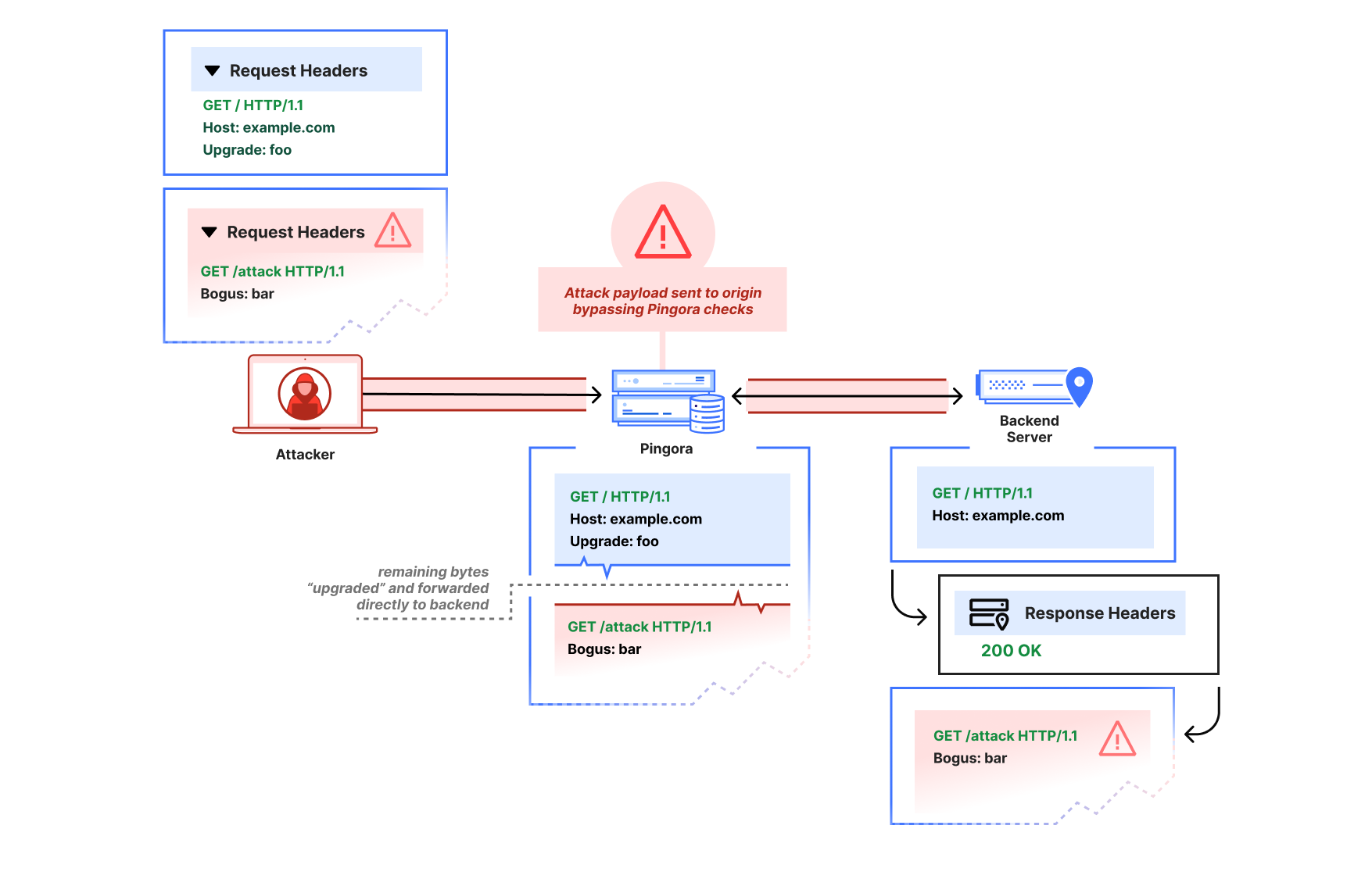
- •CVE-2026-2833 triggered by premature passthrough of bytes after Upgrade header before backend acceptance, allowing payload smuggling[2][8].
- •CVE-2026-2835 from misparsing HTTP/1.0 close-delimited bodies and multiple Transfer-Encoding headers, desyncing with backends[4][6].
- •Cloudflare's production CDN unaffected due to strict HTTP/1.1 parsing and rejection of ambiguous requests[2][3][4].
🛠️ Technical Deep Dive
- •CVE-2025-4366: On cache hit, pingora-cache serves response without draining full request body per Content-Length, leaving smuggled request (e.g., 'GET / HTTP/1.1\r\nHost: attacker.example.com') in buffer for next request on HTTP/1.1 connection[1][3].
- •CVE-2026-2833: Proxy reads Upgrade header, forwards remaining bytes to backend pre-acceptance, enabling attacker payload interpreted as subsequent request, bypassing WAF/ACL[2].
- •CVE-2026-2835: Allows HTTP/1.0 bodies close-delimited (violates RFC 9112), mishandles multiple Transfer-Encoding headers, causing framing desync with backends accepting HTTP/1.0[4].
- •Fixes in v0.8.0 enforce RFC 9112 message length parsing, drain bodies fully, reject invalid Content-Length/Transfer-Encoding, and handle upgrades correctly[2][3][4].
🔮 Future ImplicationsAI analysis grounded in cited sources
⏳ Timeline
📎 Sources (10)
Factual claims are grounded in the sources below. Forward-looking analysis is AI-generated interpretation.
- zeropath.com — Cve 2025 4366 Pingora Request Smuggling
- nvd.nist.gov — Cve 2026 2833
- blog.cloudflare.com — Resolving a Request Smuggling Vulnerability in Pingora
- nvd.nist.gov — Cve 2026 2835
- GitHub — Ghsa 93c7 7xqw W357
- research.averlon.ai — Cve 2026 2835
- miggo.io — Cve 2026 2835
- radar.offseq.com — Cve 2026 2833 Cwe 444 Inconsistent Interpretation C3ebdcf0
- app.opencve.io — Cve
- GitHub — Ghsa Xq2h P299 Vjwv
Weekly AI Recap
Read this week's curated digest of top AI events →
👉Related Updates

AI-curated news aggregator. All content rights belong to original publishers.
Original source: Cloudflare Blog ↗
This is a summary, not the original. Read the source, or get the weekly briefing.
Weekly AI briefing
One email a week. Unsubscribe anytime.