Phone Giants Lose Robot Talents to Startups
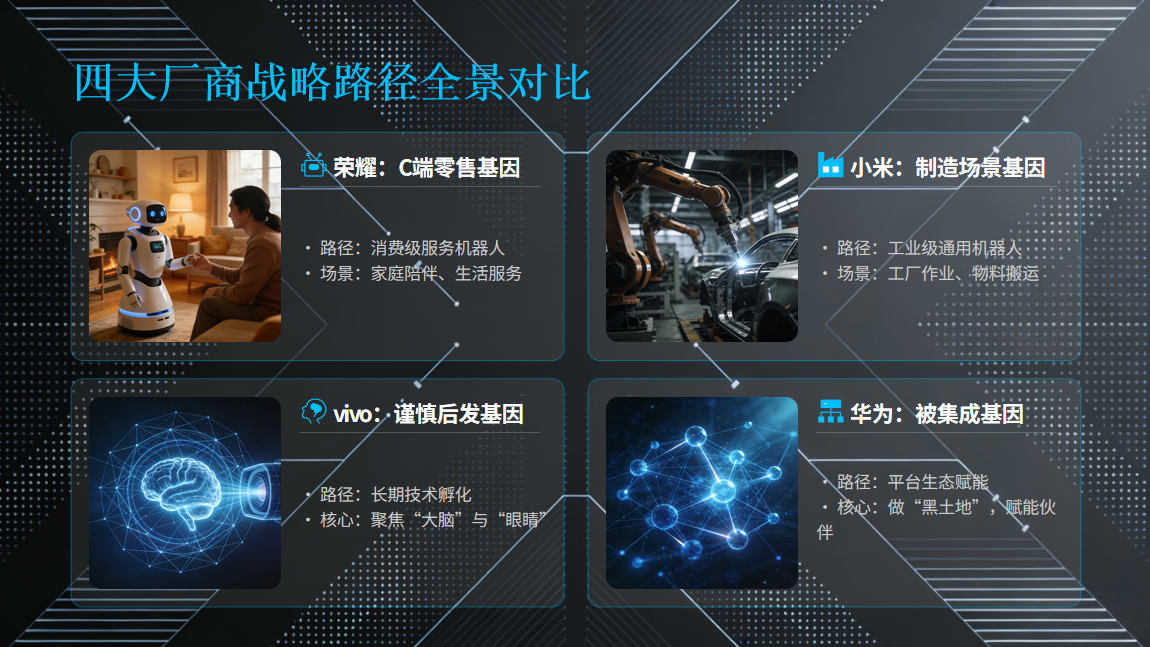
💡Why phone giants fail at robots: org traps + talent flight
⚡ 30-Second TL;DR
What Changed
Phone makers enter robotics post-MWC 2026
Why It Matters
Underscores robotics talent wars; big firms' structures hinder retention, boosting startup agility.
What To Do Next
Track Peng Zhihui's new startup for embodied AI hiring opportunities.
Key Points
- •Phone makers enter robotics post-MWC 2026
- •Org genes dictate divergent robot strategies
- •Talents Peng Zhihui, Qiao Zhongliang exit to startups
🧠 Deep Insight
Background and context from public sources — not the original article. 7 sources cited.
🔑 Enhanced Key Takeaways
- •Chinese robotics startups are attracting top talent from phone giants like Xiaomi and Huawei, with Peng Zhihui joining a new firm focused on consumer robots after leading Xiaomi's CyberDog project.[4]
- •UBTech Robotics launched the Walker S2 industrial humanoid in early 2026 for smart manufacturing, positioning itself as a key startup beneficiary of talent migration.[4]
- •Nvidia unveiled the Isaac GR00T N1 foundation model and Jetson T4000 at CES 2026, fueling the AI-robotics convergence that startups leverage for rapid prototyping.[2]
- •Boston Dynamics deployed production-ready Atlas humanoid robots at Hyundai's Georgia plant in 2026, powered by Google DeepMind models, intensifying competition for expert engineers.[2]
- •Global industrial robot installations hit $16.7 billion in 2025 per International Federation of Robotics, driving post-MWC 2026 talent scramble amid policy-driven reshoring.[2]
🛠️ Technical Deep Dive
- •Boston Dynamics Atlas: 56 degrees of freedom, 110-pound lift capacity, powered by Google DeepMind Gemini models for deployment in factories.[2]
- •Nvidia Jetson T4000: Blackwell-powered module with 4x energy efficiency improvement for edge AI in robotics.[2]
- •Nvidia Isaac GR00T N1: Open foundation model for robotics, paired with Newton physics engine co-developed with Google DeepMind and Disney Research.[2]
- •UBTech Walker S2: Next-generation industrial humanoid for manufacturing, logistics, and factory automation.[4]
- •Tesla Optimus challenges: Developing human-capable robotic hand/forearm and supply chain for 10,000+ unique components.[4]
🔮 Future ImplicationsAI analysis grounded in cited sources
⏳ Timeline
📎 Sources (7)
Factual claims are grounded in the sources below. Forward-looking analysis is AI-generated interpretation.
- intellectia.ai — Best Robotic Stock 2026
- zacks.com — Top Robotics Stocks Worth Investing Now for Solid Returns
- cmcmarkets.com — Outlook 2026 Three Robotics Stocks Powering Ahead
- themesetfs.com — 3 Exciting Humanoid Robot Stocks to Watch in 2026
- youtube.com — Watch
- therobotreport.com — Therobotreport2026 Outlook
- 247wallst.com — 5 AI and Robotics Etfs for 2026s Investment Supercycle
Weekly AI Recap
Read this week's curated digest of top AI events →
👉Related Updates


AI-curated news aggregator. All content rights belong to original publishers.
Original source: 钛媒体 ↗
This is a summary, not the original. Read the source, or get the weekly briefing.
Weekly AI briefing
One email a week. Unsubscribe anytime.