Perseverance Drives Mostly Autonomously on Mars
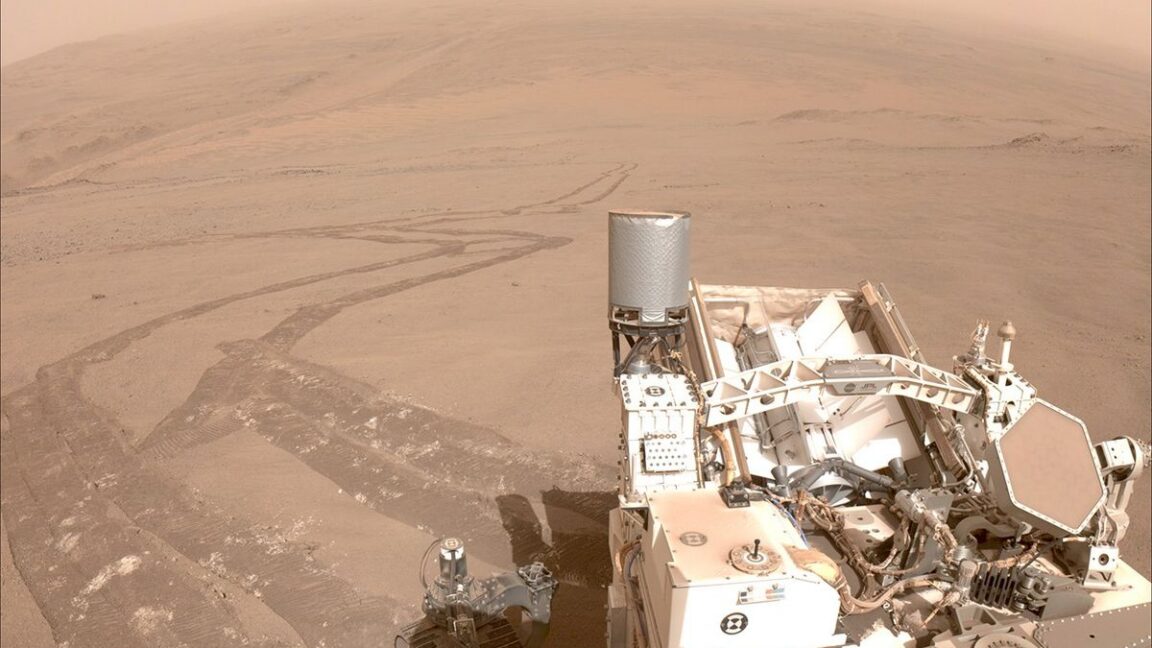
Perseverance’s 90% autonomous driving rate shows embodied AI working beyond Earth.
30-Second TL;DR
What Changed
Perseverance is described as the first self-driving vehicle operating on Mars.
Why It Matters
The result highlights how autonomous navigation can reduce reliance on constant human control in environments with severe communication delays. It also offers a useful reference point for developers building robust embodied-AI systems for robots operating in uncertain terrain.
What To Do Next
Benchmark your robot-navigation stack by measuring what percentage of missions can run autonomously under delayed communication and changing terrain conditions.
Key Points
- •Perseverance is described as the first self-driving vehicle operating on Mars.
- •Approximately 90% of its total driven distance has been autonomous.
- •The result represents a successful deployment of autonomous mobility in a remote planetary environment.
Deep Insight
AI-generated analysis for this event — not the original article.
Enhanced Key Takeaways
- •Perseverance utilizes the AutoNav (Autonomous Navigation) system, which creates a 3D map of the terrain ahead to calculate safe paths without human intervention.
- •The rover's onboard computer, the Rover Compute Element (RCE), features a dedicated vision processor that accelerates image processing to enable real-time hazard detection.
- •Unlike previous rovers like Curiosity, Perseverance can process navigation images while simultaneously driving, significantly increasing its daily traverse distance.
- •The autonomous system is specifically designed to navigate complex, rock-strewn terrain in the Jezero Crater, which was previously considered too hazardous for manual-only driving.
- •NASA engineers have successfully integrated 'thinking while driving' capabilities, allowing the rover to update its path dynamically if it detects new obstacles mid-traverse.
Technical Deep Dive
- AutoNav System: Employs a stereo vision-based navigation algorithm that identifies obstacles and calculates traversability costs in real-time.
- Hardware Acceleration: Uses a dedicated FPGA-based vision processing unit to offload compute-intensive image processing tasks from the main RAD750 processor.
- Path Planning: Implements a 'thinking while driving' architecture where the rover continuously updates its local cost map as it moves, allowing for seamless path adjustments.
- Terrain Assessment: Utilizes hazard detection software that classifies terrain as safe, risky, or impassable based on slope, rock size, and soil stability.
Future ImplicationsAI analysis grounded in cited sources
Timeline
- 2021-02Perseverance rover successfully lands in Jezero Crater.
- 2021-07Initial testing of AutoNav capabilities begins during the rover's first science campaign.
- 2022-06Perseverance sets a new single-day Mars driving record using enhanced autonomous navigation.
- 2024-04NASA reports significant efficiency gains in traverse speed due to software updates for the AutoNav system.
Weekly AI Recap
Read this week's curated digest of top AI events →
AI-curated news aggregator. All content rights belong to original publishers.
Original source: Ars Technica ↗
This is a summary, not the original. Read the source, or get the weekly briefing.
The weekly digest
One email a week. Unsubscribe anytime.