Perplexity introduces Brain Memory System for personalized knowledge
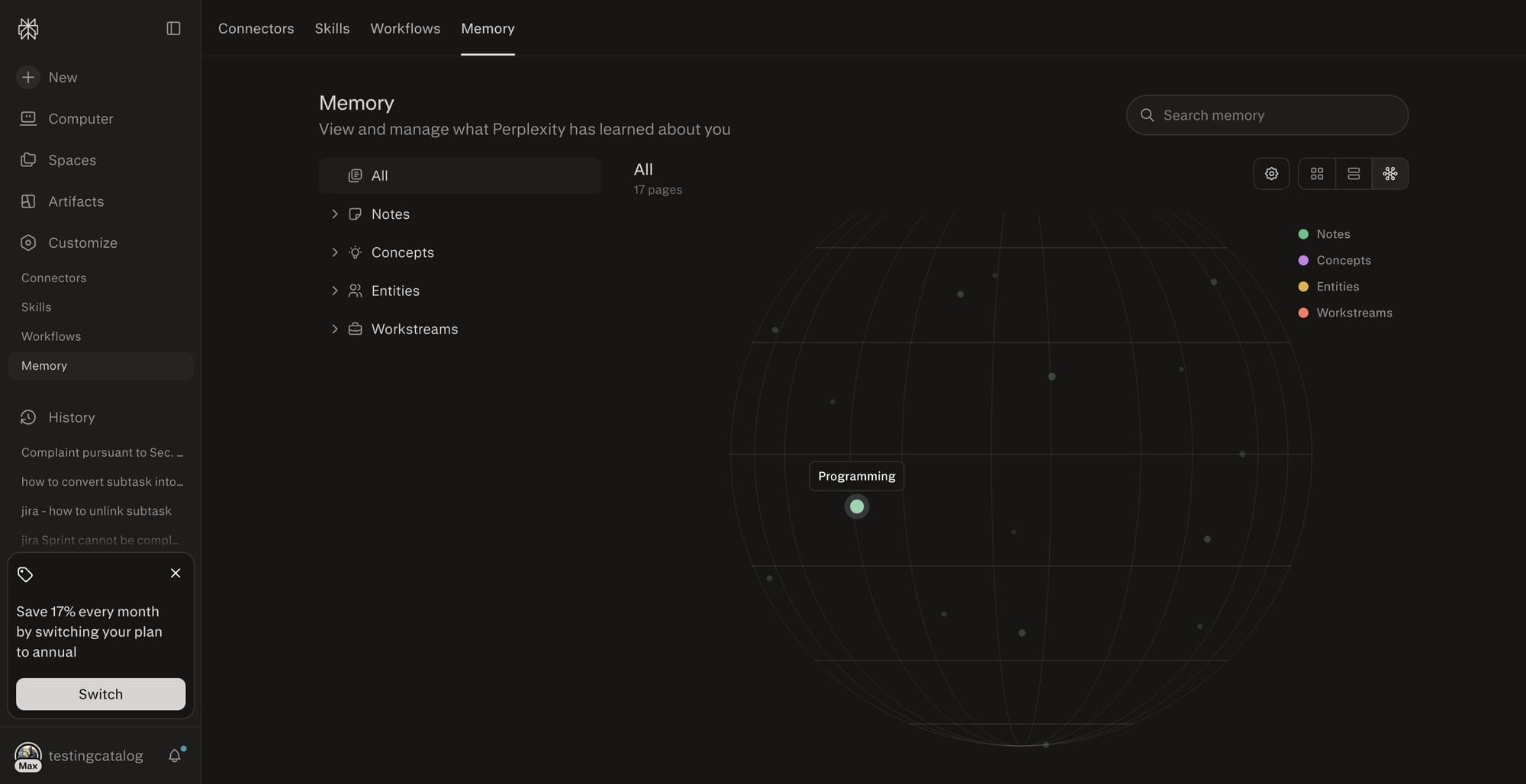
💡See how Perplexity is evolving from a search engine into a persistent, memory-enabled knowledge workspace.
⚡ 30-Second TL;DR
What Changed
Introduces a shared memory system named Brain
Why It Matters
This feature enhances the utility of Perplexity as a long-term research assistant by allowing the model to retain and structure user-specific information over time.
What To Do Next
Explore the Brain interface in your Perplexity Computer dashboard to categorize your current research projects.
Key Points
- •Introduces a shared memory system named Brain
- •Features categorized topics and detailed context management
- •Includes a 3D map interface for browsing stored knowledge
🧠 Deep Insight
AI-generated analysis for this event — not the original article.
🔑 Enhanced Key Takeaways
- •The Brain memory system utilizes a vector database architecture to enable semantic retrieval across disparate user-saved threads and documents.
- •Perplexity has integrated 'Brain' with its Pro search API, allowing the model to prioritize user-specific context over general web results when enabled.
- •The 3D visualization map is powered by a WebGL-based graph engine that maps relationships between entities, concepts, and source URLs.
- •Privacy controls allow users to toggle 'Brain' memory on or off per-session, ensuring that specific queries can be excluded from the long-term knowledge graph.
- •The system supports cross-platform synchronization, meaning memory stored on the Computer platform is immediately accessible via the Perplexity mobile application.
📊 Competitor Analysis▸ Show
| Feature | Perplexity Brain | OpenAI Memory | Google NotebookLM |
|---|---|---|---|
| Core Focus | Knowledge Graph/3D Map | Persistent User Context | Document Synthesis |
| Pricing | Pro Subscription | Plus/Team/Enterprise | Free/Gemini Advanced |
| Benchmarks | High (Contextual Recall) | High (Personalization) | High (Source Grounding) |
🛠️ Technical Deep Dive
- Architecture: Employs a RAG (Retrieval-Augmented Generation) pipeline that indexes user-provided content into a private vector store.
- Embedding Model: Utilizes a proprietary fine-tuned embedding model optimized for multi-hop reasoning across user-defined categories.
- Data Handling: Implements AES-256 encryption for stored memory snippets and provides granular deletion controls for individual data points.
- Interface: The 3D map utilizes a force-directed graph algorithm to visualize node connectivity based on semantic similarity scores.
🔮 Future ImplicationsAI analysis grounded in cited sources
⏳ Timeline
Weekly AI Recap
Read this week's curated digest of top AI events →
👉Related Updates
AI-curated news aggregator. All content rights belong to original publishers.
Original source: TestingCatalog ↗
This is a summary, not the original. Read the source, or get the weekly briefing.
Weekly AI briefing
One email a week. Unsubscribe anytime.