PDI Brew Turns Prompts into Apps
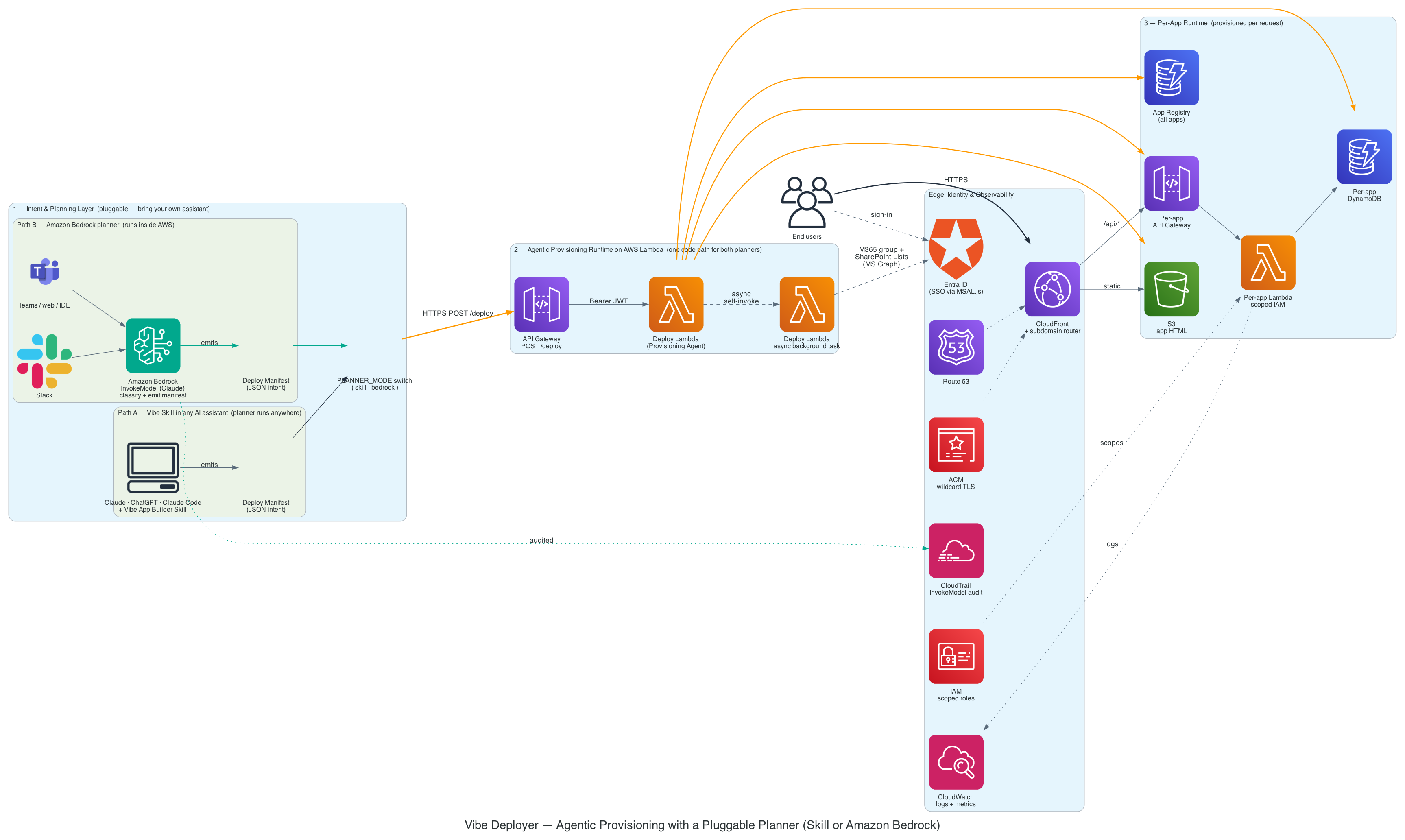
See how PDI converts plain-English intent into governed, multi-tenant apps in seconds.
30-Second TL;DR
What Changed
Converts plain-English descriptions into fully provisioned multi-tenant web applications
Why It Matters
PDI Brew illustrates how agentic systems can reduce the barrier to internal software creation while preserving centralized governance. The architecture may help enterprises safely scale custom tools beyond traditional developer capacity.
What To Do Next
Prototype a planner-plus-Lambda provisioning flow on Amazon Bedrock for one internal tool, adding tenant isolation and approval gates before deployment.
Key Points
- •Converts plain-English descriptions into fully provisioned multi-tenant web applications
- •Uses a pluggable planner to coordinate application-generation and deployment steps
- •Employs an AWS Lambda provisioning agent with governance controls and Bedrock-backed intelligence
Deep Insight
AI-generated analysis for this event — not the original article.
Enhanced Key Takeaways
- •PDI Brew is specifically designed to address the 'last-mile' automation needs of convenience retail and petroleum wholesale operations, moving beyond generic enterprise app generation.
- •The platform utilizes a RAG (Retrieval-Augmented Generation) architecture to ensure that generated applications adhere to PDI's internal data schemas and security compliance standards.
- •PDI Brew integrates with PDI's existing ERP and loyalty data ecosystems, allowing the generated apps to perform read/write operations on live business data rather than just creating static interfaces.
- •The 'pluggable planner' architecture allows PDI engineers to swap out underlying LLM providers or fine-tuned models without requiring a rewrite of the application provisioning logic.
- •The system includes a built-in 'human-in-the-loop' approval workflow that triggers automatically if the generated application requests access to sensitive PII or financial data.
Competitor Analysis
- PDI Brew
- Convenience/Retail Domain
- Microsoft Power Apps (Copilot)
- General Enterprise
- Retool AI
- Developers/Internal Tools
- PDI Brew
- Seconds (Automated)
- Microsoft Power Apps (Copilot)
- Minutes (Guided)
- Retool AI
- Minutes (Manual/Low-Code)
- PDI Brew
- High (PDI Ecosystem)
- Microsoft Power Apps (Copilot)
- Low (General Purpose)
- Retool AI
- Medium (General Purpose)
- PDI Brew
- Enterprise/Usage-based
- Microsoft Power Apps (Copilot)
- Per User/License
- Retool AI
- Per User/Usage
| Feature | PDI Brew | Microsoft Power Apps (Copilot) | Retool AI |
|---|---|---|---|
| Target Audience | Convenience/Retail Domain | General Enterprise | Developers/Internal Tools |
| Provisioning Speed | Seconds (Automated) | Minutes (Guided) | Minutes (Manual/Low-Code) |
| Domain Specificity | High (PDI Ecosystem) | Low (General Purpose) | Medium (General Purpose) |
| Pricing Model | Enterprise/Usage-based | Per User/License | Per User/Usage |
Technical Deep Dive
- Architecture: Utilizes a multi-agent orchestration layer where the Planner agent decomposes user intent into a Directed Acyclic Graph (DAG) of tasks.
- Provisioning: AWS Lambda functions act as the execution engine, dynamically spinning up containerized frontend/backend stacks on AWS Fargate.
- Model Integration: Leverages Amazon Bedrock APIs, specifically utilizing Claude 3.5 Sonnet for complex reasoning and code generation tasks.
- Governance: Implements an OPA (Open Policy Agent) sidecar within the provisioning pipeline to enforce RBAC and data access policies before deployment.
- Multi-tenancy: Uses a database-per-tenant or schema-per-tenant isolation model depending on the complexity of the generated application.
Future ImplicationsAI analysis grounded in cited sources
Timeline
- 2024-05PDI Technologies initiates internal pilot for generative AI-driven operational tools.
- 2025-02PDI integrates Amazon Bedrock into its core cloud infrastructure to support agentic workflows.
- 2026-05PDI Brew enters limited beta testing with select enterprise retail partners.
- 2026-07Official launch of PDI Brew on AWS, enabling automated app provisioning for the broader PDI customer base.
Weekly AI Recap
Read this week's curated digest of top AI events →
Related Updates

AI-curated news aggregator. All content rights belong to original publishers.
Original source: AWS Machine Learning Blog ↗
This is a summary, not the original. Read the source, or get the weekly briefing.
The weekly digest
One email a week. Unsubscribe anytime.