Overcoming perfectionism to compete with Chinese humanoids
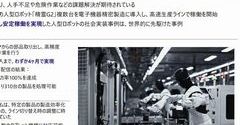
💡Understand the strategic shift in the humanoid robotics race and why open-source models are the new competitive edge.
⚡ 30-Second TL;DR
What Changed
Chinese players are leveraging open-source models for rapid deployment
Why It Matters
The shift toward open-source control models in robotics is lowering barriers to entry and accelerating the global humanoid race.
What To Do Next
Review current open-source humanoid control stacks like those used by Chinese developers to benchmark your own robotics software.
Key Points
- •Chinese players are leveraging open-source models for rapid deployment
- •The gap in embodied AI is shifting from hardware to autonomous control models
- •Japanese firms need a new survival strategy to counter speed-focused competition
🧠 Deep Insight
AI-generated analysis for this event — not the original article.
🔑 Enhanced Key Takeaways
- •The Chinese government's 'Humanoid Robot Innovation and Development Guidance' explicitly targets mass production by 2025, providing state-backed subsidies that accelerate commercialization cycles.
- •Chinese humanoid startups are increasingly adopting 'Sim-to-Real' reinforcement learning pipelines, allowing them to train agents in massive parallel simulations before deploying to physical hardware.
- •Japanese robotics firms are shifting focus toward 'Modular Robotics' and high-reliability actuators to differentiate from the lower-cost, high-volume approach favored by Chinese manufacturers.
- •Supply chain integration in the Pearl River Delta allows Chinese humanoid firms to iterate on hardware prototypes in weeks, compared to the months-long development cycles typical of traditional Japanese manufacturing.
- •Recent industry data indicates that Chinese humanoid firms are prioritizing 'General Purpose' foundation models that can be fine-tuned for specific industrial tasks, bypassing the need for bespoke programming for every new environment.
📊 Competitor Analysis▸ Show
| Feature | Chinese Humanoid Players (e.g., Unitree, Fourier) | Japanese Humanoid Players (e.g., Toyota, Kawasaki) |
|---|---|---|
| Development Philosophy | Agile, iterative, 'fail-fast' | Perfectionist, high-reliability, safety-first |
| Pricing Strategy | Aggressive (sub-$20k targets) | Premium (enterprise-grade, high CAPEX) |
| Core Advantage | Rapid software deployment/AI integration | Mechanical precision and durability |
| Market Focus | Mass-market industrial/consumer | Specialized manufacturing/healthcare |
🛠️ Technical Deep Dive
- Utilization of Transformer-based architectures for embodied AI, enabling cross-modal learning from vision, language, and tactile sensors.
- Implementation of Whole-Body Control (WBC) algorithms that allow for dynamic balancing and complex locomotion on uneven terrain.
- Integration of proprietary high-torque density actuators that reduce the weight-to-power ratio, critical for extended battery life in humanoid forms.
- Adoption of ROS 2 (Robot Operating System) as the standard middleware to facilitate rapid integration of third-party AI models and sensor suites.
🔮 Future ImplicationsAI analysis grounded in cited sources
⏳ Timeline
Weekly AI Recap
Read this week's curated digest of top AI events →
👉Related Updates


AI-curated news aggregator. All content rights belong to original publishers.
Original source: ITmedia AI+ (日本) ↗
This is a summary, not the original. Read the source, or get the weekly briefing.
Weekly AI briefing
One email a week. Unsubscribe anytime.