Orbital data centers may blind Earth’s largest telescopes
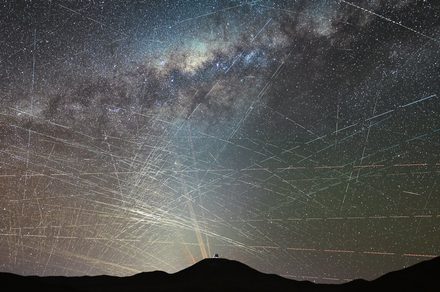
💡Space-based compute is booming, but regulatory pushback from the scientific community could impact future deployments.
⚡ 30-Second TL;DR
What Changed
Satellite constellations create significant light pollution for ground-based telescopes.
Why It Matters
This highlights a growing conflict between the expansion of space-based compute infrastructure and scientific research. Practitioners should monitor potential regulatory shifts in orbital space usage.
What To Do Next
Evaluate the environmental impact of your space-based compute projects and review current ITU guidelines on satellite frequency coordination.
Key Points
- •Satellite constellations create significant light pollution for ground-based telescopes.
- •The European Southern Observatory is pushing for new international limits on orbital infrastructure.
- •Orbital data centers could exacerbate radio frequency interference with sensitive astronomical equipment.
🧠 Deep Insight
AI-generated analysis for this event — not the original article.
🔑 Enhanced Key Takeaways
- •Orbital data centers utilize high-bandwidth laser communication terminals (optical inter-satellite links) which can create stray light beams that are difficult for telescopes to filter out.
- •The International Astronomical Union (IAU) has established the Centre for the Protection of the Dark and Quiet Sky from Satellite Constellation Interference (CPS) to coordinate global policy responses.
- •Beyond light pollution, the thermal emission from large-scale orbital data centers could potentially interfere with infrared astronomy, which relies on detecting faint heat signatures from deep space.
- •Regulatory bodies like the ITU (International Telecommunication Union) are currently debating whether orbital data centers should be classified under existing space debris or telecommunications frameworks.
- •Recent studies suggest that the cumulative effect of 'space-based computing' could increase the brightness of the night sky by up to 10% in certain regions, impacting long-exposure deep-field imaging.
🛠️ Technical Deep Dive
- Orbital data centers rely on edge computing architectures designed to process data in situ to reduce latency for Earth-based users.
- Implementation involves high-power cooling systems (often liquid-to-space radiators) that increase the satellite's cross-sectional area and albedo.
- Radio frequency interference (RFI) is exacerbated by the use of wide-band phased array antennas required for high-speed data downlinks.
- Optical inter-satellite links (OISLs) operate in the near-infrared spectrum, which overlaps with the observation bands of major ground-based observatories like the VLT and ELT.
🔮 Future ImplicationsAI analysis grounded in cited sources
⏳ Timeline
Weekly AI Recap
Read this week's curated digest of top AI events →
👉Related Updates
AI-curated news aggregator. All content rights belong to original publishers.
Original source: Digital Trends ↗
This is a summary, not the original. Read the source, or get the weekly briefing.
Weekly AI briefing
One email a week. Unsubscribe anytime.