Oracle Unifies AI Data Stack for Agentic Consistency
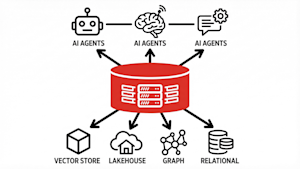
💡End data staleness in agentic AI: Oracle's unified ACID engine handles all formats seamlessly
⚡ 30-Second TL;DR
What Changed
Unified Memory Core: ACID engine for multi-format data (vector, JSON, graph, etc.)
Why It Matters
Provides enterprises a single source of truth for agentic AI, reducing failure points from data staleness. Shifts architecture from specialized stacks to converged databases, easing production deployment. Positions Oracle as key infrastructure for scalable AI agents.
What To Do Next
Explore Unified Memory Core in Oracle AI Database trial to unify your agent data sources.
Key Points
- •Unified Memory Core: ACID engine for multi-format data (vector, JSON, graph, etc.)
- •Vectors on Ice: Native vector indexing on Apache Iceberg tables
- •Autonomous AI Vector Database and MCP Server for direct agent access
- •Eliminates sync pipelines to prevent stale context in production
- •Supports 97% of Fortune Global 100 transaction systems
🧠 Deep Insight
AI-generated analysis for this event — not the original article.
🔑 Enhanced Key Takeaways
- •The Unified Memory Core leverages Oracle's existing 'Converged Database' architecture, extending its multi-model capabilities to handle high-dimensional vector embeddings with the same transactional consistency as traditional relational data.
- •The integration of the Model Context Protocol (MCP) server directly into the database layer allows agentic frameworks like LangChain or LlamaIndex to query enterprise data without requiring custom middleware or API wrappers.
- •Oracle's approach specifically targets the 'data gravity' problem by enabling AI agents to perform RAG (Retrieval-Augmented Generation) directly on operational data, reducing the latency and security risks associated with moving data to specialized vector-only databases.
📊 Competitor Analysis▸ Show
| Feature | Oracle AI Database | Snowflake Cortex | Databricks Mosaic AI |
|---|---|---|---|
| Core Architecture | Converged (Relational + Vector) | Data Cloud (Separated Storage) | Data Intelligence Platform |
| Vector Handling | Native ACID-compliant | Managed Vector Data Types | Vector Search in Unity Catalog |
| Pipeline Requirement | Zero (In-place) | ETL/Sync required | ETL/Sync required |
| Primary Strength | Enterprise Transactional Integrity | Ease of use/Cloud Agnostic | Data Engineering/MLOps integration |
🛠️ Technical Deep Dive
- Unified Memory Core: Utilizes Oracle's existing memory-optimized structures to store vector embeddings alongside relational rows, ensuring that vector updates are atomic and immediately visible to SQL queries.
- Vectors on Ice: Implements a native indexing layer for Apache Iceberg, allowing the database to perform approximate nearest neighbor (ANN) searches directly on data stored in open-table formats without converting to proprietary formats.
- MCP Server Implementation: The database exposes a standard MCP interface, enabling agents to discover and query database schemas, execute SQL, and perform vector similarity searches using standard protocol calls.
🔮 Future ImplicationsAI analysis grounded in cited sources
⏳ Timeline
Weekly AI Recap
Read this week's curated digest of top AI events →
👉Related Updates
AI-curated news aggregator. All content rights belong to original publishers.
Original source: VentureBeat ↗
This is a summary, not the original. Read the source, or get the weekly briefing.
The weekly digest
One email a week. Unsubscribe anytime.