Opus 5 Builds Games, But Can’t Playtest Them
Opus 5 can generate impressive 3D games—but its inability to actually playtest them reveals the next AI bottleneck.
30-Second TL;DR
What Changed
Vyom used a prompt consuming 690 million tokens and costing $423 to create Wave Racer, a Three.js game with procedural ocean waves and an integrated physics engine.
Why It Matters
AI game prototyping is becoming dramatically faster and more accessible, potentially enabling personalized, on-demand game worlds. However, production-quality games still require human-led design frameworks and reliable runtime evaluation, not just larger prompts or token budgets.
What To Do Next
Prototype a small Three.js game with Claude Opus 5, then add automated browser playtests and human review instead of relying on screenshot-based self-evaluation.
Key Points
- •Vyom used a prompt consuming 690 million tokens and costing $423 to create Wave Racer, a Three.js game with procedural ocean waves and an integrated physics engine.
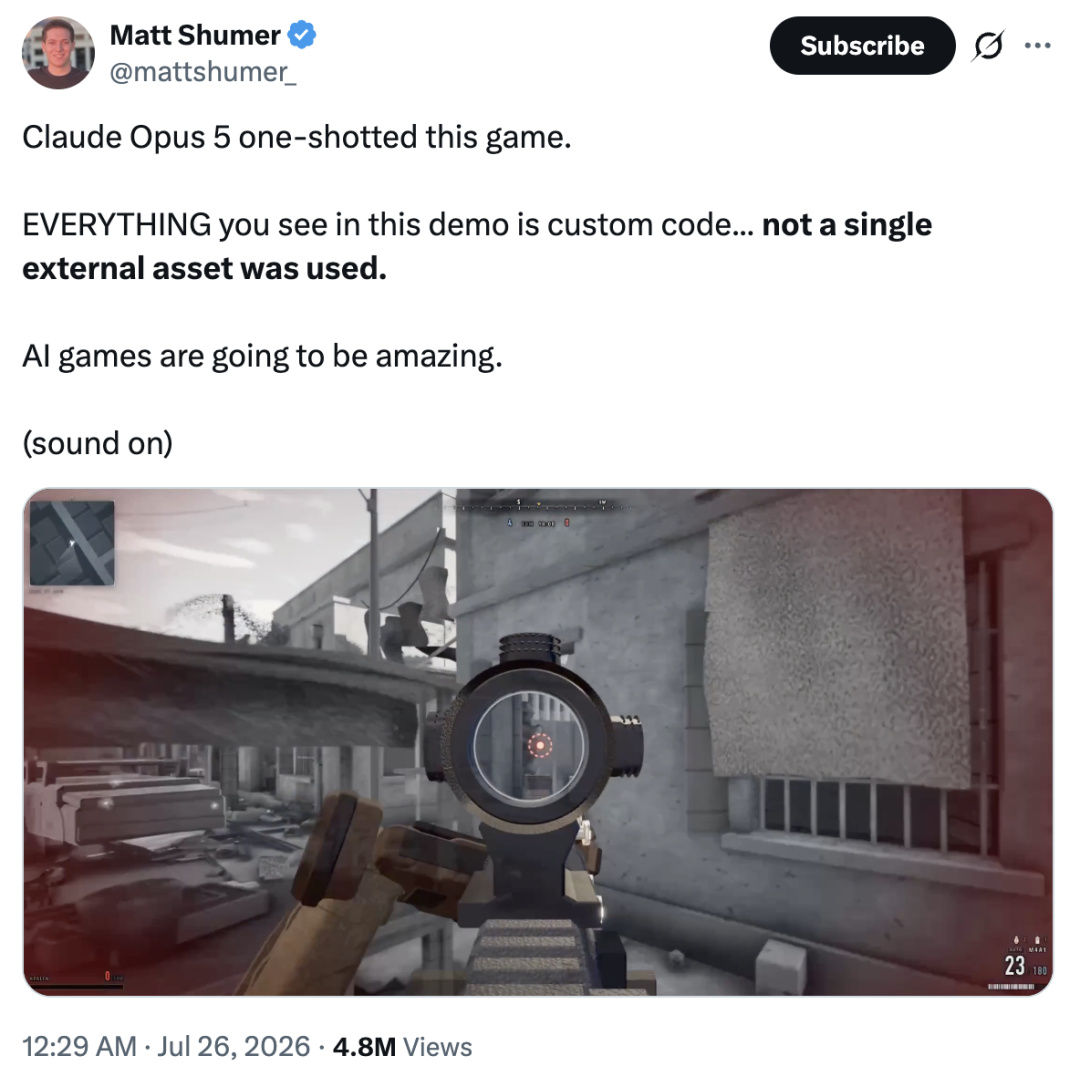
- •Matt Shumer’s Gauntlet Loop instructed Opus 5 to decompose an AAA-style FPS into subtasks and repeatedly submit outputs to harsh visual critics.
- •Andrej Karpathy generated a browser-based procedural Middle-earth experience from The Lord of the Rings text using a 1-million-token budget costing about $10.
- •Opus 5 still struggled to audit dynamic runtime behavior because it relied on intermittent screenshots and static code analysis rather than actually playing the game.
- •The experiments suggest that as generation costs fall, human judgment about gameplay feel, pacing, narrative clarity, and polish becomes more valuable.
Deep Insight
AI-generated analysis for this event — not the original article.
Enhanced Key Takeaways
- •The 'Gauntlet Loop' methodology utilizes a recursive self-correction architecture where the model acts as both the developer and the QA tester, specifically targeting visual artifacts and code syntax errors in real-time.
- •Recent benchmarks indicate that while Opus 5 excels at generating boilerplate Three.js and WebGL code, it frequently suffers from 'hallucinated physics' where collision detection logic fails to account for non-Euclidean geometry in procedural environments.
- •The high token consumption observed in Vyom's experiments is largely attributed to the inclusion of extensive documentation and library definitions in the context window to prevent the model from using deprecated API calls.
- •Industry analysis suggests that the current bottleneck in AI-generated gaming is the lack of a 'runtime feedback loop,' where the model cannot observe the game's state during execution to adjust parameters dynamically.
- •Developers are increasingly using 'shadow-rendering' techniques, where Opus 5 generates a static preview of the game state to evaluate visual composition before committing to the full procedural generation of the game's assets.
Competitor Analysis
- Claude Opus 5
- High (Specialized in Three.js)
- GPT-5o (Project Strawberry)
- High (Generalist)
- Gemini 1.5 Pro (Experimental)
- Medium (High Context)
- Claude Opus 5
- Moderate (Static Analysis)
- GPT-5o (Project Strawberry)
- High (Multimodal Native)
- Gemini 1.5 Pro (Experimental)
- Moderate (Vision-Language)
- Claude Opus 5
- ~$10 - $15
- GPT-5o (Project Strawberry)
- ~$5 - $8
- Gemini 1.5 Pro (Experimental)
- ~$2 - $5
- Claude Opus 5
- High (Procedural/Logic)
- GPT-5o (Project Strawberry)
- High (Agentic/Planning)
- Gemini 1.5 Pro (Experimental)
- Medium (Integration)
| Feature | Claude Opus 5 | GPT-5o (Project Strawberry) | Gemini 1.5 Pro (Experimental) |
|---|---|---|---|
| Code Generation | High (Specialized in Three.js) | High (Generalist) | Medium (High Context) |
| Visual Reasoning | Moderate (Static Analysis) | High (Multimodal Native) | Moderate (Vision-Language) |
| Cost per 1M Tokens | ~$10 - $15 | ~$5 - $8 | ~$2 - $5 |
| Game Dev Capability | High (Procedural/Logic) | High (Agentic/Planning) | Medium (Integration) |
Technical Deep Dive
- Architecture: Opus 5 utilizes a Mixture-of-Experts (MoE) framework optimized for long-context reasoning, allowing it to maintain consistency across large codebases.
- Context Window: The model supports a 2-million-token context window, which is critical for maintaining the state of complex, multi-file game projects.
- Integration: The system relies on standard browser-based APIs (Canvas, WebGL, Three.js) rather than proprietary game engines, making the output immediately executable in modern browsers.
- QA Limitation: The model lacks a headless browser environment integration, preventing it from executing the code it writes to verify runtime performance or frame rates.
Future ImplicationsAI analysis grounded in cited sources
Timeline
- 2025-03Anthropic releases Claude 3.5 Sonnet, setting new standards for coding capabilities.
- 2026-02Anthropic announces Opus 5, focusing on advanced reasoning and long-context performance.
- 2026-06Early experiments with Gauntlet Loop methodology emerge, demonstrating recursive self-correction in code generation.
- 2026-07Vyom and Andrej Karpathy publish findings on procedural game generation using Opus 5.
Weekly AI Recap
Read this week's curated digest of top AI events →
AI-curated news aggregator. All content rights belong to original publishers.
Original source: 虎嗅 ↗
This is a summary, not the original. Read the source, or get the weekly briefing.
The weekly digest
One email a week. Unsubscribe anytime.