Optimizing title operations with agentic AI at Rocket Close
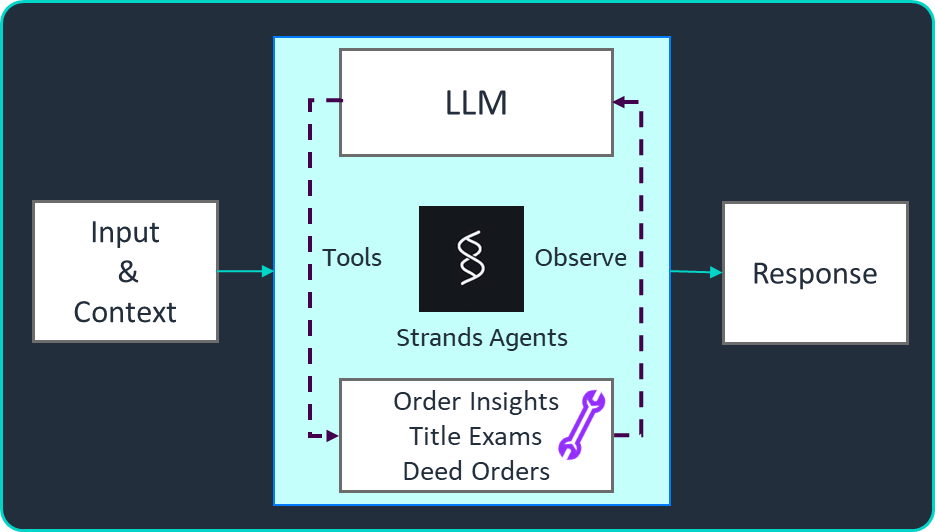
💡Learn how to build scalable, agentic workflows using Amazon Bedrock and the Model Context Protocol.
⚡ 30-Second TL;DR
What Changed
Integration of Strands Agents with Amazon Bedrock for automated document processing.
Why It Matters
The solution demonstrates how agentic workflows can reduce manual overhead in highly regulated industries like real estate title services. It provides a blueprint for enterprises to scale LLM applications using standardized protocols.
What To Do Next
Explore the Model Context Protocol (MCP) documentation to see how you can standardize your own internal tools for better agentic interoperability.
Key Points
- •Integration of Strands Agents with Amazon Bedrock for automated document processing.
- •Utilization of Model Context Protocol (MCP) to standardize tool interactions.
- •Deployment of Amazon Bedrock Knowledge Bases to provide LLMs with domain-specific context.
- •Significant business impact on operational efficiency in title processing.
🧠 Deep Insight
Background and context from public sources — not the original article. 21 sources cited.
🔑 Enhanced Key Takeaways
- •Rocket Close's agentic AI solution, developed with the AWS Generative AI Innovation Center, has dramatically reduced mortgage document processing time from up to 10 hours per package to less than two minutes, while maintaining approximately 90% accuracy in document classification and data extraction for an estimated 2,000 daily abstract document packages.
- •The Strands Agents framework, an open-source SDK released by AWS in May 2025, simplifies the creation and deployment of AI agents by leveraging the reasoning capabilities of large language models (LLMs) for autonomous planning, tool selection, and task execution, minimizing the need for complex, handcrafted workflows.
- •The Model Context Protocol (MCP), introduced by Anthropic in November 2024, is an open-source standard designed to standardize how AI systems, including LLMs, integrate and share data with external tools, systems, and data sources, thereby addressing the 'N×M integration problem' by reducing the need for custom connectors.
- •Amazon Bedrock Knowledge Bases is a fully managed service that streamlines Retrieval Augmented Generation (RAG) workflows by handling data ingestion, text chunking, embedding conversion, and storage in vector databases (e.g., Amazon OpenSearch Serverless), supporting both unstructured and structured data sources like Amazon S3 and Redshift.
- •Rocket Close is a subsidiary of Rocket Companies, which has a broader strategy of leveraging AI across its fintech services, including a 'Rocket AI Agent' for client engagement in loan origination and call center intelligence, demonstrating a wider application of agentic AI to enhance customer experience and operational efficiency.
📊 Competitor Analysis▸ Show
| Feature/Platform | PropLogix AI Operations Platform | DataTrace TitlePoint AI | Qualia AI-Enhanced Platform | Doma |
|---|---|---|---|---|
| Primary Focus | Broad workflow coverage, title examination time reduction | Low-friction integration for existing DataTrace users, reliable data accuracy | Digital closing workflows, document processing, customer communication automation | Automates underwriting and title production, reduces human error in exceptions |
| Key Strength | Strongest documented time reduction in title examination (60-70%) | Seamless integration for current DataTrace clients, incremental AI adoption | Prioritizes closing efficiency, strong for high-volume residential transactions | Predicts insurability, suggests cures for title defects, reduces turn times |
| Integration | Comprehensive operating system | Integrates with existing DataTrace systems | AI-powered document processing, customer communication automation | Integrates with existing title production systems |
| Pricing Model | Typically enterprise contracts, custom builds for large operations | Competitive pricing, incremental AI adoption | Focus on digital closing workflows | Focuses on high-volume title insurance and refinances |
🛠️ Technical Deep Dive
- OCR and Foundation Models: The solution utilizes Amazon Textract for Optical Character Recognition (OCR) processing and Amazon Bedrock for accessing various foundation models (FMs).
- Agentic Framework: Strands Agents, an open-source SDK, is used to build the AI agents. It adopts a model-driven approach where LLMs handle planning, tool selection, and task execution autonomously based on a prompt and a list of available tools.
- Knowledge Bases for RAG: Amazon Bedrock Knowledge Bases implements Retrieval Augmented Generation (RAG) workflows. It ingests documents, chunks them into text blocks, converts text to embeddings, and stores these in a vector database (e.g., Amazon OpenSearch Serverless). It supports both unstructured data (e.g., PDFs, TXT, DOCX) and structured data stores (e.g., Redshift) for natural language querying.
- Model Context Protocol (MCP): MCP is an open standard that uses JSON-RPC 2.0 messages for communication. It defines a standardized way for LLM applications (hosts) to interact with external services (servers) via clients, enabling the sharing of contextual information, exposure of tools, and building of composable integrations.
- Accuracy and Human-in-the-Loop: The system achieves approximately 90% overall accuracy in document segmentation, classification, and field extraction. A human-in-the-loop approach is maintained, where human experts verify data and handle exceptions to ensure accuracy and compliance.
🔮 Future ImplicationsAI analysis grounded in cited sources
⏳ Timeline
📎 Sources (21)
Factual claims are grounded in the sources below. Forward-looking analysis is AI-generated interpretation.
Weekly AI Recap
Read this week's curated digest of top AI events →
👉Related Updates
AI-curated news aggregator. All content rights belong to original publishers.
Original source: AWS Machine Learning Blog ↗
This is a summary, not the original. Read the source, or get the weekly briefing.
The weekly digest
One email a week. Unsubscribe anytime.