OPPO Marketing Failure Highlights AI-Human Boundary
A critical look at why AI-driven marketing ROI models fail to protect brands from cultural and ethical blunders.
30-Second TL;DR
What Changed
The incident demonstrates the danger of prioritizing 'viral' metrics over brand values and human empathy.
Why It Matters
This case serves as a reminder that AI-driven marketing must be balanced with human judgment to avoid brand damage.
What To Do Next
Implement a 'human-in-the-loop' review process for all AI-generated or data-driven marketing content to ensure alignment with brand values.
Key Points
- •The incident demonstrates the danger of prioritizing 'viral' metrics over brand values and human empathy.
- •AI can generate content and predict ROI, but it cannot judge the moral or emotional boundaries of a campaign.
- •The failure highlights the need for human oversight and 'veto power' in marketing workflows.
- •The backlash underscores the systemic risk when corporate culture is disconnected from execution.
Deep Insight
Background and context from public sources — not the original article. 11 sources cited.
Enhanced Key Takeaways
- •The controversial ad copy explicitly referred to a mother having "two 'husbands'" – one her dad and the other a celebrity idol she "sees twice a year" and "dresses up" for, which was intended to depict a mother's enthusiasm for celebrity fandom but was widely criticized for trivializing marriage and family values.
- •OPPO's initial apology was perceived as insincere, partly because the company enabled comment review on its apology post, leading to further public outrage.
- •The incident led to significant internal repercussions, with OPPO imposing strict penalties on senior executives responsible for its China market, including Senior Vice-President Duan Yaohui, who was demoted by two levels and had his salary frozen for 36 months.
- •The China Advertising Association publicly condemned brands for using "vulgar memes" and "twisting family bonds" in Mother's Day marketing, emphasizing that advertising creativity must not breach public order, social customs, or family ethics.
- •Wuhan University, the alma mater of the team leader responsible for the campaign, also publicly criticized the ad, stating it "seriously contradicts" the school's educational principles and disagreed with its value orientation.
Technical Deep Dive
- OPPO's broader AI strategy focuses on personalized, intuitive, and secure AI experiences for smartphones, integrating its self-developed Mind Space app with Google's Gemini for the Find X9 Series.
- Mind Space acts as a personalized knowledge hub, allowing users to capture, store, and organize information (notes, photos, websites) and retrieve it with AI assistance, leveraging Gemini to pull content for personalized context.
- OPPO emphasizes a "Private Computing Cloud (PCC)" approach to ensure user data is handled confidentially, aiming to address privacy and security concerns which are a leading barrier to wider AI adoption on smartphones.
- OPPO is also heavily investing in AI-enhanced photography features, such as object erasure, live image enhancement, and correcting issues like closed eyes in group portraits, aiming to differentiate itself from competitors like Apple and Samsung.
- OPPO's Global Imaging Director, Simon Liu, views AI as a "neutral thing" or a "tool" (like a gun or knife), emphasizing that the intention behind its use is what matters, and believes AI should have "no limits" in photography as long as the intention is good.
Future ImplicationsAI analysis grounded in cited sources
Timeline
- 2025-03OPPO unveils an enhanced AI strategy at MWC 2025, focusing on personal, intuitive, and secure AI experiences.
- 2025-10OPPO launches the Find X9 Pro, featuring built-in AI tools, with executives noting that users, especially those under 35, are increasingly driven by AI features.
- 2025-12OPPO's Global Imaging Director, Simon Liu, states that AI should have "no limits" in photography, viewing it as a neutral tool whose ethics depend on the user's intention.
- 2026-05-08OPPO publishes the controversial Mother's Day campaign on its official Weibo account.
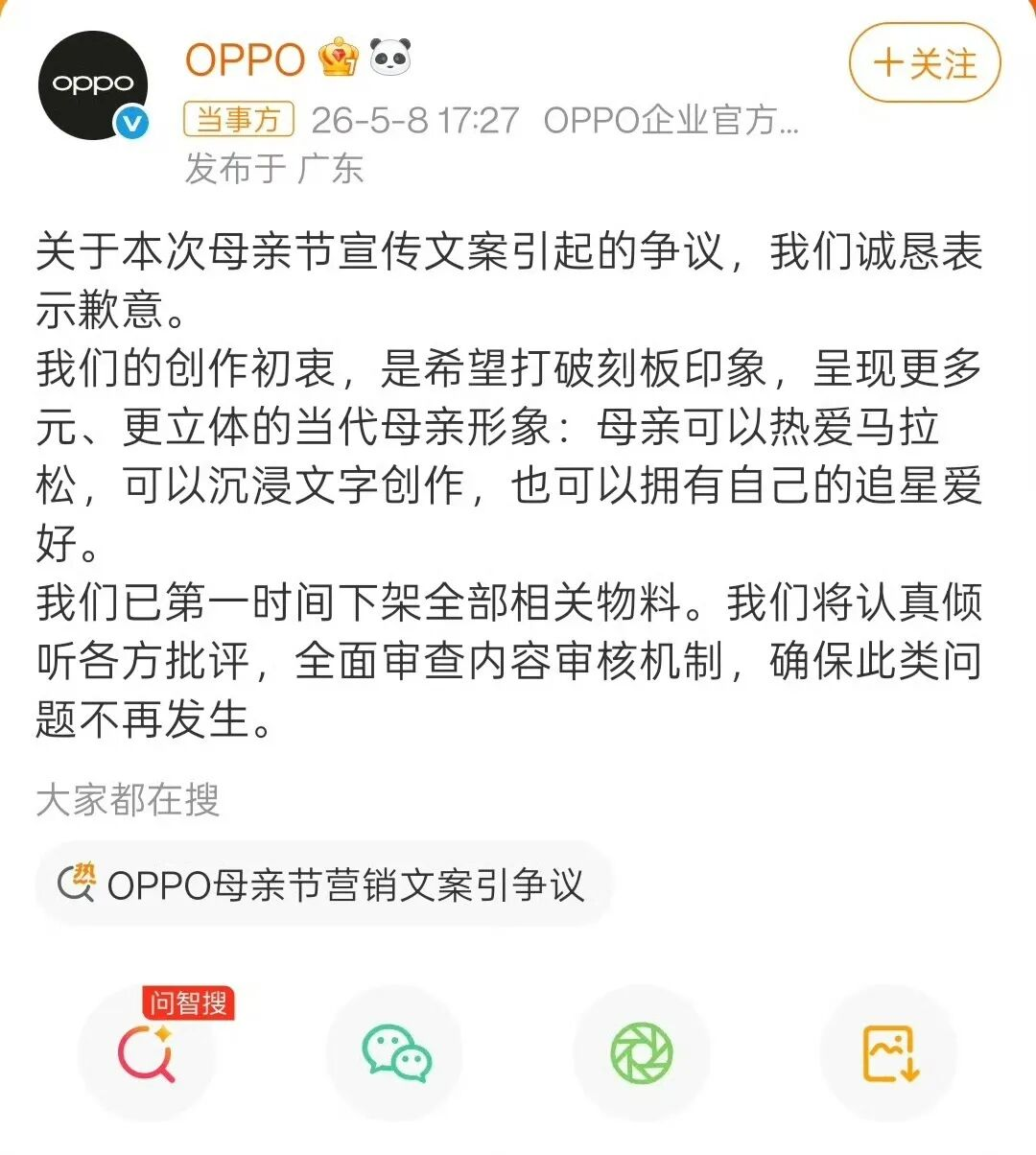
- 2026-05-08OPPO deletes the ad and issues an initial apology, which is criticized for being insincere due to comment review restrictions.
- 2026-05-11OPPO issues a fresh apology, acknowledging "serious shortcomings" and announces strict penalties, including demotion and salary freeze for Senior Vice-President Duan Yaohui and other executives.
Sources (11)
Factual claims are grounded in the sources below. Forward-looking analysis is AI-generated interpretation.
Weekly AI Recap
Read this week's curated digest of top AI events →
AI-curated news aggregator. All content rights belong to original publishers.
Original source: 虎嗅 ↗
This is a summary, not the original. Read the source, or get the weekly briefing.
The weekly digest
One email a week. Unsubscribe anytime.