Opera Neon Enables AI Browser Control
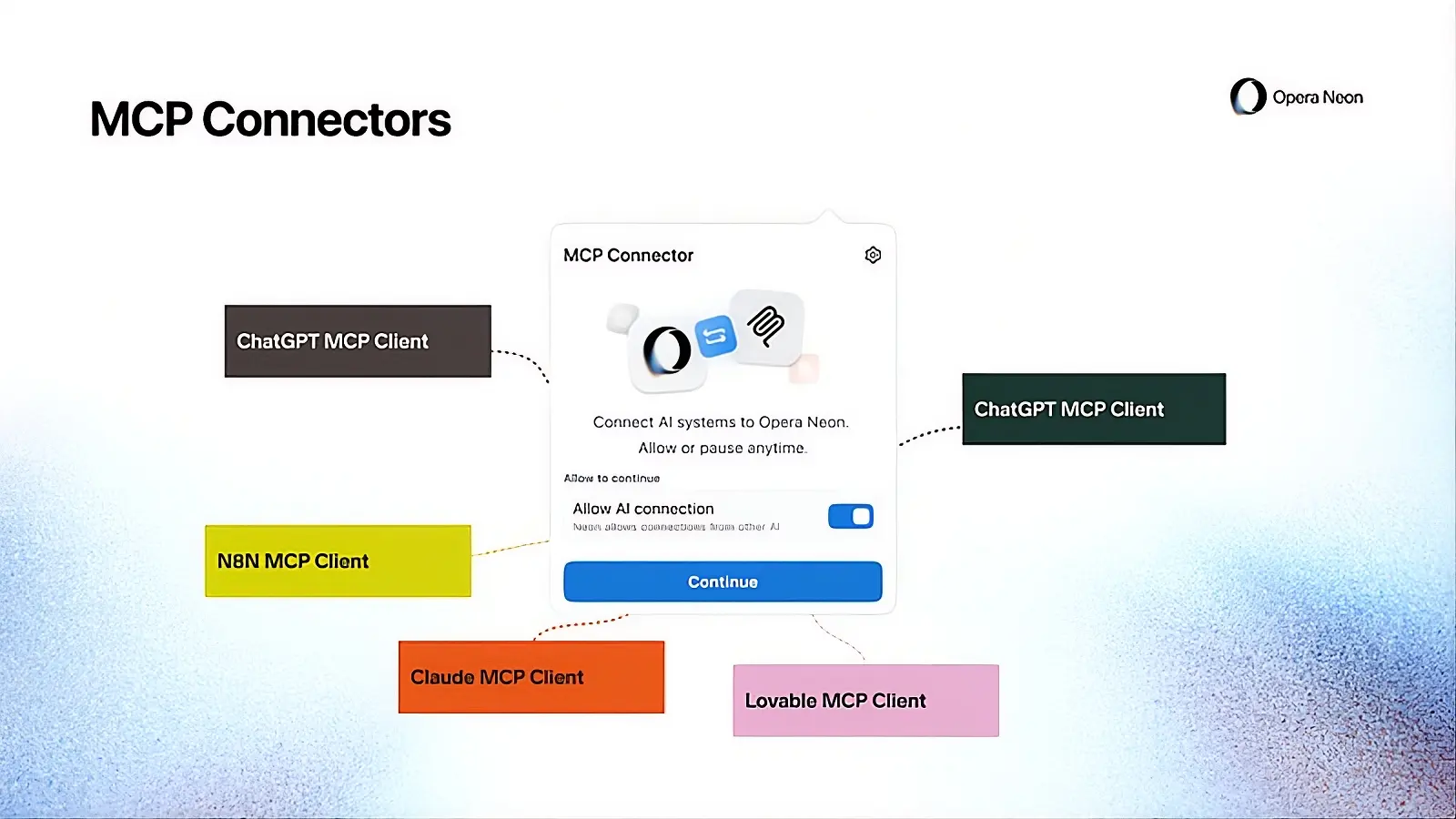
💡Opera Neon lets AI agents control real browsers—key for agentic web automation
⚡ 30-Second TL;DR
What Changed
Introduces MCP Connector for external AI access
Why It Matters
Empowers AI agents with seamless web interaction, boosting automation for developers. Could standardize browser control for external AIs, expanding agentic workflows.
What To Do Next
Test MCP Connector in Opera Neon to integrate browser control into your AI agents.
Key Points
- •Introduces MCP Connector for external AI access
- •Provides direct control over real browser sessions
- •Requires user authorization for security
- •Enables autonomous web navigation and actions
🧠 Deep Insight
AI-generated analysis for this event — not the original article.
🔑 Enhanced Key Takeaways
- •The MCP (Model Context Protocol) integration leverages an open standard developed by Anthropic to standardize how AI models interact with local data and tools, moving beyond simple API calls to direct browser DOM manipulation.
- •Opera Neon, originally a 2017 concept browser, has been repurposed as a specialized 'AI-native' testbed, distinct from the mainstream Opera One browser, to isolate experimental agentic workflows.
- •The implementation utilizes a sandboxed 'headless-plus' architecture that requires explicit user-granted permissions for every DOM interaction, addressing privacy concerns inherent in autonomous agent browsing.
📊 Competitor Analysis▸ Show
| Feature | Opera Neon (MCP) | Microsoft Copilot (Edge) | Google AI (Chrome) |
|---|---|---|---|
| Agent Architecture | Open MCP Standard | Proprietary/Closed | Proprietary/Closed |
| Browser Control | Direct DOM/Session Access | Integrated API/Copilot | Integrated API/Gemini |
| User Authorization | Granular/Per-Action | Policy-based | Policy-based |
| Pricing | Free (Experimental) | Freemium/Enterprise | Freemium/Enterprise |
🛠️ Technical Deep Dive
- •Utilizes the Model Context Protocol (MCP) to expose browser state (DOM tree, accessibility tree, and viewport metadata) to external LLMs.
- •Implements a secure bridge between the browser's internal Chromium engine and the MCP server, ensuring that external AI agents cannot access local files or system resources outside the browser session.
- •Supports bi-directional communication: the AI agent receives real-time visual and structural snapshots of the page and sends back JSON-formatted action commands (e.g., click, type, scroll).
- •Integrates with local LLM runtimes or remote API endpoints via standard MCP client-host handshake protocols.
🔮 Future ImplicationsAI analysis grounded in cited sources
⏳ Timeline
Weekly AI Recap
Read this week's curated digest of top AI events →
👉Related Updates

AI-curated news aggregator. All content rights belong to original publishers.
Original source: cnBeta (Full RSS) ↗
This is a summary, not the original. Read the source, or get the weekly briefing.
Weekly AI briefing
One email a week. Unsubscribe anytime.