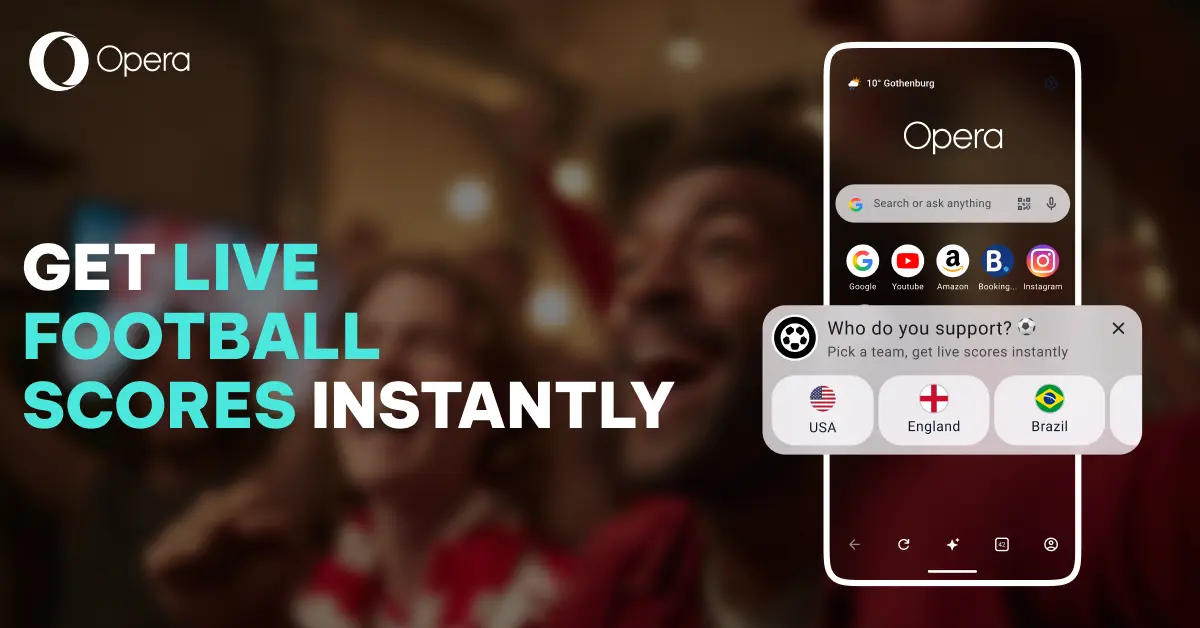
Opera adds 2026 World Cup tracking to Android browser
💡Learn how browser vendors are embedding live event data to compete for user attention.
⚡ 30-Second TL;DR
What Changed
Integration of real-time sports data directly into the browser homepage.
Why It Matters
Browser-level integration of live event data demonstrates a shift toward 'super-app' functionality to increase daily active usage.
What To Do Next
Consider integrating real-time data feeds into your product's dashboard to increase user retention.
Key Points
- •Integration of real-time sports data directly into the browser homepage.
- •Targeted feature launch ahead of the 2026 FIFA World Cup in the US.
- •Focus on enhancing user engagement through contextual, one-stop information delivery.
🧠 Deep Insight
Background and context from public sources — not the original article. 8 sources cited.
🔑 Enhanced Key Takeaways
- •Opera has a history of integrating sports features, notably with Opera Mini's "Live Scores" feature for the 2022 World Cup, which surpassed 50 million monthly active users globally.
- •The previous "Live Scores" feature in Opera Mini allowed users to customize their experience by following over 8,000 teams and offered live match alerts.
- •Opera's sports integration strategy has included gamification features like "Shake and Win" campaigns and "Predictor" games, which proved particularly successful in regions like sub-Saharan Africa.
- •The browser's approach to real-time sports updates is designed to be data-friendly, especially for users in regions with expensive mobile data, by providing an in-app solution that avoids excessive data consumption.
🛠️ Technical Deep Dive
- Opera's browsers, including the Android version, are based on Chromium and utilize the Blink rendering engine, a transition made in 2013 to enhance compatibility and performance.
- The previous "Live Scores" feature in Opera Mini was implemented as a native, in-app scoreboard, optimized for data efficiency.
- Opera's AI assistant, Aria (rebranded to Opera AI in late 2025), relies on Composer, Opera's proprietary AI engine, which integrates tools and models from partners like OpenAI and Google (including Imagen 3 for image generation).
- Opera has developed a "Browser Connector" feature that uses the Model Context Protocol (MCP), an open standard by Anthropic, to enable secure two-way connections between AI models and external data sources for real-time context.
🔮 Future ImplicationsAI analysis grounded in cited sources
⏳ Timeline
📎 Sources (8)
Factual claims are grounded in the sources below. Forward-looking analysis is AI-generated interpretation.
Weekly AI Recap
Read this week's curated digest of top AI events →
👉Related Updates
AI-curated news aggregator. All content rights belong to original publishers.
Original source: cnBeta (Full RSS) ↗
This is a summary, not the original. Read the source, or get the weekly briefing.
The weekly digest
One email a week. Unsubscribe anytime.