OpenHarmony Ecosystem Reaches 1.3 Billion Devices Milestone
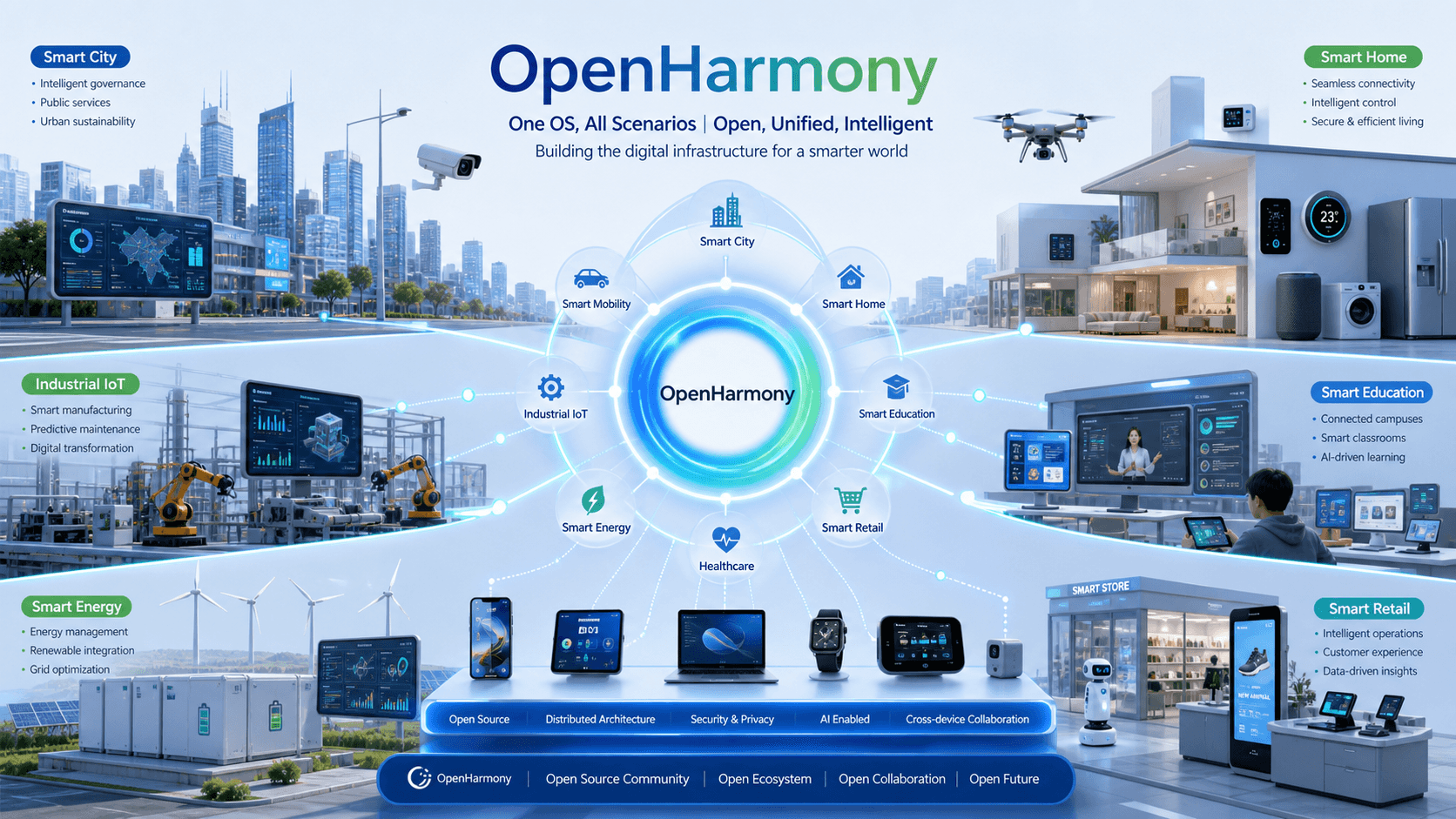
💡Understand the scale of a major open-source OS competitor that is rapidly capturing the industrial IoT and AI market.
⚡ 30-Second TL;DR
What Changed
Surpassed 13,000 active contributors to the open-source project
Why It Matters
The massive scale of OpenHarmony suggests it is becoming a dominant infrastructure layer for IoT and industrial AI applications, challenging traditional embedded OS markets.
What To Do Next
Review the OpenHarmony developer documentation to assess if your edge AI models can be ported to their distributed framework for industrial deployment.
Key Points
- •Surpassed 13,000 active contributors to the open-source project
- •Codebase has expanded to 140 million lines of code
- •Ecosystem footprint reaches 1.3 billion connected devices
- •Deep integration into industrial sectors like mining and power
🧠 Deep Insight
AI-generated analysis for this event — not the original article.
🔑 Enhanced Key Takeaways
- •OpenHarmony is governed by the OpenAtom Foundation, a non-profit organization established to manage open-source projects in China.
- •The operating system utilizes a distributed architecture that enables seamless cross-device collaboration, allowing applications to run across different hardware form factors without modification.
- •OpenHarmony has established a specialized compatibility certification system to ensure hardware interoperability across diverse IoT manufacturers.
- •The project has successfully transitioned from consumer electronics focus to industrial-grade deployments, including specialized versions for high-reliability environments like power grids.
- •Development is supported by a broad consortium of industry partners, including major Chinese telecommunications and hardware manufacturers who contribute to the core kernel and middleware.
📊 Competitor Analysis▸ Show
| Feature | OpenHarmony | Android (AOSP) | FreeRTOS |
|---|---|---|---|
| Architecture | Distributed Microkernel | Monolithic Kernel | Real-time Kernel |
| Primary Use Case | IoT & Cross-device | Mobile & Tablet | Embedded Systems |
| Hardware Req. | Highly Scalable | High Resource | Very Low Resource |
| Ecosystem | Rapidly Growing (China) | Global Dominance | Global Industrial Standard |
🛠️ Technical Deep Dive
- Distributed Soft Bus: A core component that provides a unified communication protocol for device discovery, connection, and data transmission across heterogeneous devices.
- Microkernel Architecture: Designed with a separation of kernel and user space to enhance security and system stability, allowing for modular deployment on devices ranging from smartwatches to industrial controllers.
- Distributed Data Management: Implements a synchronized database mechanism that allows data to be shared and accessed across devices in real-time as if they were a single local storage.
- Ability Framework: A unique application model that decouples UI and logic, enabling applications to be distributed and run on remote devices dynamically.
🔮 Future ImplicationsAI analysis grounded in cited sources
⏳ Timeline
Weekly AI Recap
Read this week's curated digest of top AI events →
👉Related Updates


AI-curated news aggregator. All content rights belong to original publishers.
Original source: Pandaily ↗
This is a summary, not the original. Read the source, or get the weekly briefing.
The weekly digest
One email a week. Unsubscribe anytime.