OpenClaw Ignites AI Agents War
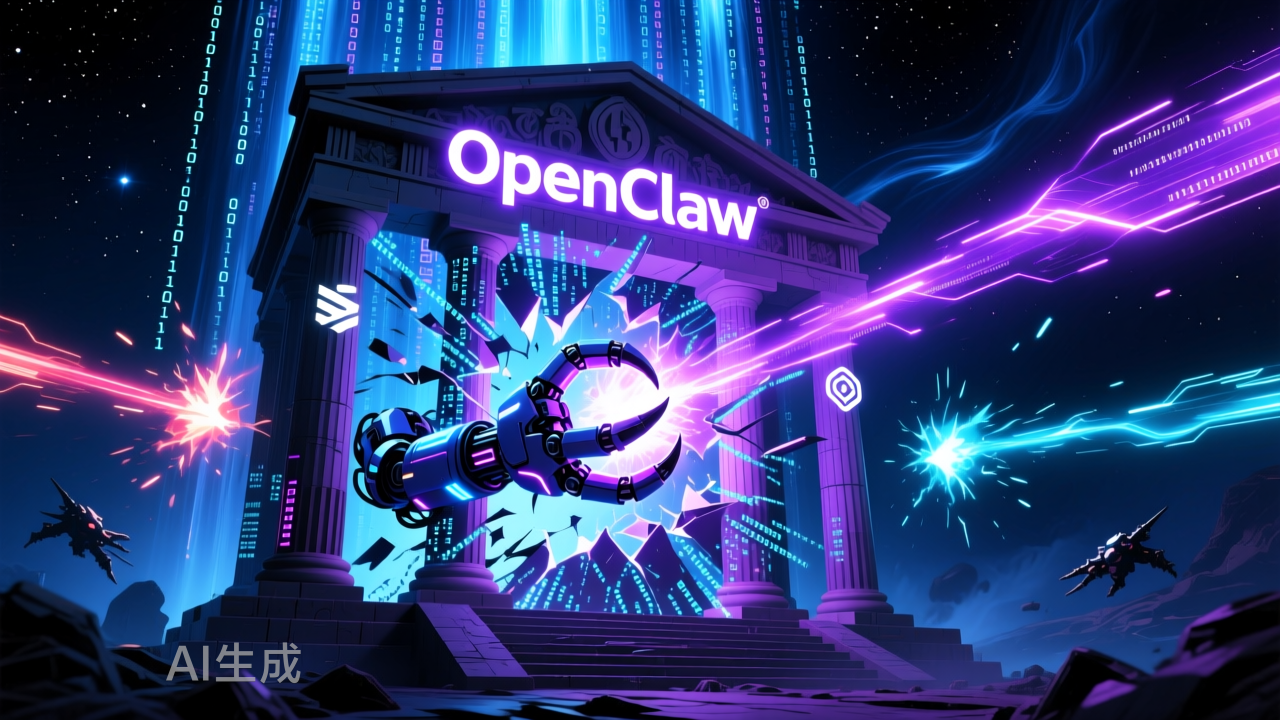
💡Uncover 3 secret wars behind top AI agents – edge for builders.
⚡ 30-Second TL;DR
What Changed
OpenClaw triggers intense rivalry among AI giants
Why It Matters
Intensifies open-source vs proprietary AI agent race, potentially accelerating innovation and adoption among developers.
What To Do Next
Fork OpenClaw on GitHub and benchmark its agents vs Claude or GPT.
Key Points
- •OpenClaw triggers intense rivalry among AI giants
- •Reveals three hidden battles in AI Agent ecosystem
- •Highlights OpenClaw's breakthrough Android-like impact
🧠 Deep Insight
Background and context from public sources — not the original article. 6 sources cited.
🔑 Enhanced Key Takeaways
- •OpenClaw reached 214,000 GitHub stars by early 2026, outpacing legendary developer tools like Docker and React in growth trajectory, demonstrating unprecedented adoption velocity in the AI agent space[4].
- •Chinese tech companies (Moonshot AI, MiniMax, Zhipu AI) have rapidly integrated OpenClaw into commercial products, with Moonshot AI's Kimi Claw achieving overseas revenue surpassing domestic revenue for the first time, signaling a shift in global AI agent market dynamics[1].
- •The modular, model-agnostic architecture of OpenClaw enables enterprises to mix open-source agent layers with any AI model and tools, fundamentally challenging the vertically integrated platform model traditionally dominated by large tech providers[2].
- •According to Deloitte, 37% of global companies have already replaced or automated significant portions of human-led manual tasks with AI agents by early 2026, with OpenClaw serving as a primary enabler of this enterprise-wide shift[4].
📊 Competitor Analysis▸ Show
| Aspect | OpenClaw | Kimi Claw (Moonshot AI) | MaxClaw (MiniMax) | AutoGLM–OpenClaw (Zhipu AI) |
|---|---|---|---|---|
| Deployment Model | Self-hosted (local/private server) | Cloud-based with zero-code deployment | Cloud-based AI assistant | Cloud-based on OpenClaw image |
| Infrastructure | Runs locally on user's hardware | Cloud-hosted environment | Cloud-hosted environment | Alibaba Cloud integration |
| Key Feature | Modular skills, model-agnostic, multi-channel gateway | Free computing power subsidies, one-click setup | Performance and ease of use focus | Reduced local infrastructure needs |
| Market Position | Open-source framework (foundation layer) | Commercial product with international expansion | Commercial cloud service | Enterprise cloud deployment solution |
🛠️ Technical Deep Dive
- Three-Layer Architecture: Gateway (local control plane), Model Connection (API integration with Claude, GPT-4, or local alternatives via Ollama), Agent Skills System (modular, reusable capability packages)[2][5]
- Skill-Based Composition: Agents built from discrete, reusable skill modules (knowledge base search, PDF parsing, trade execution) rather than monolithic prompt engineering[5]
- Multi-Channel Gateway: Routes agent interactions across Telegram, WhatsApp, Discord, Slack, Signal, iMessage, Google Chat, and Microsoft Teams with persistent memory and session management across all channels[3]
- Model Agnosticism: Supports OpenAI GPT-4, Anthropic Claude, open-source models via Ollama, and custom fine-tuned weights with configurable API keys[2][5]
- Local Autonomy Design: Agent memory, tool access, and execution loop remain under user control on local hardware (PC, Raspberry Pi, AWS instance) while AI brain may use cloud APIs[2]
- Workflow Integration: Native support for n8n and other workflow automation platforms with evolving skill ecosystem and feature updates[5]
🔮 Future ImplicationsAI analysis grounded in cited sources
⏳ Timeline
📎 Sources (6)
Factual claims are grounded in the sources below. Forward-looking analysis is AI-generated interpretation.
- technode.com — Openclaw Sparks Boom As Chinese Firms Race Into the AI Agent Era
- o-mega.ai — Openclaw Creating the AI Agent Workforce Ultimate Guide 2026
- pacgenesis.com — What Is Openclaw AI Everything You Need to Know About the Open Source AI Agent That Actually Does Things
- stormy.ai — 2026 Gtm Playbook Openclaw AI Agents
- tencentcloud.com — 140791
- youtube.com — Watch
Weekly AI Recap
Read this week's curated digest of top AI events →
👉Related Updates


AI-curated news aggregator. All content rights belong to original publishers.
Original source: 钛媒体 ↗
This is a summary, not the original. Read the source, or get the weekly briefing.
Weekly AI briefing
One email a week. Unsubscribe anytime.