OpenClaw and Claude: AI Agents Bring Chaos
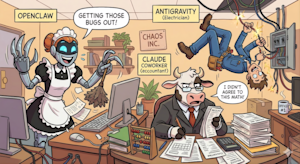
💡OpenClaw's 150k stars & Claude's stock chaos signal agentic AI's disruptive rise—essential read.
⚡ 30-Second TL;DR
What Changed
OpenClaw (ex-Moltbot/Clawdbot) hits 150k+ GitHub stars for autonomous local tasks
Why It Matters
AI agents threaten job displacement in legal, dev, and admin sectors, as seen in stock sell-offs. Open-source nature of OpenClaw amplifies adoption but governance challenges. Users must balance power with safeguards to avoid chaos.
What To Do Next
Clone OpenClaw GitHub repo and test local deployment for inbox triaging automation.
Key Points
- •OpenClaw (ex-Moltbot/Clawdbot) hits 150k+ GitHub stars for autonomous local tasks
- •Claude Cowork launches AI agents for legal tasks like contract review, triggers SaaSpocalypse
- •Google Antigravity offers IDE-based coding agent for full app development
- •Agents require deep access, heightening risks of data leaks and system failures
🧠 Deep Insight
Background and context from public sources — not the original article. 9 sources cited.
🔑 Enhanced Key Takeaways
- •OpenClaw's rapid growth to over 250,000 GitHub stars in four months has triggered significant security concerns, with reports indicating that 20% of plugins in its 'ClawHub' marketplace are malicious and approximately 30,000 instances have been exposed to remote takeover.
- •The 'SaaSpocalypse' event in February 2026, triggered by the release of Anthropic's Claude Cowork legal plugins, resulted in a rapid $285 billion market capitalization decline across software and legal-tech sectors within 48 hours, as investors reassessed the viability of per-seat SaaS pricing models.
- •Google's Antigravity platform, launched in November 2025, introduces an 'agent-first' development paradigm that utilizes a 'Manager Surface' for orchestrating multiple asynchronous agents, moving beyond traditional IDE-based AI coding assistants to support end-to-end autonomous software development.
📊 Competitor Analysis▸ Show
| Feature | OpenClaw | Claude Cowork | Google Antigravity |
|---|---|---|---|
| Primary Focus | Personal AI Automation | Enterprise Knowledge Work | Agentic Software Development |
| Deployment | Local-first (Self-hosted) | Desktop App (Research Preview) | IDE (Local-first) |
| Key Interface | Messaging Platforms (Slack, Telegram, etc.) | Claude Desktop App | Agent Manager / IDE Sidebar |
| Pricing | Open Source (Free) | Paid Plans (Research Preview) | Free (Public Preview) |
| Core Strength | Multi-channel control plane | Domain-specific plugins (Legal/Finance) | Multi-agent orchestration & Artifacts |
🛠️ Technical Deep Dive
- •OpenClaw: Utilizes a local-first architecture that functions as a multi-channel control plane, allowing agents to execute tasks across messaging platforms (WhatsApp, Telegram, Discord, etc.) and local file systems via a CLI tool.
- •Claude Cowork: Employs the Model Context Protocol (MCP) to securely connect to enterprise tools and data, enabling modular plugins that bundle specialized skills, connectors, and workflows for specific roles.
- •Google Antigravity: Built as a modified fork of Visual Studio Code, it features an 'Agent Manager' for asynchronous task orchestration and generates 'Artifacts' (markdown, code diffs, browser recordings) to provide verifiable transparency into agentic reasoning and task progress.
- •Security Architecture: OpenClaw has faced criticism for default unauthenticated remote access, while Antigravity emphasizes 'Artifacts' over raw tool logs to build user trust and mitigate the 'Trust Gap' in autonomous execution.
🔮 Future ImplicationsAI analysis grounded in cited sources
⏳ Timeline
📎 Sources (9)
Factual claims are grounded in the sources below. Forward-looking analysis is AI-generated interpretation.
Weekly AI Recap
Read this week's curated digest of top AI events →
👉Related Updates
AI-curated news aggregator. All content rights belong to original publishers.
Original source: VentureBeat ↗
This is a summary, not the original. Read the source, or get the weekly briefing.
Weekly AI briefing
One email a week. Unsubscribe anytime.