OpenAI Urges CISOs to Deploy Security Agents

💡See how OpenAI wants security teams to deploy agents—and where analysts see hidden risks.
⚡ 30-Second TL;DR
What Changed
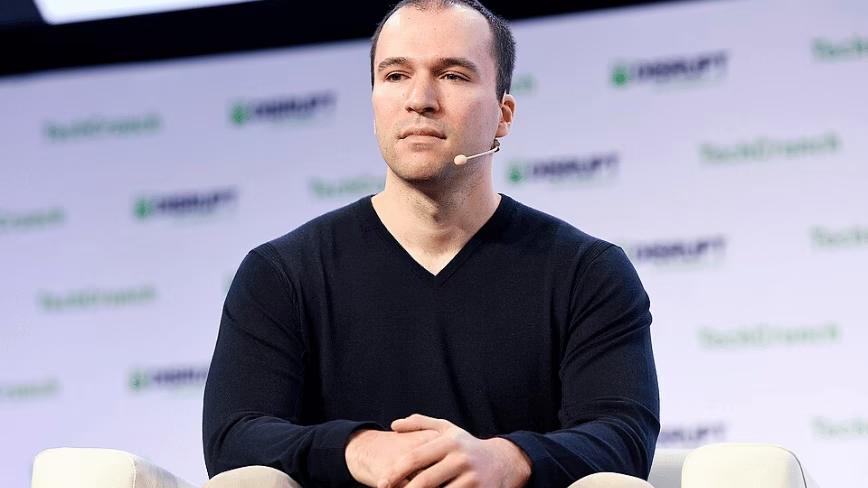
Greg Brockman said enterprise systems may contain hidden flaws that AI-powered agents could identify before attackers do.
Why It Matters
Security teams may accelerate adoption of agentic coding and security tools, but broad access to source code and infrastructure creates governance, privacy, and authorization risks. Enterprises should validate agent outputs and preserve layered controls rather than treating agents as autonomous security authorities.
What To Do Next
Pilot Codex or the Codex Security plugin on one high-priority repository with read-only permissions, logging, and human approval for every remediation.
Key Points
- •Greg Brockman said enterprise systems may contain hidden flaws that AI-powered agents could identify before attackers do.
- •OpenAI recommended giving security agents approved access to codebases, infrastructure configurations, and technical documentation.
- •Suggested workflows include static analysis, security-focused code review, vulnerability variant analysis, and software supply-chain risk assessment.
- •Analysts criticized the post for making an unusually explicit sales pitch while omitting discussion of liability.
🧠 Deep Insight
AI-generated analysis for this event.
🔑 Enhanced Key Takeaways
- •OpenAI's push for agentic security aligns with the broader 'Secure-by-Design' initiative promoted by CISA and the White House, which emphasizes shifting security responsibilities to technology providers.
- •The recommendation to grant agents access to infrastructure configurations mirrors the rise of 'Infrastructure as Code' (IaC) scanning tools that integrate directly into CI/CD pipelines.
- •Industry critics highlight that OpenAI's proposal lacks a framework for 'human-in-the-loop' verification, which is currently a regulatory requirement for critical infrastructure security in several jurisdictions.
- •The Codex model family, while foundational, has been largely superseded in OpenAI's product roadmap by newer iterations of the GPT-4o and o1 series, which exhibit higher reasoning capabilities for complex security tasks.
- •Security researchers have noted that deploying autonomous agents with broad codebase access creates a new 'prompt injection' attack surface where malicious code could manipulate the agent's decision-making process.
📊 Competitor Analysis▸ Show
| Feature | OpenAI (Agentic Security) | Anthropic (Claude Security) | GitHub (Copilot Security) |
|---|---|---|---|
| Primary Focus | Autonomous remediation | Constitutional AI/Safety | IDE-integrated scanning |
| Pricing | Enterprise API/Usage-based | Enterprise API/Usage-based | Per-seat subscription |
| Benchmarks | High reasoning/Agentic | High safety/Alignment | High code coverage |
🛠️ Technical Deep Dive
- Agentic security workflows rely on ReAct (Reasoning + Acting) prompting patterns to allow models to query documentation and execute diagnostic scripts.
- Implementation requires a secure sandbox environment (often containerized) to prevent agents from executing unauthorized system calls during vulnerability remediation.
- Integration typically utilizes RAG (Retrieval-Augmented Generation) to ground the agent in the specific organization's security policies and historical incident data.
- Vulnerability variant analysis is performed by embedding code snippets into high-dimensional vector spaces to identify semantically similar patterns across large repositories.
🔮 Future ImplicationsAI analysis grounded in cited sources
⏳ Timeline
Weekly AI Recap
Read this week's curated digest of top AI events →
👉Related Updates
AI-curated news aggregator. All content rights belong to original publishers.
Original source: Computerworld ↗