OpenAI to Retire o3 and GPT-4.5 Models
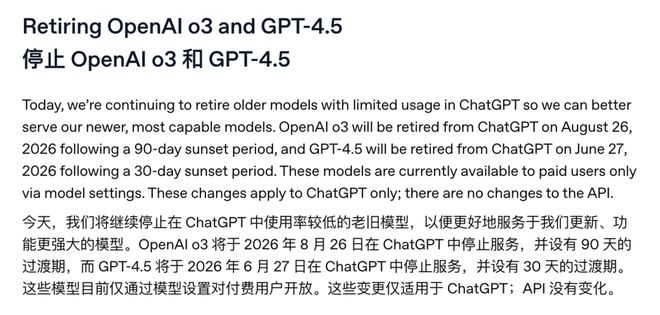
💡OpenAI is sunsetting key models; check your API dependencies now to prevent production downtime.
⚡ 30-Second TL;DR
What Changed
o3 model support ends on August 26, 2026
Why It Matters
Developers relying on these specific model versions must migrate to newer OpenAI models to avoid service disruptions. This highlights the importance of model versioning strategies in production environments.
What To Do Next
Audit your current API calls to identify any dependencies on o3 or GPT-4.5 and plan a migration to the latest stable models.
Key Points
- •o3 model support ends on August 26, 2026
- •GPT-4.5 model support ends on June 27, 2026
- •Users have a limited 30-day buffer for the GPT-4.5 transition
🧠 Deep Insight
Background and context from public sources — not the original article. 19 sources cited.
🔑 Enhanced Key Takeaways
- •The retirement of o3 and GPT-4.5 applies exclusively to the ChatGPT consumer interface, while both models will remain accessible via OpenAI's API, signaling a strategic divergence between OpenAI's consumer and developer product offerings.
- •This deprecation is part of OpenAI's broader strategy to streamline and consolidate its ChatGPT experience around the newer, more capable GPT-5.x generation, aiming to simplify model selection for users.
- •GPT-4.5, codenamed 'Orion,' was the last model in the GPT series primarily focused on unsupervised learning for pattern recognition and factual accuracy, rather than explicit chain-of-thought reasoning.
- •The o3 model is a 'reasoning model' designed for step-by-step logical deliberation, succeeding the o1 model, and offers adjustable reasoning effort levels (low, medium, high) to balance speed and thoroughness.
- •The differing sunset periods—30 days for GPT-4.5 and 90 days for o3—suggest that OpenAI internally assessed o3 as having deeper integration into user workflows within ChatGPT.
📊 Competitor Analysis▸ Show
Competitor Analysis: OpenAI o3 and GPT-4.5 in Context
| Feature/Metric | OpenAI GPT-4.5 (Orion) | OpenAI o3 (Reasoning Model) | Google Gemini 2.0/2.5 Pro | Anthropic Claude 3.7/4 Opus | xAI Grok 3 |
|---|---|---|---|---|---|
| Release Date | Feb 27, 2025 | o3-mini: Jan 31, 2025; o3: Apr 16, 2025; o3-pro: Jun 10, 2025 | Preview: Dec 2024 (Gemini 2.0) | Feb 24, 2025 (Claude 3.7) | Feb 18, 2025 (Grok 3) |
| Primary Focus | Unsupervised learning, pattern recognition, factual accuracy, creativity, emotional intelligence | Step-by-step logical reasoning, complex problem-solving (coding, math, science), visual reasoning, tool use | Reasoning capabilities | Advanced reasoning, conversational abilities | Conversational AI |
| Key Capabilities | Multilingual understanding (outperformed GPT-4o on MMLU across 15 languages), agentic planning, multi-step coding, task automation, vision capabilities | Reflective thinking, private chain of thought, adjustable reasoning effort, full tool integration (web browsing, Python, image/file analysis, image generation, canvas, memory) | Reasoning capabilities | - | - |
| Pricing (API) | $75/M input tokens, $150/M output tokens (as of Feb 2025) | o3: $2/M input, $8/M output; o3-pro: $20/M input, $80/M output | - | - | - |
| Benchmarks | Outperformed GPT-4o on MMLU (15 languages) | GPQA Diamond (87.7%), SWE-bench Verified (71.7%), Codeforces (2727 Elo), AIME 2024 (87.3%), AIME 2025 (88.9%) | - | Compared to GPT-4.5 | Compared to GPT-4.5 |
| Successor/Context | Replaced by GPT-4.1 (API) and GPT-5 (ChatGPT) | Succeeded by o4-mini, o3-pro, and eventually unified into GPT-5.x | - | - | - |
🛠️ Technical Deep Dive
-
OpenAI o3 Model:
- Architecture: Reflective Generative Pre-trained Transformer (GPT) model, successor to OpenAI o1.
- Reasoning Mechanism: Designed to devote additional deliberation time for step-by-step logical reasoning, utilizing a 'private chain of thought' and trained with large-scale reinforcement learning on chains of thought.
- Capabilities: Excels in complex tasks like coding, mathematics, science, and visual perception.
- Features: Offers adjustable reasoning effort levels (low, medium, high) to balance speed and thoroughness. Integrates full tool capabilities including web browsing, Python code execution, file analysis, image generation, canvas, automations, file search, and memory.
- Variants: Includes o3-mini (cost-efficient, specialized for technical domains requiring precision and speed) and o3-pro (most capable, designed for deep, logical thinking).
-
GPT-4.5 Model:
- Codenamed: "Orion".
- Architecture: Large language model built upon a modified transformer structure.
- Training Methodology: Primarily trained using unsupervised learning to enhance pattern recognition, draw connections, and generate creative insights without explicit reasoning. This was combined with supervised fine-tuning and reinforcement learning from human feedback.
- Computational Resources: Trained on Microsoft Azure AI supercomputers.
- Key Architectural Innovations: Dynamic attention routing (conditional computation pathways), hierarchical token processing (64k context windows with tiered attention mechanisms), and multi-modal fusion layers for integrating text, image, and code representations.
- Training Data: Utilized a pre-training corpus of 13.8 trillion tokens from diversified sources.
- Capabilities: Known for broader knowledge, deeper world understanding, reduced hallucinations, and improved reliability. Supports vision capabilities through image inputs.
- Cost: Described by Sam Altman as a "giant, expensive model."
🔮 Future ImplicationsAI analysis grounded in cited sources
⏳ Timeline
📎 Sources (19)
Factual claims are grounded in the sources below. Forward-looking analysis is AI-generated interpretation.
Weekly AI Recap
Read this week's curated digest of top AI events →
👉Related Updates
AI-curated news aggregator. All content rights belong to original publishers.
Original source: cnBeta (Full RSS) ↗
This is a summary, not the original. Read the source, or get the weekly briefing.
The weekly digest
One email a week. Unsubscribe anytime.