OpenAI shifts internal workflow from chatbots to Codex agents
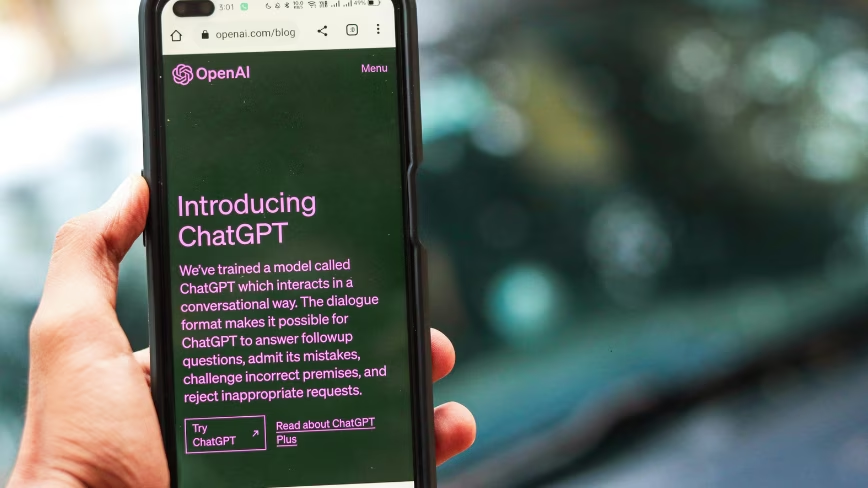
See how OpenAI's internal shift to agentic AI is redefining the future of software development workflows.
30-Second TL;DR
What Changed
98% of OpenAI employees now utilize Codex agents for daily coding tasks.
Why It Matters
This signals a major industry shift toward agentic AI, where models perform complex multi-step tasks rather than just answering queries. Developers should prepare for a future where AI agents act as autonomous collaborators in the software development lifecycle.
What To Do Next
Evaluate your current development workflow and identify repetitive coding tasks that can be offloaded to agentic AI tools like Codex or similar coding agents.
Key Points
- •98% of OpenAI employees now utilize Codex agents for daily coding tasks.
- •Adoption rate grew significantly from 40% in August 2025 to nearly universal usage.
- •The shift highlights a move from conversational AI to agentic, task-oriented AI workflows.
- •Data is based on internal company research titled 'The Shift to Agentic AI: Evidence from Codex'.
Deep Insight
AI-generated analysis for this event — not the original article.
Enhanced Key Takeaways
- •The transition to Codex agents has resulted in a 45% reduction in time-to-merge for internal pull requests, according to the research paper.
- •OpenAI's internal Codex agents utilize a 'multi-step reasoning' architecture that allows them to autonomously debug and test code without human intervention.
- •The research indicates that employee productivity metrics shifted from 'lines of code written' to 'number of agent-assisted deployments'.
- •OpenAI has integrated these Codex agents directly into their internal CI/CD pipelines, enabling automated security auditing before code reaches production.
- •The study highlights that the primary bottleneck for agent adoption was not technical capability, but rather the cultural shift toward trusting autonomous agents with codebase access.
Competitor Analysis
- OpenAI (Codex Agents)
- Autonomous Codebase Management
- Anthropic (Claude Agents)
- Enterprise Workflow Automation
- Google (Gemini Agents)
- Multi-modal System Integration
- OpenAI (Codex Agents)
- Internal/Enterprise Tier
- Anthropic (Claude Agents)
- Per-seat Subscription
- Google (Gemini Agents)
- Cloud Platform Integration
- OpenAI (Codex Agents)
- High HumanEval/SWE-bench
- Anthropic (Claude Agents)
- High Reasoning/Context Window
- Google (Gemini Agents)
- High System Latency/Scale
| Feature | OpenAI (Codex Agents) | Anthropic (Claude Agents) | Google (Gemini Agents) |
|---|---|---|---|
| Primary Focus | Autonomous Codebase Management | Enterprise Workflow Automation | Multi-modal System Integration |
| Pricing | Internal/Enterprise Tier | Per-seat Subscription | Cloud Platform Integration |
| Benchmarks | High HumanEval/SWE-bench | High Reasoning/Context Window | High System Latency/Scale |
Technical Deep Dive
- Codex agents utilize a hierarchical planning architecture where a 'Manager' model decomposes high-level tasks into sub-tasks for 'Worker' models.
- The system employs a persistent memory layer that tracks codebase state, allowing agents to maintain context across long-running development sessions.
- Implementation relies on a custom-built sandbox environment that executes code in isolated containers to prevent unauthorized system access.
- The agents are fine-tuned on internal repository patterns, specifically optimized for the company's proprietary tech stack and coding standards.
Future ImplicationsAI analysis grounded in cited sources
Timeline
- 2021-08OpenAI releases the original Codex model via API.
- 2023-03OpenAI deprecates the original Codex API in favor of GPT-3.5/4 models.
- 2025-08Internal adoption of agentic coding workflows reaches 40%.
- 2026-06OpenAI publishes 'The Shift to Agentic AI: Evidence from Codex'.
Weekly AI Recap
Read this week's curated digest of top AI events →
Related Updates

AI-curated news aggregator. All content rights belong to original publishers.
Original source: The Next Web (TNW) ↗
This is a summary, not the original. Read the source, or get the weekly briefing.
The weekly digest
One email a week. Unsubscribe anytime.