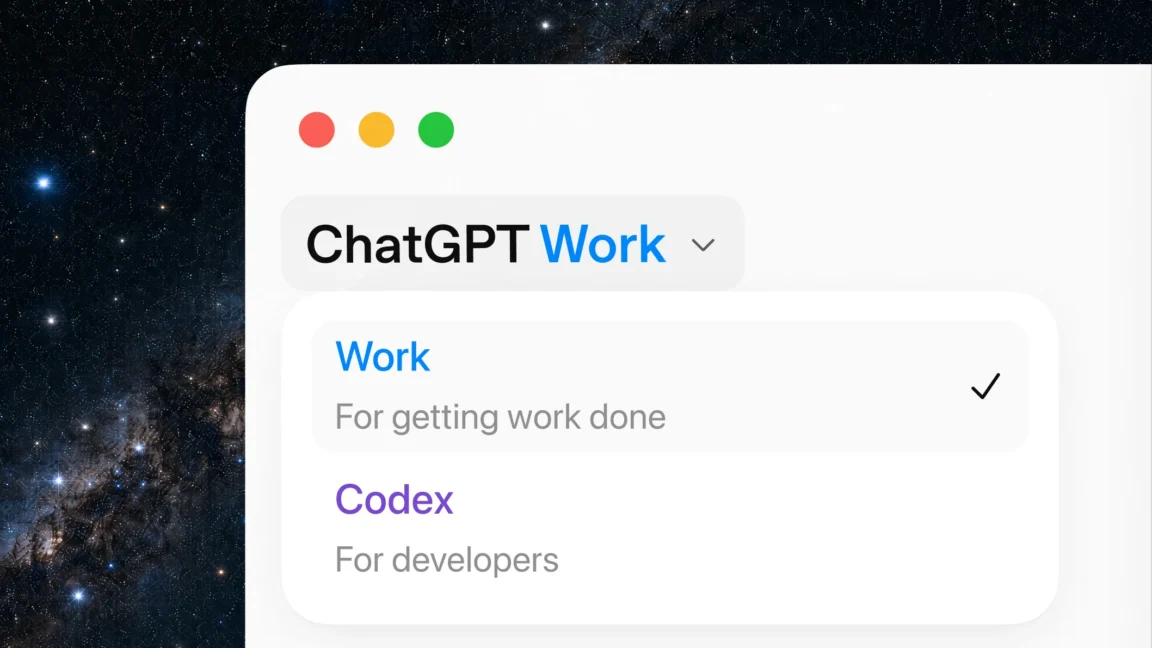
OpenAI rebrands Codex for autonomous multi-hour workflows
💡OpenAI's shift to long-running autonomous agents could fundamentally change how developers build and deploy AI tools.
⚡ 30-Second TL;DR
What Changed
Codex is being rebranded to support autonomous task execution.
Why It Matters
This evolution suggests OpenAI is prioritizing agentic AI that can replace human oversight for long-running coding or data tasks. Developers should prepare for a shift from chat-based interfaces to autonomous agent workflows.
What To Do Next
Monitor the OpenAI developer platform for the release of the new autonomous workflow APIs to test agentic task delegation.
Key Points
- •Codex is being rebranded to support autonomous task execution.
- •The tool is designed to handle workflows that run for hours.
- •Focus is shifting from simple code completion to independent agentic behavior.
🧠 Deep Insight
AI-generated analysis for this event — not the original article.
🔑 Enhanced Key Takeaways
- •The rebranding initiative, internally codenamed 'Project Operator,' marks the formal sunsetting of the original Codex API which previously powered GitHub Copilot.
- •New autonomous workflows utilize a persistent state management architecture that allows the model to recover from execution errors without human intervention.
- •OpenAI has introduced a 'Human-in-the-loop' checkpoint system that requires authorization for high-stakes API calls during multi-hour operations.
- •The underlying model architecture has been optimized for long-context reasoning, specifically targeting the reduction of hallucination rates in recursive coding tasks.
- •Pricing for the new autonomous tier is shifting from a per-token model to a compute-time-based billing structure to account for extended background execution.
📊 Competitor Analysis▸ Show
| Feature | OpenAI (Codex/Operator) | Anthropic (Claude Computer Use) | Google (Project Astra/Agents) |
|---|---|---|---|
| Primary Focus | Autonomous Coding/DevOps | UI/Desktop Automation | Multimodal Agentic Tasks |
| Pricing | Compute-time based | Usage-based (API) | Tiered/Enterprise |
| Benchmark | High (SWE-bench Verified) | High (HumanEval/Agentic) | Moderate (Generalist) |
🛠️ Technical Deep Dive
- Utilizes a novel 'Chain-of-Verification' (CoVe) loop that forces the model to validate code output against unit tests before proceeding to the next step in a workflow.
- Implements a sandbox environment with ephemeral containerization to ensure multi-hour tasks do not compromise host system security.
- Features a state-persistence layer that snapshots the model's 'thought process' and memory buffer, allowing for task resumption after system interrupts.
- Incorporates a specialized 'Action-Planner' module that decomposes high-level user goals into sub-tasks with defined success criteria.
🔮 Future ImplicationsAI analysis grounded in cited sources
⏳ Timeline
Weekly AI Recap
Read this week's curated digest of top AI events →
👉Related Updates


AI-curated news aggregator. All content rights belong to original publishers.
Original source: Ars Technica AI ↗
This is a summary, not the original. Read the source, or get the weekly briefing.
The weekly digest
One email a week. Unsubscribe anytime.