OpenAI Launches Personal Financial Management Features in ChatGPT
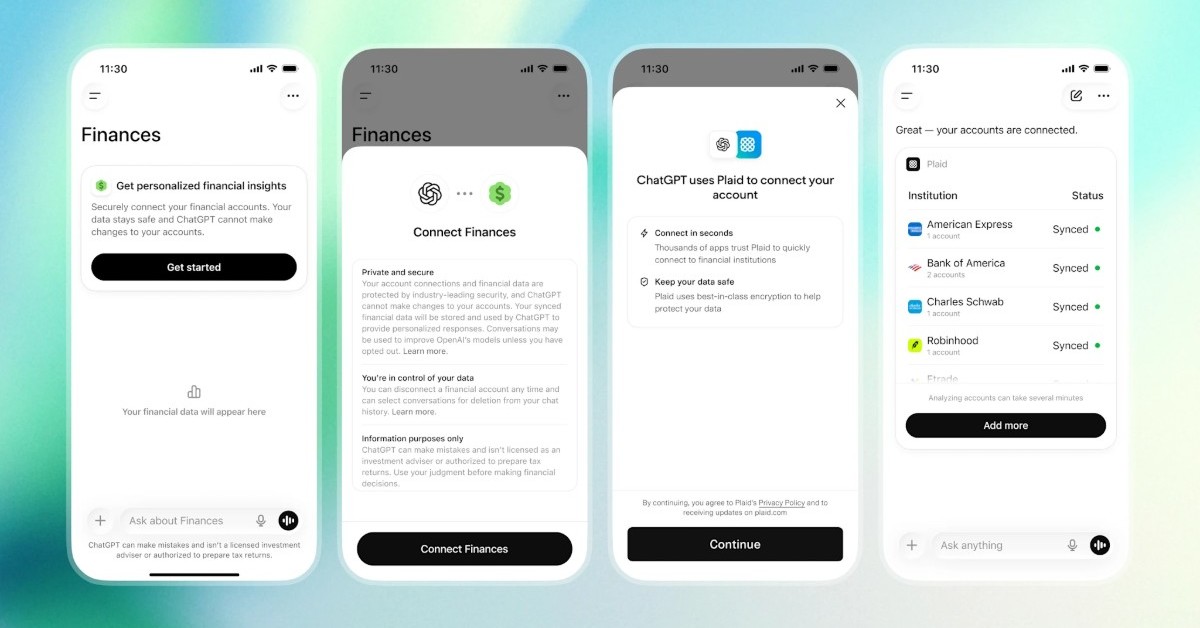
💡OpenAI is moving into fintech; learn how they handle secure financial data integration for AI agents.
⚡ 30-Second TL;DR
What Changed
Integrates with banks and brokerage accounts using the Plaid financial data network.
Why It Matters
This move signals OpenAI's shift toward becoming a comprehensive personal assistant by integrating sensitive financial data. It sets a precedent for AI agents handling high-stakes personal information, raising new requirements for data privacy and security.
What To Do Next
If you are building AI agents, study how OpenAI implements Plaid integration to handle secure third-party financial data authentication and user consent flows.
Key Points
- •Integrates with banks and brokerage accounts using the Plaid financial data network.
- •Provides a dedicated dashboard for users to track and manage their personal assets.
- •Offers personalized financial consultations based on real-time user financial data.
- •Currently available as a preview for US-based Pro plan subscribers with plans for wider rollout.
🧠 Deep Insight
Web-grounded analysis with 14 cited sources.
🔑 Enhanced Key Takeaways
- •The new personal financial management features in ChatGPT are powered by GPT-5.5 Thinking, a version of OpenAI's latest large language model specifically optimized for reasoning, which scored 60% on the FinanceAgent benchmark for LLM financial task performance.
- •OpenAI intends to expand the availability of these financial features beyond the initial preview for US-based Pro plan subscribers, with plans for a wider rollout that may eventually include free accounts and future integration with Intuit.
- •ChatGPT's access to user financial accounts through Plaid is strictly read-only, meaning it cannot initiate transactions, move money, or make any changes to accounts, and users retain full control to disconnect their accounts at any time, with synced data deleted within 30 days of disconnection.
- •More than 200 million users already utilize ChatGPT monthly for general financial inquiries, indicating a substantial existing demand for AI-powered financial guidance that this new personalized feature aims to address.
- •Beyond basic dashboards, the feature enables advanced analysis such as identifying spending patterns, assessing investment risks, reviewing subscriptions, and generating multiyear budget roadmaps.
📊 Competitor Analysis▸ Show
Competitor Analysis: AI Personal Financial Management Tools
| Feature / Product | OpenAI ChatGPT (with PFM) | Google Gemini (Standalone) | Microsoft Copilot (Standalone) | Cleo | Origin Financial | FinChat.io |
|---|---|---|---|---|---|---|
| Live Financial Integration | Yes (via Plaid, Intuit planned) | Limited/No (integrates with Google Workspace) | Limited/No (integrates with Microsoft 365) | Yes (AI-powered chatbot) | Yes (real-time data with AI-driven analysis) | No (investment research tool) |
| Personalized Advice | Yes (based on real-time data) | Generic (learning about finances) | Generic (budget review from CSV) | Yes (builds better habits) | Yes (context-aware guidance) | No (data analysis) |
| Expense Tracking | Yes (dashboard, spending patterns) | Limited (manual CSV upload) | Limited (manual CSV upload) | Yes | Yes (fully integrated) | No |
| Investment Advice | Yes (portfolio performance, risk analysis) | Generic | Generic | Limited | Yes (personalized, data-driven) | Yes (deep insights, stock analysis) |
| Long-Term Planning | Yes (financial goal planning, multiyear roadmaps) | Generic | Generic | Limited | Yes (continuous, AI-powered) | No |
| Model Used | GPT-5.5 Thinking | Gemini (Google's LLM) | Copilot (Microsoft's AI) | Natural language AI engine | AI-driven analysis | Generative AI tool |
| Pricing | Pro users ($200/month reported for Pro tier) | Varies by plan | Varies by plan | Subscription-based (some features limited) | Subscription-based | Subscription-based |
| Key Differentiator | Direct bank integration for actionable advice. | Google Workspace integration. | Microsoft 365 integration. | Conversational, habit-building. | Real-time, holistic financial management. | Investment research, institutional-grade data. |
🛠️ Technical Deep Dive
- Financial Data Integration: The feature integrates with financial accounts via Plaid, which acts as a secure bridge to connect with over 12,000 financial institutions, including major banks like Citi and Chase, and services like Affirm and Robinhood.
- Data Access Scope: ChatGPT's access to financial data is read-only, limited to balances, transactions, investments, and liabilities. It cannot view full account numbers, nor can it initiate or make changes to user accounts.
- Underlying AI Model: The personal finance features are powered by GPT-5.5 Thinking, a version of OpenAI's large language model specifically optimized for reasoning tasks, which achieved a 60% score on the FinanceAgent benchmark for evaluating LLMs' financial capabilities.
- User Controls and Privacy: Users can disconnect their financial accounts at any time. OpenAI states that any synced account data will be deleted from its systems within 30 days after disconnection. Users also have options to delete 'financial memories' (data saved from finance-related conversations) or use temporary chats that do not access connected financial accounts.
- User Interface Activation: Users can initiate the financial management features by finding the 'Finances' section in ChatGPT's sidebar or by typing a prompt such as '@Finances, connect my accounts'.
- Plaid's Role in Security: Plaid authenticates users directly with their banks and retrieves financial data, passing it to ChatGPT without the AI application ever directly handling the user's bank credentials.
🔮 Future ImplicationsAI analysis grounded in cited sources
⏳ Timeline
📎 Sources (14)
Factual claims are grounded in the sources below. Forward-looking analysis is AI-generated interpretation.
Weekly AI Recap
Read this week's curated digest of top AI events →
👉Related Updates
ShieldFont uses obfuscated typography to block AI scrapers

How to keep your AI conversations as private as possible

OpenAI Bans Cambodia-Based Fraud Network Using ChatGPT
Google Announces Gemini Robotics 2 for Advanced Humanoid Control
AI-curated news aggregator. All content rights belong to original publishers.
Original source: ITmedia AI+ (日本) ↗