Source钛媒体•Stalecollected in 25m
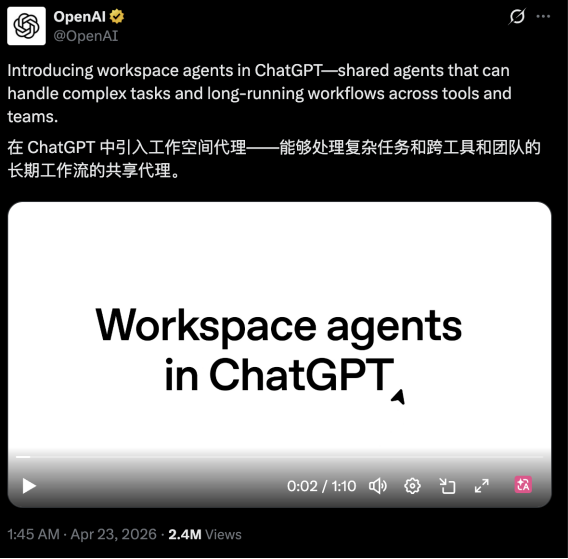
OpenAI Launches No-Code Workflow Agents
#agent#no-code#workflowworkflow-agentopenaigpts
💡OpenAI's no-code agents end GPTs era – build team AI workflows instantly.
⚡ 30-Second TL;DR
What Changed
Workflow Agent officially launched by OpenAI
Why It Matters
Democratizes agent creation, accelerating AI workflow adoption across organizations. May replace custom GPTs for team collaboration.
What To Do Next
Build a test workflow agent via OpenAI's platform dashboard now.
Who should care:Developers & AI Engineers
Key Points
- •Workflow Agent officially launched by OpenAI
- •GPTs phase-out signaled
- •Zero-code agent assembly feature
- •Accessible to non-technical teams
🧠 Deep Insight
AI-generated analysis for this event — not the original article.
🔑 Enhanced Key Takeaways
- •Workflow Agents utilize a new 'Stateful Orchestration' engine that allows agents to maintain context across multi-step, asynchronous tasks, a significant upgrade from the stateless nature of previous GPTs.
- •The platform integrates directly with OpenAI's 'Enterprise Data Connectors,' enabling agents to securely pull real-time data from internal databases like Salesforce, Notion, and SQL servers without custom API coding.
- •OpenAI has introduced a 'Human-in-the-Loop' (HITL) approval layer within the workflow builder, allowing non-technical managers to set specific trigger points where an agent must pause and wait for human verification before executing sensitive actions.
📊 Competitor Analysis▸ Show
| Feature | OpenAI Workflow Agents | Anthropic Claude Projects | Microsoft Copilot Studio |
|---|---|---|---|
| Core Focus | Stateful multi-step automation | Knowledge retrieval & coding | Enterprise integration & low-code |
| Pricing | Usage-based (token/task) | Subscription (Pro/Team) | Per-user/month + consumption |
| Benchmarks | High reasoning/complex logic | High context window/coding | High ecosystem integration |
🛠️ Technical Deep Dive
- •Architecture: Built on a new 'Agentic Orchestration Layer' that sits atop the o3-mini and GPT-5o models, utilizing a directed acyclic graph (DAG) structure for workflow execution.
- •State Management: Implements a persistent memory layer that tracks variable states across long-running workflows, allowing for mid-process interruptions and state recovery.
- •Integration Protocol: Uses a proprietary 'Schema-First' connector system that automatically maps external API endpoints to natural language function calls, reducing the need for manual JSON schema definition.
- •Security: Features 'Scoped Execution Environments' where each agent instance runs in an isolated container with granular permission controls (RBAC) mapped to the user's enterprise identity.
🔮 Future ImplicationsAI analysis grounded in cited sources
GPTs will be fully deprecated by Q4 2026.
The transition to Workflow Agents consolidates OpenAI's product strategy, moving away from static, single-purpose chatbots toward dynamic, process-oriented automation.
Enterprise adoption of OpenAI's platform will increase by 40% in the next six months.
The removal of the coding barrier for complex business process automation directly addresses the primary bottleneck for non-technical enterprise teams.
⏳ Timeline
2023-11
OpenAI announces GPTs at the first DevDay, allowing users to create custom versions of ChatGPT.
2024-01
OpenAI launches the GPT Store, enabling users to share and monetize their custom GPTs.
2025-09
OpenAI introduces 'Agentic Reasoning' capabilities in the o3 model series, laying the groundwork for autonomous workflows.
2026-04
OpenAI launches Workflow Agents, signaling the shift from static GPTs to process-oriented automation.
📰
Weekly AI Recap
Read this week's curated digest of top AI events →
👉Related Updates



AI-curated news aggregator. All content rights belong to original publishers.
Original source: 钛媒体 ↗
This is a summary, not the original. Read the source, or get the weekly briefing.
The weekly digest
One email a week. Unsubscribe anytime.