OpenAI Captures 90% of Congress's AI Spend
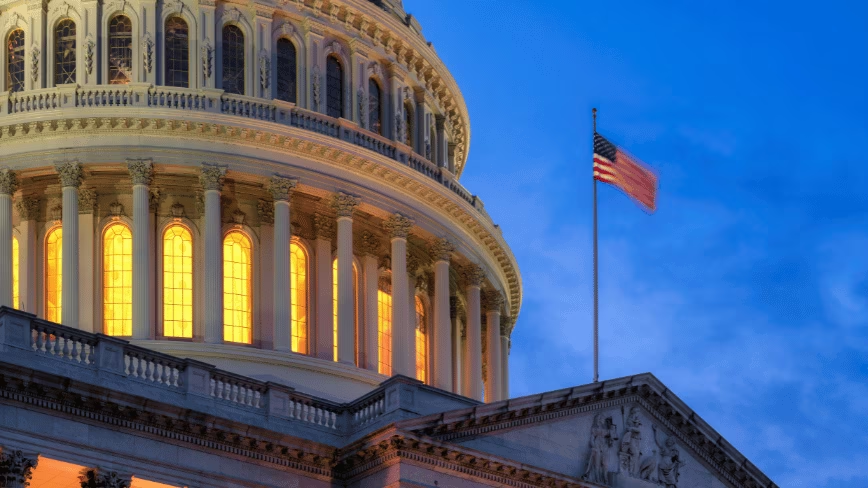
Government AI procurement is already highly concentrated around ChatGPT before formal rules exist.
30-Second TL;DR
What Changed
OpenAI's ChatGPT received roughly 90% of visible AI spending by House offices.
Why It Matters
The concentration gives OpenAI an early advantage in government adoption, feedback, and institutional familiarity before Congress establishes broader AI rules. It may also increase concerns about vendor concentration and procurement diversity in public-sector AI.
What To Do Next
If you sell AI to government, benchmark ChatGPT alongside at least two alternatives and document portability, procurement, and data-governance differences.
Key Points
- •OpenAI's ChatGPT received roughly 90% of visible AI spending by House offices.
- •The spending covered the year ending in March.
- •The figures come from CNBC's analysis of House disbursement records.
Deep Insight
AI-generated analysis for this event — not the original article.
Enhanced Key Takeaways
- •The spending analysis specifically highlights a reliance on ChatGPT Plus subscriptions, which are often purchased individually by staff members rather than through enterprise-wide procurement contracts.
- •House ethics rules and cybersecurity guidelines have created significant friction for adopting AI, leading many offices to default to OpenAI due to its perceived status as the industry standard.
- •The total expenditure of $113,740 is considered remarkably low relative to the total House budget, suggesting that many offices are likely using free tiers of AI services or unauthorized tools that do not appear in disbursement records.
- •Congressional oversight committees have expressed concerns regarding data privacy and the potential for sensitive constituent information to be ingested by public AI models, prompting calls for more centralized procurement.
- •The dominance of OpenAI in these records reflects a broader trend of 'shadow AI' adoption, where individual staffers utilize consumer-grade tools to manage administrative workloads without formal IT department vetting.
Competitor Analysis
- OpenAI (ChatGPT)
- Web/App (Consumer)
- Anthropic (Claude)
- Web/API (Enterprise)
- Google (Gemini)
- Workspace Integration
- OpenAI (ChatGPT)
- $20/mo (Plus)
- Anthropic (Claude)
- $20/mo (Pro)
- Google (Gemini)
- $20/mo (Advanced)
- OpenAI (ChatGPT)
- Market Penetration
- Anthropic (Claude)
- Constitutional AI/Safety
- Google (Gemini)
- Ecosystem Integration
| Feature | OpenAI (ChatGPT) | Anthropic (Claude) | Google (Gemini) |
|---|---|---|---|
| Primary Deployment | Web/App (Consumer) | Web/API (Enterprise) | Workspace Integration |
| Pricing Model | $20/mo (Plus) | $20/mo (Pro) | $20/mo (Advanced) |
| Key Differentiator | Market Penetration | Constitutional AI/Safety | Ecosystem Integration |
Technical Deep Dive
- OpenAI's deployment in government settings typically utilizes the GPT-4o or GPT-4o mini architectures, which are optimized for low-latency text generation and multimodal reasoning.
- Data handling for these accounts generally falls under standard consumer terms of service unless specific Enterprise agreements are signed, raising concerns about data retention policies.
- Integration within House offices is primarily browser-based, lacking the API-level security controls or private VPC deployments that would be required for handling classified or highly sensitive legislative data.
Future ImplicationsAI analysis grounded in cited sources
Timeline
- 2022-11OpenAI launches ChatGPT, sparking rapid adoption across various sectors including government offices.
- 2023-06House Chief Administrative Officer issues initial guidance on the use of generative AI tools.
- 2024-01House offices begin formalizing internal policies for AI usage, often defaulting to ChatGPT due to staff familiarity.
- 2025-03Conclusion of the fiscal period analyzed by CNBC, showing the $113,740 spending figure.
- 2026-05Increased scrutiny from oversight committees regarding the security of AI tools used by legislative staff.
Weekly AI Recap
Read this week's curated digest of top AI events →
Related Updates


AI-curated news aggregator. All content rights belong to original publishers.
Original source: The Next Web (TNW) ↗
This is a summary, not the original. Read the source, or get the weekly briefing.
The weekly digest
One email a week. Unsubscribe anytime.